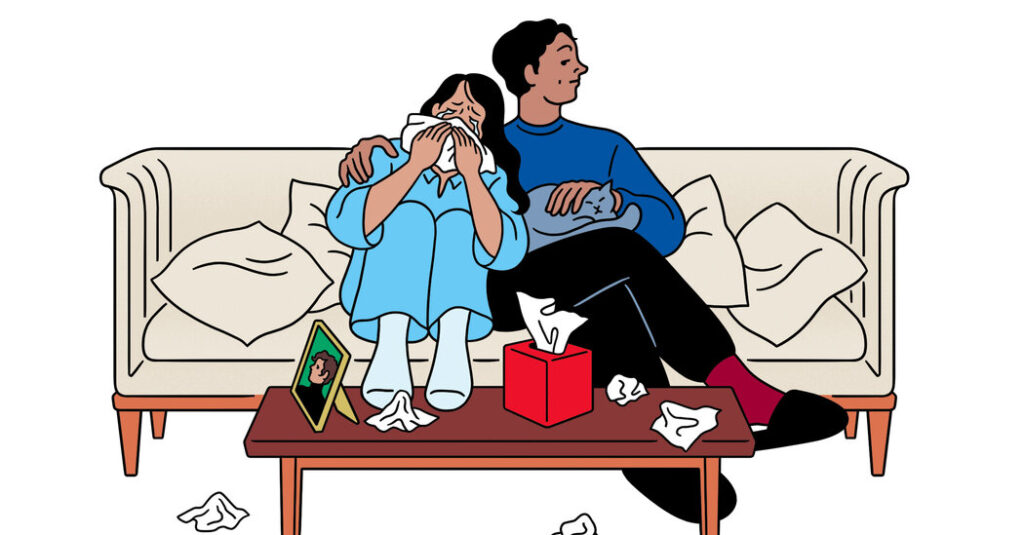
I have been married for many years, and I still love and care deeply about my partner. Over the past year, she had an affair, and I knew about it from the beginning. She said that she needed it, that it gave her vitality, that she enjoyed a sexual freedom she had longed for and that she felt it was wrong to do this in secret and without my consent. I agreed; what she said made sense to me, and she convincingly assured me this was no threat to our relationship. At the same time, I always suffered when she was away with her affair partner and could not find a way to take this easily.
She recently decided to break it off because the overall emotional burden for both of us was too great. But while she is grieving about it, I feel relieved. Even though I wish that I could have better coped with a situation I rationally and ethically consider OK, it conflicted with something deeper inside me that I can’t easily change.
My question is: Should I feel sorry for my wife? At the moment, I don’t. I understand her feelings and I care about her, but at the same time I feel it is not my job to console her for this particular loss. What do you think about this? — Name Withheld
From the Ethicist:
We don’t have voluntary control over our emotional responses, at least not in any straightforward way. You’re glad; she’s sad. And neither of you can simply choose to feel otherwise. From what you say, it sounds as if she gave up the affair for you and for her relationship with you, just as you consented to it for her and for your relationship with her. You most likely felt you had little choice about acquiescing to what she wanted, and, in time, she may have felt that she had little choice about acquiescing to what you clearly wanted. Your partnership would not have gone well, you perhaps thought, if you had withheld your consent; it would not have gone well, she perhaps thought, if she had persisted. Beneath the velvet of sweet reasonableness lurked the edged steel of unspoken ultimatums.
But while your sense of relief is unsurprising — and while you can’t simply resolve to feel otherwise — maybe you could help her deal with her loss out of gratitude for her belated acknowledgment of your needs? Solace is one of the gifts of marital love. And consoling someone you love when they’re in pain doesn’t require that you share that pain.
Still, these distinctions may be elusive in practice. And so it may be worth your both talking this all through with a counselor. Neither of you will ever be able to adjust your feelings on demand, but it could help to give them somewhere to go, in a way that helps you stay connected.
Readers Respond
The previous question was from a reader who wondered whether it’s ever OK to exclude someone from a family reunion. They wrote:
I’m part of a large extended family that has occasional reunions, usually organized around a birthday or anniversary. There are email lists that grow and shift and merge; siblings and cousins span the country. When plans began for our latest event, an agreement was reached to delete a particular woman from all invitations. This family member is brilliant but troubled and has become estranged from many people in her life, including her daughter. Because her daughter missed the last reunion, the family felt in all fairness that she should be included in this reunion, and that her mother should not. Of course, the mother got wind of it. She is furious, bitter and threatening suicide. No one is up for trying to “fix” her. But my question is: What are the ethics of family gatherings? Is it wrong to exclude one (or more) members who would bring pain and anguish rather than joy? — Name Withheld
In his response, the Ethicist noted:
People are invited to these gatherings because they’re family, not because they’re charming. But though boundaries are elastic, they’re not infinitely so, and conduct can override kinship. Inclusion is a value to be given serious weight here; it doesn’t trump everything else. What you’ve learned, though, is that there’s no keeping this person out of the loop. … The news will get out, and learning that she wasn’t only excluded but kept in the dark about it will just compound the pain. As it evidently has. What would make more sense is for someone in the family — you? — to tell her directly why she hasn’t been invited, while being very clear that it isn’t a negotiation. … I understand the temptation to avoid a conversation like that. But being up front leaves open the possibility of repair in the future and avoids the scenario you’re dealing with right now.
(Reread the full question and answer here.)
⬥
I agree that the letter writer should have a conversation with the difficult person, but I would not have high hopes that she will understand or have insight into how her own actions may have led to her exclusion. When our abusive and difficult mother asked my brother why neither of us invite her to family outings, he gently and kindly told her that she is not pleasant to be around with her constant criticism and mean comments to both us and our kids. Her response: “You are both too sensitive.” — Helena
⬥
Every family has people with varying levels of animosity toward other members. No large family has totally harmonious relationships. Starting to exclude people because they don’t get along with other people is a slippery slope. No one person has the right to request, much less demand, the exclusion of someone they do not get along with. They simply have the right to not attend. — Neal
⬥
It was clumsy and disrespectful of the letter writer’s family to add to the distance between this family member and her daughter. Either include her or stop pretending to give a damn about her or her daughter. You’re not the “judge” of their relationship, even though you’ve appointed yourself one. — Fred
⬥
I’m from a family in which estrangement is a common theme, and I have had to navigate similar situations many times. What I’ve learned from hard experience is that, in the long run, the least painful course for all involved is to invite everyone, inform the estranged parties that that’s the case and let them make their own decision about whether or not to attend. Sometimes it’s necessary to extract a promise (“If X is there, can you be civil? If not, please don’t come.”). This approach has definitely resulted in some awkward silences and cold shoulders at events over the years! But trying to run ahead of the issue by limiting who is on the invite list is, as the Ethicist notes, a path to hurt and anger down the road. — Anna
⬥
The Ethicist got it right. That the woman threatened suicide over this matter is an example of the extreme behavior the family prefers to avoid, which at this stage seems reasonable. If she is that dangerous to herself, she belongs not at a party but in the emergency room. I suspect, however, that this has been a pattern of behavior for some time. — Benjamin
The post I Let My Wife Have an Affair. Do I Have to Console Her Now That It’s Over? appeared first on New York Times.