Ryookyung Kim has long been fascinated by weddings.
As a child, Mx. Kim, who identifies as gender fluid and uses they/them pronouns, was interested in the structure of weddings more than romance. “It was less about finding a person to get married to and more about the details and the flow of an event,” they said.
And yet they struggled with the stimuli of big events. As a child, camera flashes made them cry, and the sound of balloons popping was a source of extreme discomfort. They were considered “just really sensitive,” Mx. Kim recalled.
Years later, Mx. Kim, now 33, was diagnosed with attention deficit hyperactivity disorder, which they said fit with “how I’ve moved through my life.” When they met their partner, Philip Chan, 33, who is also neurodivergent (diagnosed with obsessive-compulsive disorder and also A.D.H.D.), they knew a conventional wedding celebration — long, loud and crowded — would feel uncomfortable. So they did it their way.
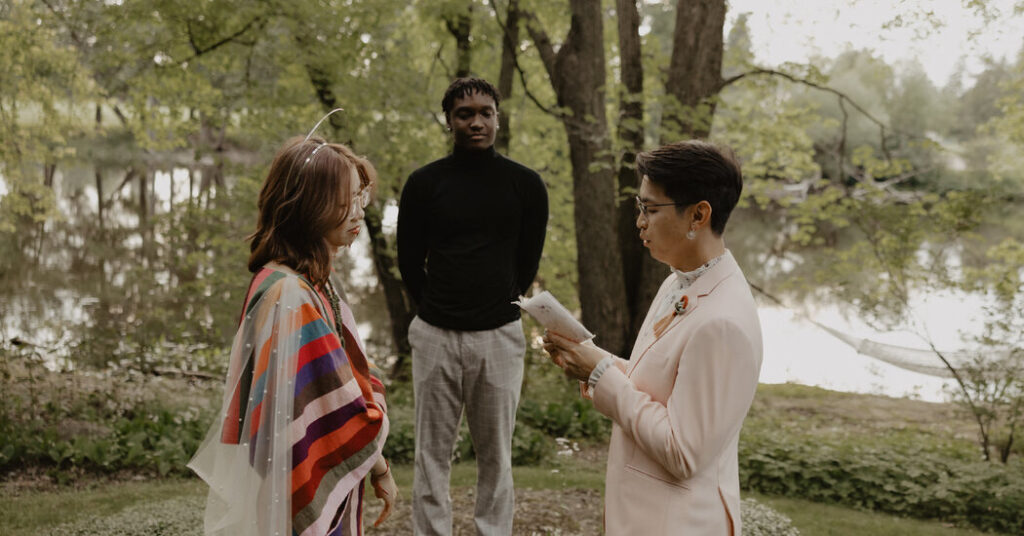
Mx. Kim and Mr. Chan, who live in a suburb near Toronto, split the June 2022 wedding into multiple parts to reduce overstimulation. First, they chose to do a private elopement with just their photographer, Aisha Keita, and her husband, Maxwell Step, “without the pressure to perform,” said Mx. Kim, of the celebration held at the Good Northern, a waterfront cottage in Ontario. They did their legal paper signing in October 2022 with about a dozen immediate family members, which felt intimate.
In December 2022, they hosted a reception at a queer-run photo and event space in Toronto for about 50 people — the maximum number they felt comfortable with. At the reception, they added a quiet room for decompressing, opted not to have a D.J. in favor of a sound system they could control themselves and skipped the traditional first dance. “We didn’t want to be the center of attention,” Mx. Kim said.
Their choices reflect a growing awareness of neurodivergence (such as autism, A.D.H.D., and dyslexia) in the last decade, including how it relates to love (see the hit Netflix series “Love on the Spectrum”) and experiences like weddings. Now, more vendors are accommodating these needs in the planning process. “There’s so much stigma already with being neurodivergent,” said Mona Kay, a social worker and host of the “Neurodiverse Love” podcast. “This is your special day. You want to make it as happy and fun and calming as you possibly can.”
‘Discomfort has been the unspoken rule’
Ariel Meadow Stallings has watched this shift unfold for more than 20 years.
She founded Offbeat Wed, formerly Offbeat Bride, a digital publication for wedding professionals, in 2007 and has tracked how each generation uses weddings to express identity and individuality. While in the early 2000s, weddings were themed around subcultures, by the mid-2010s, they were more about fandoms and cultural references.
Now, she said, in the 2020s, that identity expression has turned inward. “We went from, ‘I’m going to have a punk wedding,’ to, ‘I’m having a Harry Potter wedding,’ to ‘I want to have a wedding that honors that I’m on the spectrum, and my partner has A.D.H.D. and social anxiety.’”
For Ms. Stallings, sensory-friendly weddings represent more than just a style change. “So many couples and guests are taught that exhaustion and overwhelm and anxiety is just part of what a wedding is,” she said.
Couples are questioning that logic. They are asking how long a ceremony needs to be, how loud a party needs to get and how much social demand guests can realistically handle. Ms. Stallings said that once weddings become more about feeling than appearance, “that’s when weddings become more humane.”
In July 2025, in Salem, Mass., Amanda Paterson, 38, renewed her vows to James Paterson, 41, at a small Satanic-themed venue with six guests. The couple had first married in a simple ceremony on Valentine’s Day 2023. Ms. Paterson has A.D.H.D. and a strong sensitivity to textures. Her dress included a cage structure underneath to keep fabric off her skin.
She carried a heavy bouquet weighted with a bloodstone. The stone grounded her and gave her something to focus on. “Instead of pacing, I would play with the stone, keep my hands busy,” she said. Mr. Paterson does not share her sensory sensitivities, but was happy to plan the day around hers. “The last thing anyone wants to be at their own wedding is uncomfortable,” he said.
Elizabeth Matfin, a wedding dress boutique owner, noticed similar needs among brides entering her store in York, England. Many told her they were not “dress people,” and that fabrics like sequins and glitter were things some people “can’t stand.”
Brides often told her that traditional boutiques felt overwhelming with harsh lighting, stark white walls and pressure to perform excitement. In 2024, she redesigned her shop, Maidens & Ravens, to feel calmer and more inviting. “I wanted it to feel cozy and welcoming,” she said. “I have candles, classical music on very low.” She now stocks dresses specifically for sensory-sensitive brides, noting that many know almost immediately whether a gown will work for them. The dresses, she said, “need to be lightweight” and “easy to move in.” Scratchier fabrics — including netting or beading under the arms — are “no-nos,” she added.
Abby Sinclair, 24, who has Ehlers-Danlos syndrome and autism, and uses a wheelchair and has feeding tubes, said shopping for a bridal gown was challenging. At previous shops, fabrics had irritated her skin and the atmosphere — bright lights and constant chatter — quickly became overwhelming. At Maidens & Ravens, she said, the experience was different. She said, fabrics of the dresses “were far superior to other shops, netting and embroidery wasn’t itchy, everything was soft and comfortable. The boutique also felt really homey.”
She and Ms. Matfin talked through practical details, like how skirts would fit inside her wheelchair, and linings could cover medical tubes, but Ms. Sinclair, a Ph.D. student, said the focus stayed on how she imagined herself as a bride at her wedding to Jack Schofield this fall. By the end of the appointment, Ms. Matfin said, “everyone was crying.” Ms. Sinclair said it was the first time wedding dress shopping felt possible.
‘Do we have to?’
Jake Taylor, 36, founded the planning company Functions and Gatherings in 2017 to help queer couples escape rigid traditions. “I really started my company to empower folks, especially queer folks, to have the wedding they want and not the wedding that is expected of them,” he said. Over time, he realized many of his clients were neurodivergent (and said he has been diagnosed with A.D.H.D.).
The question he hears most often is not about budgets or flowers, but permission. “The biggest question I get asked is, ‘Do we have to?’” he said.
“For some people, the worst part of the day is the moment they are the center of attention,” Mr. Taylor added. He suggested structural changes like walking in together instead of being presented, appearing from the side instead of walking down an aisle, holding private vows before a public ceremony or skipping dances entirely.
Maya Lovro, a photographer with autism and A.D.H.D. who identifies as nonbinary and uses they/them pronouns, treats wedding days as long exercises in flexibility. “Wedding days are hard, and timelines are brutal,” they said. Being with the couple all day, they often see overload before others do. “I can see when people are starting to shut down,” Mx. Lovro said.
When that happens, they step in subtly. “I can lie for them and say I need them for 10 minutes,” Mx. Lovro said. They also avoid stiff posing to make the couple more comfortable. Most importantly, they prioritize neurodiverse needs. “I always ask before wedding days, what do you need in terms of accessibility support?” they added.
Ms. Stallings has watched couples begin to prioritize this kind of accommodation when choosing vendors. On Offbeat Wed’s directory, vendors themselves can self-identify as L.G.B.T.Q., disabled or neurodivergent, signaling to couples that accommodation is welcome.
A Turning Point
For some people, like Jackie Barnes, wedding planning can be a turning point. Ms. Barnes, 39, who lives in Pittsburgh, knew she couldn’t handle a big wedding. In September 2022, she and her partner, Greg Lyons, 35, married at a state park in Pennsylvania with 19 guests. She scheduled photos early because she knew she would be overwhelmed later in the day.
But even with a small wedding, the process made her anxious. One night during the planning process, unable to sleep, she searched online and found articles about sensory-friendly weddings. “That was the first thing where I was like, ‘Oh, other people also feel this way,’” she said.
Almost a year later, she received an autism diagnosis. “Wedding planning set me on that path,” she said.
Dr. Kay, the host of “Neurodiverse Love,” who also has a Ph.D. in social work, said she often coaches neurodiverse couples after the wedding is over. By then, many are exhausted, burned out or emotionally shut down. Weddings, she said, disrupt every routine at once, from food to sound, clothing, and social demands.
She encourages couples to plan for that disruption. “Have a toolbox,” she said, like safe foods, favorite music, fidgets, exit scripts and people assigned to run interference. She tells couples to imagine the wedding as a party they would host at home.
Dr. Kay also urges couples to practice being in the space before the wedding, like visiting the venue several times, learning where the bathrooms are, practicing the walk and even choosing utensils and dishes carefully. Tiny surprises, she said, can trigger a meltdown or shutdown. “Your relationship and your wedding,” she said, “isn’t necessarily going to look like everybody else’s.”
For Mx. Kim, that freedom has become a vocation. After their own wedding, they became a wedding officiant in 2023, working mostly with disabled, neurodivergent, queer and multi-faith couples. For many of the ceremonies they officiate, they wear the same rainbow, handwoven cotton textile, $500 dress they wore at their own ceremony.
“The wedding industry relies heavily on the couple,” Mx. Kim said. “And really, it takes a village to put on an event on like this.”
Sarah Diamond is a Times audio producer, based in New York. She also writes a biweekly column, Word Through The Times.
The post Your Wedding Doesn’t Have to Be Long, Loud or Uncomfortable appeared first on New York Times.