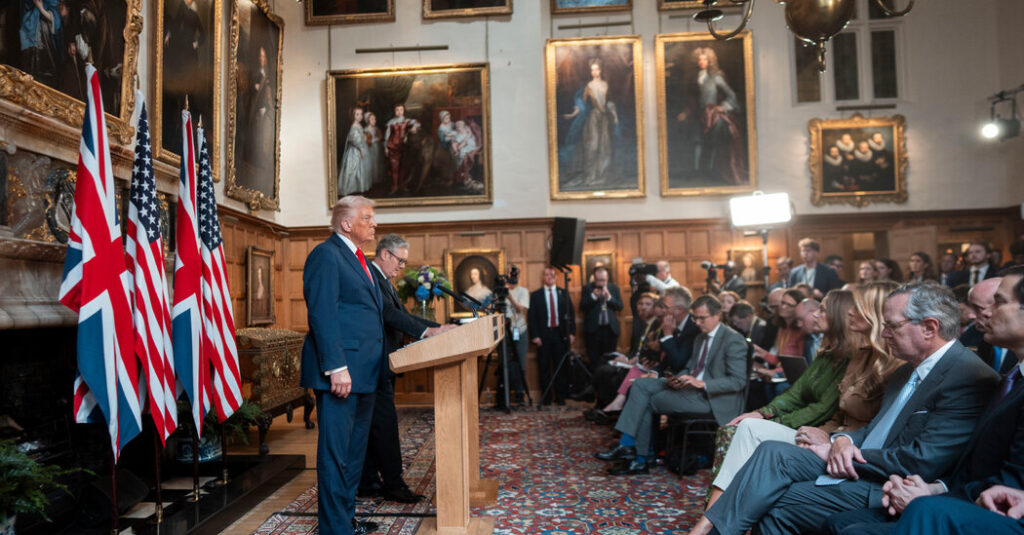
Britain has learned, after a roller coaster year that ended in a tense confrontation over Greenland, that it cannot change President Trump. The more tantalizing question is whether Mr. Trump has changed Britain.
Prime Minister Keir Starmer’s charm offensive toward the president did not spare Britain a fusillade of new tariff threats and stinging social media posts over the British government’s opposition to Mr. Trump’s designs on Greenland. Mr. Starmer might argue that Mr. Trump’s subsequent climb-down validated his emollient approach.
Still, Mr. Trump also turned against a deal made by Mr. Starmer, which he had previously endorsed, to relinquish a chain of strategically sensitive islands in the Indian Ocean to Mauritius. He disparaged it as an “act of GREAT STUPIDITY,” handing Mr. Starmer’s opponents a cudgel with which to beat him.
On Wednesday, the leader of the opposition Conservative Party, Kemi Badenoch, parroted Mr. Trump’s criticism. “This is surrendering British territory, with a strategic military base on it, for no reason whatsoever,” she said to Sky News, referring to the air base on an island in the chain, Diego Garcia, which is jointly operated by Britain and the United States.
Never mind that Britain began negotiating the return of the chain, the Chagos Islands, under a government led by Ms. Badenoch’s Conservatives. Or that Mr. Trump’s pique appeared to be caused less by the loss of the islands than by Mr. Starmer’s refusal to go along with an American takeover of Greenland.
It was a telling example of how Mr. Trump has commandeered the political debate in Britain, often shifting it in his direction. On topics as diverse as immigration, climate change, geopolitics and social justice, Mr. Trump has moved Britain’s “Overton window,” the term used to refer to the range of ideas that are considered acceptable to mainstream society.
“There’s no doubt that Trump has shifted the center of gravity in British politics,” said Tim Bale, a professor of politics at Queen Mary University of London. “Politicians on the right — and not just those who belong to the populist, radical right but to a supposedly mainstream party like the Conservatives — are prepared to propose policies and use language that hitherto would have been seen as beyond the pale.”
“Just as importantly, like Trump, they’ve gotten away with it,” he added, “and, as a result, are tempted to go further and further — all of which has led to both a coarsening and a polarization of debate.”
Even Mr. Starmer, a center-left politician known for his tempered style, has strayed into the divisive rhetoric of Mr. Trump. Last year, speaking about immigration, he warned that Britain risked becoming an “island of strangers” if it did not regain control of its borders. (Mr. Starmer later expressed regret for those words, which drew invidious comparisons to an infamous speech about immigration by a Conservative Party lawmaker, Enoch Powell, in 1968.)
Under pressure from a right-wing anti-immigration party, Reform U.K., which is in turn partly inspired by Mr. Trump, the Labour government has adopted strikingly tougher policies toward asylum seekers. Mr. Starmer has posted photographs and footage on social media of young men being rounded up, fingerprinted and interviewed by the authorities, and the government has boasted about the removal of almost 50,000 people since it came to power.
Mr. Trump’s influence is felt in a backlash against diversity, equity and inclusion policies. Blue Labour, an activist group that promotes culturally conservative values within the Labour Party, has called on the government to legislate against such policies in hiring, in part to fend off the threat from Reform. The Guardian newspaper reported in October that many British companies were changing their policies in response to attacks on “woke” policies.
Then, too, there is Mr. Trump’s insurgency against the establishment, which has its echoes in Britain. This month, a former senior adviser to Mr. Starmer, Paul Ovenden, roiled political waters with a column in The Times of London, in which he condemned unelected civil servants who, he claimed, waste their time on “political folderol” rather than on issues that ordinary citizens care about.
“The supremacy of the Stakeholder State,” Mr. Ovenden called it, in words that bear more than a passing resemblance to the “deep state” vilified by allies of Mr. Trump, like Stephen K. Bannon.
Trump Administration: Live Updates
Updated
- Federal judge extends deportation protections for Burmese migrants.
- Renée Fleming won’t perform at Kennedy Center concerts.
- The U.S. says its first boat strike since Maduro’s capture killed 2 in the eastern Pacific.
Some of the changes in British policies, like the cuts to foreign aid, are driven by fiscal constraints. Others, like the pressure to water down climate change targets, are prompted by fears that they could hamper long-term economic growth. Yet they dovetail with Mr. Trump’s agenda.
Britain has continued to embrace renewable energy even as Mr. Trump has ridiculed the wind turbines that dot the North Sea. “One thing I’ve noticed,” Mr. Trump said in Davos, Switzerland, this past week, “is that the more windmills a country has, the more money that country loses and the worse that country is doing.”
Mr. Trump’s influence is not limited to Britain. Timothy Garton Ash, an author and historian at Oxford University, argued that the president had had a bigger effect on Germany and Poland. Germany has embarked on a landmark rearmament program to compensate for Mr. Trump’s disengagement from Europe. In Poland, the right-wing populist Law and Justice Party benefited from Mr. Trump’s endorsement in last year’s presidential elections.
“Where you can see his influence in Britain is on the right-wing conversation,” Mr. Garton Ash said. “It has blurred the boundaries between liberal conservatives and the anti-liberal right.”
As Mr. Starmer fended off Ms. Badenoch’s attacks on the Chagos Islands deal, one could see the risks in Mr. Trump’s influence. The prime minister told Parliament, in an uncharacteristic break with Mr. Trump, that the president’s criticism was not about the islands but was a calculated effort to put pressure on Britain to acquiesce in his attempted conquest of Greenland.
By jumping on Mr. Trump’s remarks, Mr. Starmer said, Ms. Badenoch was “undermining our position, Britain’s position, on Greenland.”
Mr. Starmer’s steely tone suggested that there were limits to his solicitous treatment of Mr. Trump. He said he would not be cowed, either by the president’s reversal on the Chagos deal or by threats of additional tariffs. Mr. Trump dropped the tariff threat after negotiating the outlines of a deal on Greenland with NATO. But on Friday, the Conservatives forced the government to delay a debate in Parliament on legislation enshrining the Chagos deal.
Diplomats have credited Mr. Starmer’s softly-softly approach to the president with reducing the damage of tariffs — the Trump administration signed a first-in-the-world trade deal with Britain — and with keeping Mr. Trump more engaged in the war in Ukraine than he might otherwise have been.
Still, said Peter Westmacott, a former British ambassador to Washington, “It did not moderate Trump’s demands for Greenland, while his ill-informed outburst on Diego Garcia was plain nasty. So Starmer has had to call him out publicly on important issues of principle.”
The most vivid example of this came on Friday when Mr. Starmer rebuked Mr. Trump for saying that European troops had “stayed a little off the front lines” during the Afghanistan war. Mr. Starmer said his remarks were “insulting and frankly appalling” to Britain, which lost 457 soldiers in two decades of fighting there.
“The challenge,” Mr. Westmacott said, “is to do that without provoking even worse reactions from the notoriously thin-skinned president.”
Mark Landler is the London bureau chief of The Times, covering the United Kingdom, as well as American foreign policy in Europe, Asia and the Middle East. He has been a journalist for more than three decades.
The post How a Year of Trump Changed Britain appeared first on New York Times.