The call came from an editor in London last Monday morning. Could I get to the scene of a deadly train crash in southern Spain? I checked flights from Barcelona, where I live, grabbed my cameras and rushed to the airport. During my flight and a two-hour drive to the town of Adamuz, where two high-speed trains had collided, I considered what I needed to capture.
I would reach the scene 22 hours after the crash, once survivors had been evacuated and the wounded taken to faraway hospitals. Most of the bodies had been retrieved. Their relatives were privately undertaking the grim task of identifying remains, mostly through DNA testing.
Our first responsibility as journalists covering a disaster lies with the victims and their families. Their testimony is important to understanding what has happened and what it means. But we must avoid compounding people’s trauma or deepening their pain. I would arrive too late to photograph those most affected, and for that I was quietly relieved.
I’ve covered countless conflicts and disasters throughout my career, including wars in Afghanistan, Ethiopia, Gaza, and Sudan, a plane crash in Cameroon that killed 114 people, the immediate aftermath of Russian strikes on civilians in Ukraine, and, in the Democratic Republic of Congo, an Ebola outbreak, a volcanic eruption and massacres.
In such situations, we weigh the risks — both physical and emotional — to ourselves and to those we are documenting. We are up against the demand for news, competing with large networks of photographers working for the news wire services, as well as the unchecked flow of social media information and misinformation. Official accounts need to be verified. The Times relies on teams of reporters, editors, photographers and graphics editors to deliver detailed, deeply reported and accurate information.
Our main role in reporting on disasters is to document what happened and ask tough questions. My job on this assignment was to provide visuals illustrating the extensive reporting being done by my colleagues.
The cause of the crash was a mystery. It occurred on a straight stretch of track. The authorities said the trains and the tracks had recently been maintained. Taking a forensic approach, I knew I’d need to photograph as many angles of the wreckage as possible.
One problem: The authorities had closed off much of the surrounding area, blocking media access from the direction of Adamuz, east of the tracks. I approached from the west, driving up a winding back road through the spectacular Parque Natural Sierra de Hornachuelos.
As I crested a ridge, I saw in the distance a stalled train — a slash of red cutting across rugged green hills. When I got closer, emergency and construction crews were working on the other side of the tracks.
The crash site was obscured by the terrain, so I walked up a nearby hill for a better view. I passed no police lines or cordons. On the hilltop, I reached above a chain-link fence to snap a few frames of the overturned carriages. Then, a drone buzzed me several times.
I took this to mean I should leave the area. I walked back to my car, where two members of the Guardia Civil law enforcement agency inspected my press pass and ID before politely asking me to move along. I complied. One of my photos from the hilltop was published on the front page of The Times the following day.
I still need more pictures of the scene, so I set out before dawn the next morning looking for views from the opposite side of the tracks. Without encountering any police cordon, and keeping my distance from the crash site, I walked through steep forest trails for several hours, crossing streams and crawling through undergrowth. I found a vantage point in some bushes far enough away to avoid interfering with the investigation while offering a partial view of the second train, which had come to rest about 2,000 feet from the wreck I photographed the day before.
I was soon joined by another photographer from the Reuters news agency. After a few hours, we left. Looking for a shorter route back to my car, I stumbled through some bushes and emerged at the edge of a sun-dappled stream.
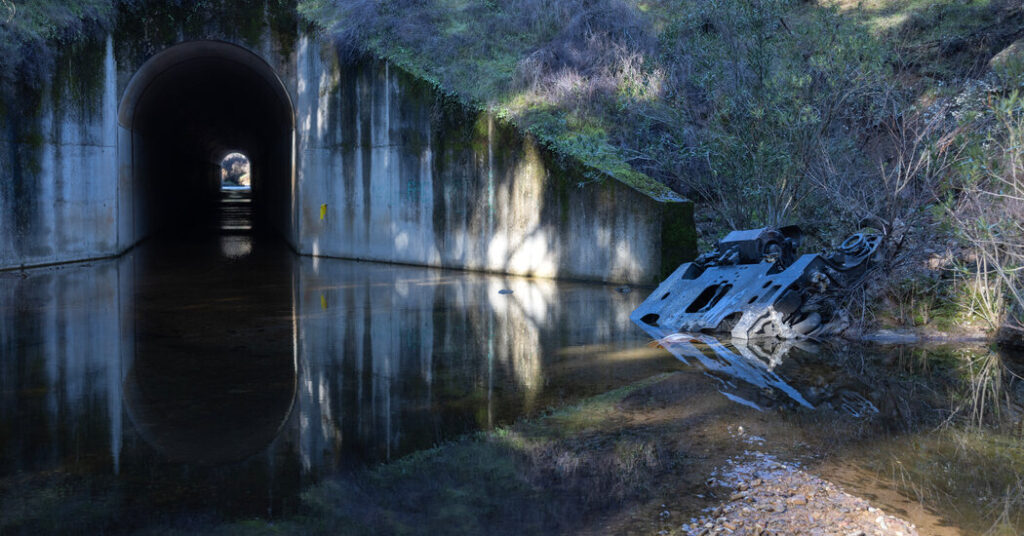
Before me, partly submerged at the edge of the stream, was a large piece of metal. At first I thought it was just junk — it was not cordoned off like the rest of the wreckage — but I quickly put things together in my mind.
That front page photo showed that something was missing from the underside of the train — something much like the debris in front of me. Could this piece provide a critical clue to what went wrong? And were the authorities aware that it was sitting here, half-submerged and unmarked?
Understanding that it could be important evidence, I kept my distance, took a few pictures, then climbed away, not wanting to disturb the area. I sent the photos to my colleagues, who swiftly informed the authorities while beginning their own investigation. The publication of our story and photos ignited a firestorm across Spanish media and raised questions about the thoroughness of the investigation.
Asked for official comment, the authorities said they knew about the debris, without answering questions about when they became aware of it.
The minister of transportation, Óscar Puente, told Spain’s state broadcaster that the undercarriage had been located on Monday morning.
The day after my discovery — and three days after the crash — the authorities shared photographs of their investigators marking the site and documenting the undercarriage. They have not responded to questions about when the photographs were taken.
The post How a Photographer Stumbled Upon a Key Picture of the Spain Train Crash appeared first on New York Times.