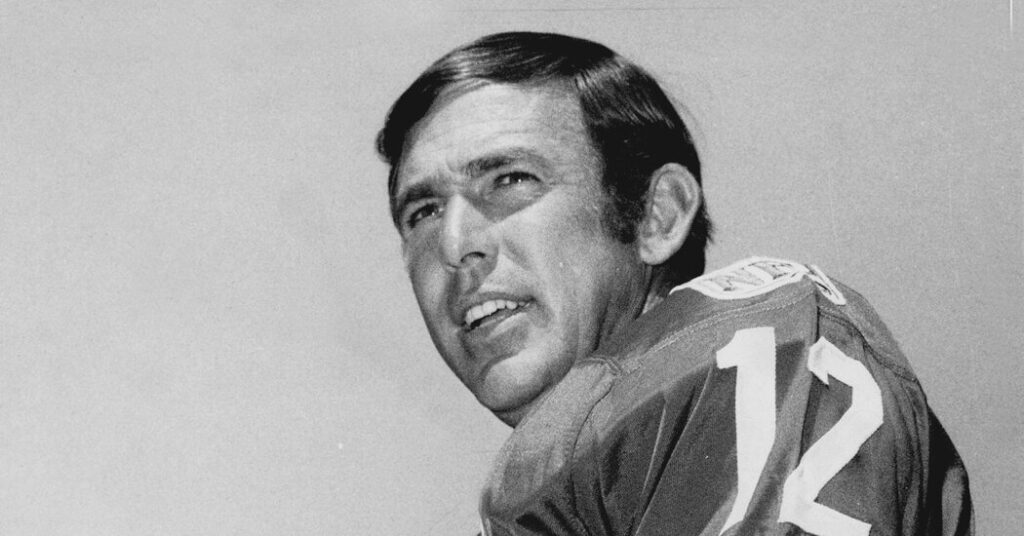
John Brodie, the star quarterback for the San Francisco 49ers from the late 1950s into the early ’70s, who endured years of boos on bad teams before developing into a prized passer and becoming football’s highest-paid player, died on Friday in Solana Beach, Calif. He was 90.
His wife, Sue Brodie, confirmed his death, which was also announced by the 49ers.
Brodie was an often brilliant quarterback whose quick screens and throws on well-timed out routes led to the pass-first strategy that came to define the game. An All-American at Stanford in 1956, he was the National Football League’s most valuable player in 1970.
Over 17 seasons in the N.F.L., all with San Francisco, he lifted the Niners from West Coast irrelevance into reliable competitiveness, though he never won a league championship or Super Bowl. He nonetheless earned praise from people not known for dispensing it. Tom Landry, the Dallas Cowboys’ solemn coach, once said of Brodie, “I marvel at the way he has now mastered the art of quarterback.”
Brodie rose as football was becoming a national fascination, with quarterbacks in particular — Johnny Unitas, Y.A. Tittle, Sonny Jurgensen, Bart Starr — regarded as role models in gridiron leadership.
Yet Brodie made clear early on that football was a game he played, not who he was.
At Stanford, he refused an athletic scholarship, choosing instead to walk on so that he would not be required to attend spring football practices and could play varsity golf for the university. For a few years, he also competed on the Professional Golfers Association tour in the N.F.L. off-season.
At 50, after more than a decade as a football analyst for NBC, Brodie left broadcasting to join the P.G.A. senior tour. He played for 14 years, winning one tournament, the 1991 Security Pacific Senior Classic at Rancho Park in Los Angeles, where he defeated George Archer and Chi Chi Rodriguez in a playoff. He won $688,305 in prize money over his years on the senior tour.
In 1966, Brodie became football’s highest-paid player through an unusual bit of brinkmanship.
After the 1965 season, in which he led the league in completions, completion percentage, passing yards and touchdowns, Brodie asked for a raise. He had been earning $35,000 a year. He asked for $65,000.
The 49ers said no.
At the time, the upstart American Football League was trying to steal the N.F.L.’s top quarterbacks, including Brodie, even as it negotiated a merger with the older league. In May 1966, Don Klosterman, the general manager of the A.F.L.’s Houston Oilers, met with Brodie, took out a memo pad and wrote down what the A.F.L. would pay him: $750,000 for five years.
The deal appeared imminent but stalled as merger talks accelerated.
Hours later, when Brodie learned that the leagues had agreed to unite, he pulled Klosterman’s note from his pocket and said, “Somebody owes me $750,000.”
He ultimately sought even more. His lawyer told the two leagues that Brodie would accept $1 million plus $100,000 in legal fees or else sue for treble damages. Fearing that an antitrust suit could threaten the merger, the leagues and 49ers reached an agreement that paid Brodie $921,000 for three years, to be paid over 12 years. Every team in both leagues would pay part of that salary. If Brodie played beyond three years — which he did — he would get additional annual salaries of $81,000 to $90,000, enormous sums in pro football at the time.
Despite his success, Brodie was far from perfect on the field. In his early years, he spent so much time ducking beer cans thrown from the seats at Kezar Stadium after losses that protective fencing had to be installed over the ramps players used to leave the field. Over his career, he threw more interceptions than touchdowns — 224 to 214. In 1963, he broke his right arm, his throwing arm, in a car accident in which he was the driver.
Seven years later, Brodie won the Most Valuable Player award, and he gave some of the credit for his recovery to Scientology.
“Early last season my arm was bothering me,” he said in 1971. “Ever since I broke it in 1963, it hadn’t been completely right. A friend of mine suggested that I take a crack at Scientology, just to see if I couldn’t clear it up.”
For a time, Brodie was among Scientology’s most prominent apostles. He later broke with the church, citing the poor treatment of some of his friends by its leadership. He also explored the human potential movement led by Michael Murphy, the founder of the Esalen Institute in California and author of “Golf in the Kingdom,” a novel about golf and self-awareness that Brodie admired.
In 1973, Brodie was among several sports stars who helped Murphy start the short-lived Esalen Sports Center.
John Riley Brodie was born on Aug. 14, 1935, in San Francisco. He grew up in Oakland, where he played high school basketball against Bill Russell and batted behind Curt Flood on an American Legion baseball team. He graduated from Oakland Technical High School.
Brodie was 165 pounds when he tried out for the Stanford football team as a freshman. By his senior year, he grew to 6-foot-1 and 188 pounds, led the nation in total offense and passing, was named an All-American, and earned a bachelor’s degree in history.
The 49ers chose Brodie third overall in the 1957 draft. Paul Hornung of Notre Dame was chosen first by the Green Bay Packers, and Jon Arnett went second to the Los Angeles Rams.
Tittle was San Francisco’s starter when Brodie arrived. When Tittle was injured in a game against the Baltimore Colts in the fall of 1957, Brodie entered and threw a game-winning touchdown pass to Hugh McElhenny. Four years later, Tittle was traded to the Giants, and Brodie became the starter.
Over 17 seasons with the 49ers, often on losing teams, Brodie passed for 31,548 yards, led the league three times in passing yardage and three times in completions, He played in two Pro Bowls. When he retired, the 49ers retired his No. 12 jersey. John Madden, the television analyst and former coach, once said that Brodie threw the screen pass better than anyone he had ever seen.
In later years, Brodie lived in La Quinta, Calif., with his wife, Sue. They married in 1957.
He is survived by his wife; his sister Katie; his four daughters, Kelly, Cammie, Diane and Erin; his son, Billy; 11 grandchildren; and two great-grandchildren.
Brodie was a fierce competitor, whether the game was football, golf, cards or Ping-Pong.
In 1974, he wrote a memoir, “Open Field,” with the novelist James D. Houston. The book touched on his philosophy of competitive sports.
“Vince Lombardi used to say, ‘Winning isn’t everything, it’s the only thing,’” Brodie wrote. “Grantland Rice often quoted a famous line about it’s not mattering whether you win or lose, but how you play the game. My own view of the subject is somewhere in between these two.”
Frank Litsky, a longtime sportswriter for The Times, died in 2018.
John Yoon contributed reporting.
The post John Brodie, a Star Quarterback for the 49ers, Dies at 90 appeared first on New York Times.