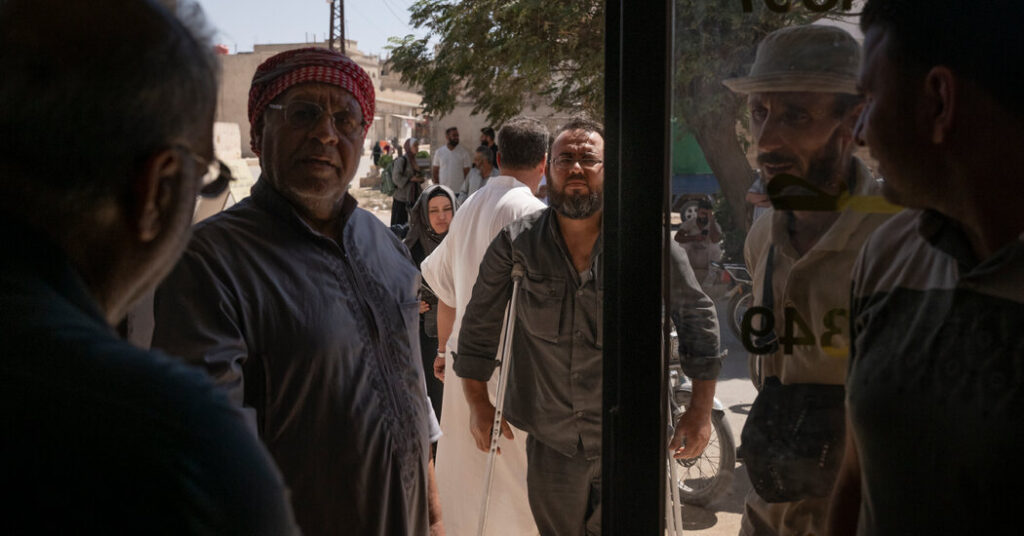
At a bustling money changer in northwestern Syria, a 46-year-old farmer gripped a plastic card like a lifeline. She had never heard of cryptocurrency, but the card held $500 of it to help restart her farm after nearly 14 years of civil war.
As a teller confirmed the total and cashed out the account, the farmer, Hala Mahmoud Almahmoud, smiled with relief and paused to give thanks. Where had such technology come from, she asked.
The answer surprised her: Afghanistan.
Blockchain-based cash transfers are not the kind of innovation that many people would expect from a country better known for its repressive Taliban leadership, which views the internet with suspicion. But in a nation that has largely turned its back on the world, an Afghan start-up is building tools that it hopes will transform how humanitarian aid is delivered in countries shattered by conflict.
“We’ve lived through these challenges ourselves, so we know how to develop an approach that works,” said Zakia Hussaini, 26, a programmer at the start-up, HesabPay, which designed the technology driving Ms. Almahmoud’s card.
An early proponent of the platform was the United Nations High Commissioner for Refugees. The agency uses it to support more than 86,000 families in Afghanistan in one of the biggest public blockchain aid initiatives in the world. Mercy Corps, which donated the funds to Ms. Almahmoud, worked with HesabPay to expand its reach to include Syria, and programs for Sudan and Haiti are in development.
In Syria, getting money from abroad can be complicated. Cash is scarce, international banks steer clear of the country and remittance firms like Western Union can charge as much as 10 percent in transfer fees. HesabPay allows organizations like Mercy Corps to sidestep those roadblocks.
Sanzar Kakar, the Afghan American entrepreneur behind HesabPay, used to run Afghanistan’s leading payroll processor. But the U.S. withdrawal from Afghanistan in 2021 and the Taliban’s return set off a financial collapse. Sanctions put a halt to international transfers, and the central bank unraveled.
To address the country’s increasing financial insecurity, Mr. Kakar turned to blockchain. He built HesabPay, named after the local word for “account,” as a phone-based app that enabled instant transfers from one digital wallet to another, bypassing banks and the Taliban government. The Afghan government has since granted his business a license to operate officially as a financial institution, he said.
Today, the platform has more than 650,000 wallets in Afghanistan, of which about 50,000 are in regular use, moving approximately $60 million a month in stablecoins backed by the afghani, Afghanistan’s currency.
Since February 2025, the U.N. has used HesabPay to deliver nearly $25 million via 80,000 digital wallets to vulnerable Afghans returning home, said Carmen Hett, the corporate treasurer of the U.N. refugee agency. “This helps reduce transaction fees, waiting periods and enhance traceability, real-time monitoring and accountability of transactions,” she said.
It is not surprising that organizations like Mercy Corps and the United Nations are turning to blockchain-based money transfers to deliver aid, said Ric Shreves, an expert in decentralized finance solutions and the president of the Decentralized Cooperation Foundation. For such organizations, he said, “it’s almost all upsides, compared to the way aid has traditionally been delivered.”
But there are still risks, he said, especially when the payment systems are based on local-currency stablecoins, as they are in Afghanistan. (In Syria, the cryptocurrency in HesabPay wallets is backed by the U.S. dollar, a more stable option.) Just as wallets can be shut down for interacting with sanctioned individuals, they can also theoretically be shut down by a country’s central bank for political reasons.
“When we provide people with a nonphysical means of doing transactions, that also means there’s a possibility that those transactions could be blocked through technological means,” Mr. Shreves said. Digital currencies are demonstrably safer than cash, he added, but they still cannot be stashed under a mattress.
In recent years, aid groups have increasingly turned to cash as a fast and dignified form of assistance. But cash has a flaw: It is hard to track. Donors want proof that their money reaches the right hands. Since President Trump slashed U.S. foreign assistance early last year, groups like Mercy Corps have come under even more pressure to demonstrate their impact and integrity.
That is where blockchain comes in, creating a digital trail that records exactly how much was sent, to whom, and where it was spent. That mix of speed and accountability could be “a way to win back trust from those who have come to doubt the usefulness of aid,” said Scott Onder, Mercy Corps’s chief investment officer.
HesabPay comes with additional safeguards, like a real-time dashboard that tracks wallet activity and cross-checks it against international compliance databases. The company says the system is designed to detect illicit activity like terrorist financing, money laundering and online scams, and to raise an alert the moment suspicious transactions appear. For aid donors, it offers a level of oversight rarely possible in fragile states.
During a recent online demonstration, Nigel Pont, the company’s senior adviser for humanitarian affairs, clicked on a purple dot representing a HesabPay agent in Afghanistan. Dozens of pale blue beneficiary wallets fanned out, showing recent transfers. Another click revealed where the money went next. Then one wallet pulsed red with a potential scam alert — an awkward moment in a live demo, but exactly the kind of risk the system is built to expose.
“From an aid donor perspective, that’s immensely valuable,” said Mr. Pont, who previously served as chief strategy officer at Mercy Corps. “A system that can automatically flag a fraud risk means you can check it out immediately instead of waiting six months for a report that somebody stole 20 grand.” No system is entirely corruption-proof, he conceded, but then again, a bag of cash is not, either.
Abdul Halim Hasan, 22, who was waiting in the same line as Ms. Almahmoud for his turn at the money changer in Syria, said he imagined that one day he could use HesabPay as a regular bank account, receiving funds, making payments and saving money safely. But for the moment, it was enough that his HesabPay card allowed him to gain access to money he needed to restart his life after war.
“I certainly want to see this method spread in Syria,” he said.
Leen Rihawi contributed reporting.
The post An Unlikely Source of Crypto Innovation: Afghanistan appeared first on New York Times.