Venezuela’s interim government, in another sign of its willingness to placate the Trump administration, is receiving more deportation flights in the aftermath of the U.S. capture of President Nicolás Maduro, according to U.S. officials.
Last year, Venezuela allowed as many as two flights per week, a number that is now expected to rise to three, according to a U.S. official. Two other officials also confirmed an increase without giving a specific number.
The Trump administration has been pressing Venezuela’s interim government on deportations since the United States captured Mr. Maduro on Jan. 3, according to one of the U.S. officials. All the officials spoke on the condition of anonymity because they said they were not authorized to speak publicly on the matter.
This week, for the first time since Mr. Trump took office, three deportation flights from the United States arrived in a single week in Caracas, the Venezuelan capital.
If three flights per week becomes the norm, it would mean that the United States would deport nearly 30,000 Venezuelans this year, roughly double the number from last year, immigration experts said. That figure would place Venezuela in the top five countries receiving deportees from the United States. An estimated 650,000 Venezuelans live in the country without legal status.
Asked about the development, a White House spokeswoman said in a statement, “The Trump Administration will continue using all the tools at our disposal to carry out the largest mass deportation operation of criminal illegal aliens in history.”
The Venezuelan government did not respond to a request for comment.
The increase in flights represents a victory for President Trump and for advisers in his administration like Stephen Miller, who has focused intently on detaining and expelling undocumented immigrants and who joined other administration officials in pressing for the ouster of Mr. Maduro.
The United States effectively cut diplomatic ties with Venezuela in 2019, and like many countries that sever diplomatic relations with the United States, Venezuela, for several years, did not accept regular deportation flights. (Since the U.S. seized Mr. Maduro, both countries have taken initial steps to re-establish diplomatic ties and reopen their embassies in Caracas and Washington.)
The inability to deport migrants directly to Venezuela became a source of frustration for successive U.S. administrations as hundreds of thousands of Venezuelans poured into the United States over the last decade, amid an economic collapse in their homeland and a record migration surge at the U.S. border.
Venezuelan migrants, who lacked an extensive support network of relatives already in the United States and were often fleeing extreme poverty, became the face of the crisis. They filled buses sent north by Texas governor Greg Abbott and strained government resources as they crowded New York City shelters.
After Mr. Trump took office, his administration portrayed them as gang members and terrorists who were sent by Mr. Maduro to destabilize the United States, a largely baseless claim. Hundreds were sent to the U.S. base at Guantánamo Bay, Cuba and to a notorious maximum-security prison in El Salvador.
The increase in deportation flights this month has raised concerns that more Venezuelan migrants will be deported without due process, said Savi Arvey, whose research team at Human Rights First, a rights group, monitors deportation flights. It has also stoked fears because Venezuela is still facing political and economic instability and an ongoing climate of repression.
Under Mr. Maduro, security forces detained opponents, political activists and journalists, and despite his removal, many officials responsible for those crackdowns remain in power.
Luís Ángeles, a lawyer who represents Venezuelan migrants, described one client who is especially frightened. The man, in his 60s, was a longtime member of an opposition party before coming to the United States, Mr. Ángeles said.
He lost his legal status last year when the Trump administration revoked humanitarian parole, a Biden-era program that shielded more than 530,000 immigrants from Cuba, Haiti, Nicaragua and Venezuela from deportation. (The administration also ended Temporary Protected Status for Venezuelans, another program protecting people from deportation.)
The man has been detained since November, when the police stopped the vehicle he was driving for Uber in Florida, and turned him over to immigration authorities. “He’s fearful of being returned,” Mr. Ángeles said.
Adam Isacson, a migration expert at the Washington Office on Latin America, said that any increase in flights could accelerate the pace at which Venezuelans are detained.
Following Mr. Trump’s “de-documenting” of Venezuelans, he said, “just about all of them” are at risk of being detained, and detention centers are growing crowded.
“If they can actually get them out of the detention centers and back in Caracas faster — yeah, they’re going to arrest more of them,” he said.
Delcy Rodríguez, Venezuela’s interim leader, has said her government would work together on a “cooperative agenda” with the Trump administration.
She has agreed to open Venezuela’s oil sector to the United States and has released some political prisoners, including Americans.
In a sharp contrast with Mr. Maduro’s government, which strongly condemned the Trump administration’s treatment of Venezuelan migrants, Ms. Rodríguez’s has stayed quiet on the subject, including after a Venezuelan man in Minneapolis was shot in the leg by an I.C.E. officer this month as immigration officers descended on the city.
The Biden administration had also pressed Mr. Maduro to accept deportation flights, but flights resumed only briefly around late 2023. When President Trump took office last year, Mr. Maduro faced immediate pressure to accept deportees.
He agreed, but experts say he used the flights as leverage in negotiations with the United States, angering U.S. officials. In March, after Mr. Maduro briefly suspended deportation flights, the Trump administration sent more than 200 Venezuelans to a maximum-security prison in El Salvador, including migrants with no criminal record.
In 2025, Mr. Maduro accepted 76 flights, with two flights per week maximum. In the first half of the year, he frequently sent planes from Venezuela’s national airline to pick up deportees from a U.S. air base in Honduras. Last summer, he began to accept more deportation flights directly from the United States.
The Maduro government portrayed its acceptance of deportees as a “rescuing” of its citizens, including in animations on social media and meme-like videos that mocked the allure of the American dream. Deportees disembarking planes in white T-shirts and sweatpants from I.C.E. detention were often featured in government-filmed videos thanking Mr. Maduro by name.
The planes, which typically carried roughly 200 deportees, landed at the international airport that serves Caracas, usually on Wednesdays and Fridays. They were largely filled with Venezuelan men and a smaller number of women and children. Some of the children drew attention because they had been left in the United States when U.S. authorities deported their parents to Venezuela.
The flights largely continued even as the U.S. escalated its military pressure campaign on Mr. Maduro and conducted boat strikes off Venezuela’s coast, halting only on Dec. 10.
After the capture of Mr. Maduro, U.S. officials began discussing a resumption of deportation flights with Ms. Rodriguez’s government, and increasing the number of flights, according to the U.S. officials.
The first plane in more than a month landed last week, on Jan. 16, from Phoenix, Arizona, carrying 199 Venezuelans. It was followed by flights this Monday, Thursday and Friday.
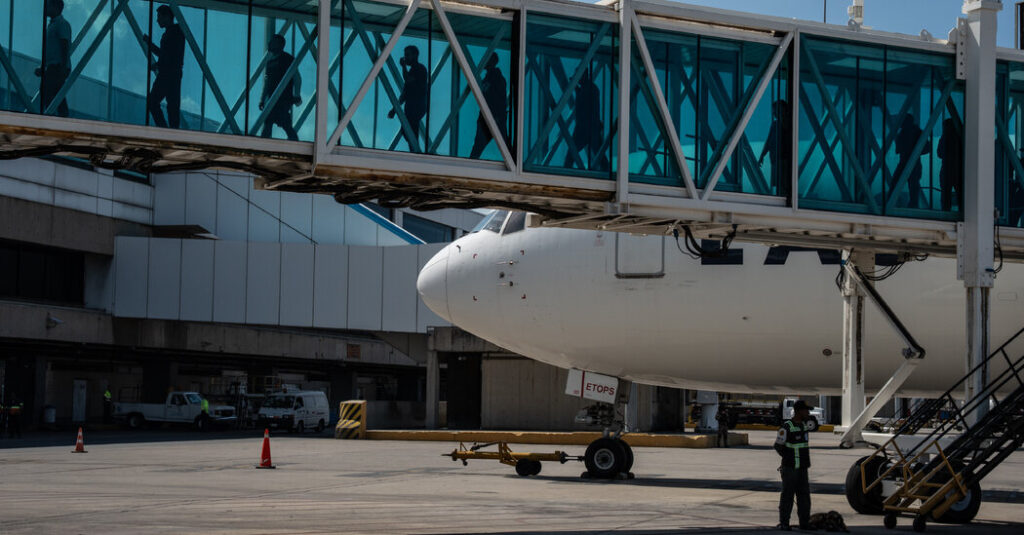
On Thursday, more than 180 men and women disembarked a white plane in Caracas operated by Eastern Air Express, an American charter airline that has contracted with I.C.E. They crossed an air bridge into an airport terminal where they were received by Venezuelan government officials.
The government-run Instagram account that documents repatriations said the migrants were being welcomed “with dignity, following all the necessary protocols to ensure a happy return to our nation.”
Reporting was contributed by Zolan Kanno-Youngs and Tyler Pager in Washington, Isayen Herrera in Caracas, Venezuela, and Patricia Sulbarán in New York.
Annie Correal is a Times reporter covering Mexico, Central America and the Caribbean.
The post Facing U.S. Pressure, Venezuela Agrees to Take More Deportees appeared first on New York Times.