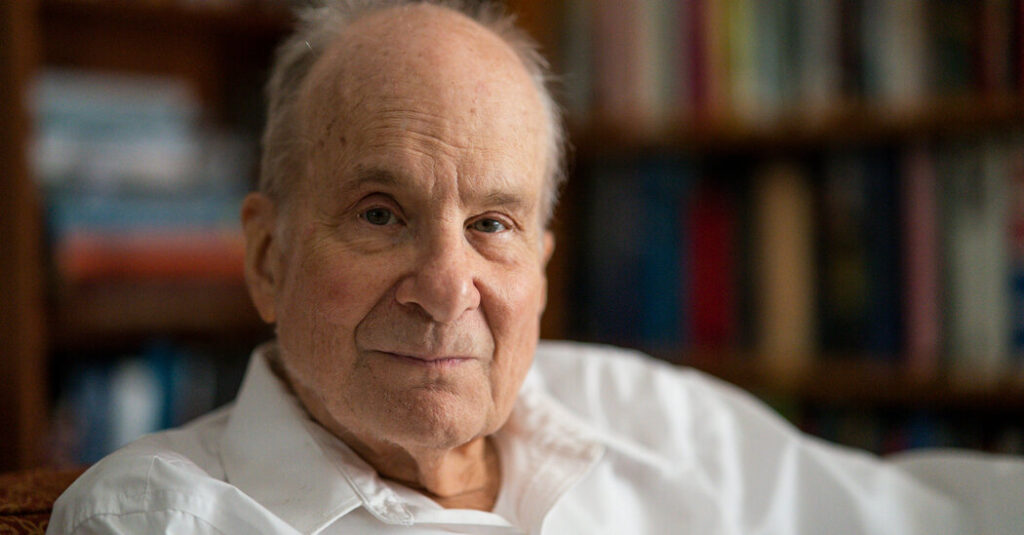
Louis E. Brus, a chemist and Nobel laureate who discovered quantum dots, tiny crystals that emit various colors of light depending on their size, died on Jan. 11 at his home in Hastings-on-Hudson, N.Y. He was 82.
The cause was complications of myelodysplastic syndrome, a type of bone marrow cancer, his daughter Elizabeth Brus said.
Dr. Brus was a scientist at Bell Laboratories, in New Jersey, in 1983 when he discovered that crystals of cadmium sulfide, a semiconducting material, could absorb different colors of light if they were small enough — as narrow as just a few thousand atoms across. Today, scientists refer to these nanocrystals as quantum dots.
Quantum dots were one of the first observations of a physical property that was determined by a material’s size rather than its elemental makeup. In 2023, Dr. Brus shared the Nobel Prize in Chemistry with two other scientists, Moungi Bawendi and Aleksey Yekimov, for this discovery and for the development of quantum dots.
In the decades since Dr. Brus’s initial discovery, quantum dots have been used to improve the vibrancy of TV and computer screens, and to map organs inside the human body. They may also someday power more efficient solar cells and advanced methods of information encryption.
Dr. Bawendi, who studied under Dr. Brus as a postdoctoral researcher at Bell Labs in the 1980s, wrote in an email, “The entire field of nanoscience and nanotechnology owes a huge debt to him.”
As early as the 1930s, physicists suspected that if particles were squeezed small enough, their physical properties would change. The idea was based on quantum mechanics, a theory of how the universe behaves at a subatomic scale. But it remained theoretical for decades because scientists couldn’t figure out how to create and separate structures that small.
Dr. Brus created quantum dots by accident. In the 1980s, he designed an experiment to study the chemical reactions that occurred on the surface of semiconductors, using tiny crystals of cadmium sulfide dispersed in a water-based solution.
He left the mixture on a lab bench overnight, and the next day discovered that the nanocrystals had grown slightly larger and that in doing so they had absorbed different wavelengths of light. He began to investigate this effect, comparing nanocrystals of various sizes. Larger crystals absorbed redder light, he found, while smaller ones absorbed bluer light.
These “became known as quantum dots,” Michael Steigerwald, a chemist at Columbia University, who collaborated with Dr. Brus at Bell Labs, said. “But at the time, we called them semiconductor nanoclusters.”
At larger scales, the optical properties of a material do not change with size. But the nanoworld — where materials can be 10,000 times thinner than the diameter of a strand of hair — is governed by the strange laws of quantum mechanics, which state that particles can sometimes behave like waves.
Electrons exist at fixed energies around the nucleus of an atom. They can jump to higher energies by absorbing light, and fall back down to their ground state by releasing light. Like waves, they have a frequency, and this value determines the color of light they absorb or emit.
Squeezing atoms into a tiny enough container — a quantum dot — can push the electrons closer together and increase that frequency. The color of light absorbed or emitted, then, is adjustable, or tunable, based on the size of the quantum dot — an effect that today can be controlled by manufacturers.
“In the beginning, I thought the knowledge would be important just for scientific understanding,” Dr. Brus said in an interview after winning the Nobel Prize. “I never really appreciated how widely they might be used.”
Louis Eugene Brus was born on Aug. 10, 1943, in Cleveland, to Victor John Brus, a World War II veteran and insurance administrator, and Mary Alicia (Megede) Brus, a teacher.
He spent his early childhood in rural Missouri. The family later moved to Chicago and then to a suburb in Johnson County, Kan., where he attended high school and developed an interest in chemistry.
In 1961, he enrolled at Rice University on a naval R.O.T.C. scholarship. He was expected to serve on active duty after graduation, but the Navy granted him a leave of absence to enroll in a graduate program at Columbia University in 1965.
At Columbia, he studied the production of energized sodium atoms and their chemical reactions. After earning his Ph.D. in 1969, he reported to the U.S. Naval Research Laboratory in Washington, D.C., as a scientific staff officer. There, he explored which gases and chemical reactions would be most effective in creating a laser beam.
Dr. Brus went to work for Bell Labs in 1973, joining a community of scientific experts trained in various fields — an environment he described as “legendary” in a telephone call hours after winning the Nobel Prize.
He initially studied the flow of energy in solids and developed a technique to observe the structure of molecules created in chemical reactions using pulsed lasers. He then pivoted to research on semiconducting nanocrystals, which led to his discovery of quantum dots.
Dr. Yekimov, the Russian-born physicist with whom Dr. Brus and Dr. Bawendi shared the Nobel Prize, had independently published his discovery of quantum dots using another material two years earlier, in 1981. But during the Cold War, Russian scientists struggled to collaborate with American researchers and to publish their work in mainstream scientific journals. Dr. Brus eventually came across a translated version of Dr. Yekimov’s results, and sent a handwritten letter to one of Dr. Yekimov’s collaborators, including a copy of the paper describing his own discovery.
Dr. Brus left Bell Labs in 1996 and joined the faculty of Columbia University’s chemistry department. He continued tackling new problems at the forefront of nanoscience, including studying the properties of extremely narrow wires called carbon nanotubes and atomically thin sheets of carbon known as graphene.
Tony Heinz, a physicist at Stanford University, described Dr. Brus as a chemist who masterfully combined expertise from various scientific fields with an “inimitable, unpretentious style.”
That style was perhaps illustrated by the way Dr. Brus summarized the breadth of his research career — as simply “trying to understand what the electrons are doing.”
He was recognized for his contributions to chemistry with the 2008 Kavli Prize, a $1 million award viewed by some as a precursor to the Nobel. He was elected to the National Academy of Sciences and the National Academy of Inventors.
After retiring in 2018, he remained active in Columbia’s chemistry department.
Dr. Brus married Marilyn Drennan in 1970. In addition to their daughter Elizabeth, his wife survives him, along with two other children, Michael and Christina; and four grandchildren.
After Dr. Brus’s death, notable chemists around the country commented on his influence on their careers and his insatiable passion for science.
“That’s what I will remember about him more than anything else,” said William Wilson, a chemist at Harvard University who collaborated with Dr. Brus at Bell Labs and was a close friend. “He was the consummate scientist, phenomenally intellectually curious about everything.”
Katrina Miller is a science reporter for The Times based in Chicago. She earned a Ph.D. in physics from the University of Chicago.
The post Louis E. Brus, Nobel Laureate Who Illuminated the Nanoworld, Dies at 82 appeared first on New York Times.