People who made it all the way through President Donald Trump’s comical address Wednesday at the World Economic Forum were rewarded with relief when he said a military invasion of Greenland was off the table. For now. He also said U.S. ownership of Greenland wouldn’t be a threat to NATO. (That’s comforting!)
But first, he bragged about his many accomplishments as president: ending wars, imposing tariffs and using the office to enrich himself to the tune of more than $1.4 billion (he left that out). He also made his argument for taking Greenland, which he said the United States returned to Denmark after defending the island in World War II. “How stupid were we to do that?” he asked his restless audience.
But really, folks, all he was asking for was a simple handover of a largely uninhabitable, “big, beautiful piece of ice.” Greenland, Trump told the crowd, is essential to national security (America’s and, by his own extrapolation, the world’s). The only viable deterrent to “potential enemies” would be an American military occupation and construction of “the greatest golden dome ever built” over the slab of ice that actual human beings call home.
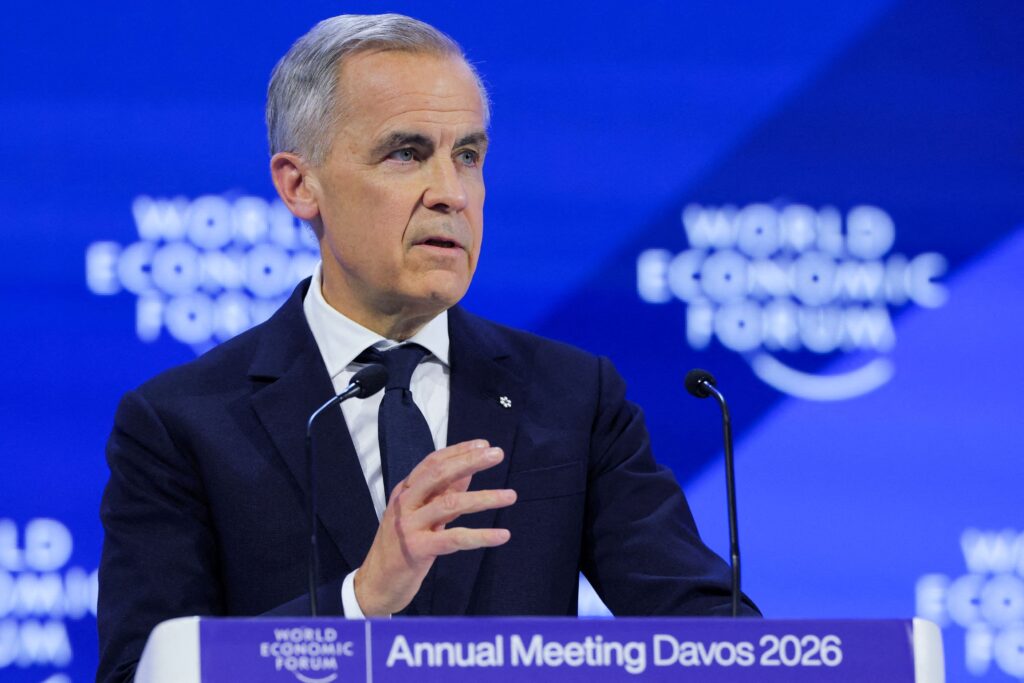
Though Trump’s speech offered some reassurance to other world leaders gathered in Davos, Switzerland, his overlong performance paled in comparison with others, chiefly that of Canada’s prime minister. Mark Carney’s elegant speech on Tuesday was Beethoven’s Fifth Symphony to the monotonous strains of Trump’s swaggering ditty. Eloquent but direct, Carney basically ended Trump with gentlemanly clarity and poetic innuendo.
In an era of superpower rivalry, Carney said, hoping that complacency will buy safety is no longer an option.
“We are in the midst of a rupture, not a transition,” he said, referring to the once-trusted, if sometimes fictional, rules-based international order. The fiction was useful for a time. American hegemony, he said, helped provide public goods, such as open sea lanes, a stable financial system, collective security and support for frameworks for resolving disputes. “This bargain no longer works,” he said.
Rules today are only for the little guys. Superpowers, including the U.S., now do what they want when they want. Vladimir Putin wants Ukraine, he goes in. China wants Taiwan, it’s only a matter of time. The U.S. took Venezuela and now wants Greenland. How long before Trump chooses another target on a whim?
Carney’s suggested remedy is greater strategic autonomy in energy, food, critical minerals, finance and supply chains. “When the rules no longer protect you,” he said, “you must protect yourself.”
But middle powers, as he described Canada and Europe, building fortresses of self-sufficiency while competing against each other would be less effective against aggression than a coalition of nations with shared values and an acceptance of reality as the world is, not as one wishes it to be. Negotiating bilaterally with a hegemon would be to negotiate from weakness.
“We compete with each other to be the most accommodating. This is not sovereignty. It is the performance of sovereignty while accepting subordination.”
The audience went wild — cheering, stomping and leaping to their feet to applaud. This was nothing like the tepid response to Trump’s mischaracterizations and fantasies. It was a relief, finally, to hear a statesman articulate the sense of rupture so many Americans have felt but been loath or unable to express. Complacency in the hope of safety doesn’t work and never has.
Everyone understood, especially when Carney noted Canada’s support for Greenland and Denmark. His remarks essentially were a call to arms and a plea to “live in truth,” to build strength at home and act together.
“That is Canada’s path … and it is a path wide open to any country willing to take it with us.”
It has been a long while since anyone has given a grander speech, inspiring memories of Winston Churchill, which brings to mind Harry Hopkins, President Franklin D. Roosevelt’s emissary to the British prime minister in 1941. As told by Erik Larson in “The Splendid and the Vile,” based on historical records and diaries, Churchill sought to persuade Roosevelt to join Britain in its defense against Germany. Hopkins, a mild-mannered man of “death’s-door appearance,” was also charming and had been sent to hear Churchill’s case and speak for the president.
Over brandy and cigars, Churchill launched into a monologue describing the war thus far, proffering a vision of the United States of Europe, explaining England’s rule of law and free speech values, and his wish only to protect them against tyranny.
“What would the president say to all this?” he asked Hopkins.
After a long pause, Hopkins drawled, “I don’t think the president will give a damn for all that.” Another long pause. “You see, we’re only interested in seeing that the Goddamn sonofabitch Hitler gets licked.”
Speaking of reality. Hopkins was surely more direct than Carney, but circumstances were vastly different. Hitler had just bombed Britain in the Blitz, and the country’s invasion seemed imminent. Yet both instances — then and now — required a recognition of reality and an embrace of what must be done.
Carney didn’t say Trump must be “licked,” but few could have missed his point.
The post This unlikely leader ended Trump — with gentlemanly clarity appeared first on Washington Post.