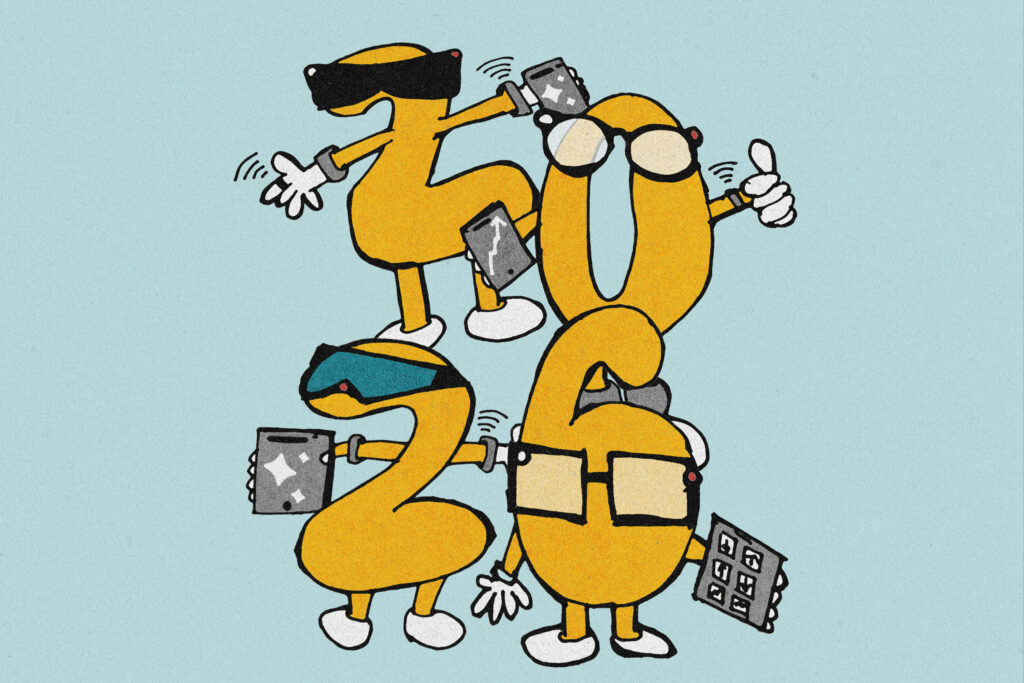
The tech you use, and the way it influences your life, stands to change dramatically in 2026.
New gadgets powered by artificial intelligence will proclaim a vision of life beyond the smartphone. Tech companies are taking a more detailed view of our health — for better or worse. And behind events big and small, expect a lot of gambling to happen.
The Washington Post’s personal tech team dissected the technology trends we think will be on your radar in the months ahead. We’re not packing crystal balls: just years of experience and an eye for the themes that seem likely to unfold in front of us.
To help you get ahead of it all, here’s our guide to what you may be delighted by — or detest — in 2026.
Post-smartphone devices
What comes after the iPhone? We may be about to find out. A wave of AI-focused gadgets is on the horizon, promising to put bots always within reach — even as they raise thorny privacy questions.
Forget things you stick in your pocket. AI gadgets will take the form of what you already own or wear: glasses, pens, rings, other jewelry. Since you can interact with AI through your voice, the devices don’t need screens — just a microphone and a speaker.
Meta has been an early leader with its Ray-Ban AI glasses, which let users snap photos and summon its bot by saying, “Hey Meta.” Google has previewed smart glasses, too. Start-ups have tried AI pins and necklaces, but those devices struggled to catch on.
Now the heavy hitters are entering the game. All eyes are on ChatGPT maker OpenAI, which spent $6.5 billion to acquire a hardware start-up co-founded by Jony Ive, who led design of Apple’s original iPhone. Announcing the deal, Ive said we need hardware purpose-built for AI — something more “peaceful” and less distracting than launching ChatGPT on a laptop. OpenAI has said its first hardware product should arrive in th esecond half of 2026. (The Post has a content partnership with OpenAI.)
One big question: How will these devices get to know their owners? Will they record audio — or even video — constantly throughout the day? And if so, will they capture everyone nearby, too? Recording someone without consent is creepy. In some states, it’s also illegal. For example, Meta’s AI glasses flash a light when they’re capturing photos or video for the user to keep, but not when they’re collecting images to inform conversations with Meta’s AI.
Everything is gambling
On the websites Kalshi and Polymarket, you can bet on whether Iran’s supreme leader will be ousted or who will be a bridesmaid at Taylor Swift’s wedding.
The start-ups kicked off a boom in forums where billions of dollars are wagered each month on the outcomes of real-world events. These and other “prediction” market companies say they’re on a noble mission to elevate the hidden wisdom within the masses.
But like other financial trends over the past decade, such as cryptocurrencies and viral “meme” stocks, prediction markets have also become another legitimized way to gamble. Concerns have followed about gambling addiction, insider trading and athletes throwing games to profit from wagers on prediction markets.
There are now regular suspicions of prediction market wagers being manipulated by leaks of secret information. In recent weeks, an anonymous trader earned roughly $400,000 by predicting the ouster of Venezuelan leader Nicolás Maduro just hours before U.S. forces took him into custody. There was also scrutiny on well-timed bets predicting Google 2025 search trends and the winner of last fall’s Nobel Peace Prize.
You can expect prediction markets to grow this year — even President Donald Trump’s family business is getting in on the action — and for concern and controversy to follow.
AI’s push and pull
After several years of warning bells from AI alarmists who say the technology is eroding privacy, fueling fake content and preying on the lonely, 2026 could be the year that consumer really grapple with the role they want AI to play in their lives.
This year, AI is likely to get top billing in our search engines, phones, dating profiles and workplace software. More companies will probably add AI into their products and ask people to use it in a bid to boost efficiency. But some consumers online are loudly against AI’s entry into personal technology, and you’ll likely hear more from them in 2026. They may pump out more roasts of AI gadgets, a la the frenzy around Friend, an AI-powered necklace that claims to take the place of real-life companions. Or online fan communities might band together to ask movie and video game studios to hire real actors and hold off on AI-powered performances. You could even see more pushback from friends, lovers and colleagues if you turn to AI for help with difficult conversations — some creators across social media dedicate serious energy to spotting AI-assisted breakup messages, declarations of love and dating app profiles.
Stricter tech safeguards for kids
This coming year, we are likely to continue to grapple with technology’s impact on kids as they are exposed to more AI. Look for additional attempts to go back and beef up parental settings and age restrictions on existing AI products, and more concerns about its impact on mental health and learning.
In the United States, some schools have already begun to try to go back to handwritten assignments done in school, avoiding access to devices and the AI features baked into everything. After initially launching without strong parental controls, AI bots from companies such as Meta and ChatGPT have announced they are working on more protections. It’s not just AI; in Australia, social media has already been banned for young teens.
It could also be a pivotal moment for parents and educators to learn from teens’ AI use. The Center for Digital Thriving at Harvard Graduate School of Education has found that teens who confided in the technology want someone in their lives who will listen to them without judgment. Adults might be able to learn from the appeal of chatbots and open up similar lines of communication that embrace real empathy.
Health tech takes a closer look at us
New and unexpected health tools are ready to get a better look at you.
At the sprawling CES trade show this year, there was a $449 wearable called Peri that will stick to a user’s torso and detect hot flashes, night sweats and other signals of perimenopause when it goes on sale this year. Nearby was a handheld gadget for detecting reproductive hormones that could help people conceive.
Meanwhile, users of Samsung phones, watches and smart rings may soon be notified that — based on shifts in their gait and speech — they’re experiencing symptoms of cognitive decline.
You may even find yourself turning to ChatGPT to help make sense of all the data products like these collect — The company recently pulled back the curtain on its specialized ChatGPT Health experience, designed to pull insights from apps and medical records you feed it.
Make no mistake: There’s a huge financial incentive for these companies to get these things right. But will they deliver while respecting people’s privacy? That’s a question consumers will be asking.
How will AI affect our jobs?
More workers are using AI in the workplace, and that’s expected to accelerate in 2026 as companies start to codify and execute their strategies.
There are a few things that might result from increased adoption.
Some companies may go all in on the tech only to realize it isn’t able to produce the expected results. Companies could use AI as a scapegoat for layoffs to reframe tough financial decisions. AI could introduce new problems for workers like introducing errors or bias, and depending on the situation, that could have detrimental aftermath, such as in the health care or legal industries. And experts and academics who study AI’s impact on work say that it will probably replace some jobs, especially those that have routine, predictable and repetitive tasks.
There’s some evidence to suggest it’s already affecting computer programmers, entry-level jobs and translators.
On the flip side, experts also believe new jobs will be created over time (prompt engineers became popular a couple of years ago but since then a slew of new jobs like knowledge architect have started to pop up). Workers might leverage AI to get new jobs by learning new skills and pivoting, earn more money by increasing efficiency or reaching new goals or take on dream projects like building a video game without knowing how to code. And employers could implement AI in ways that benefit their people (hello, four-day workweek?).
The post These technology trends will define 2026 — whether you like them or not appeared first on Washington Post.