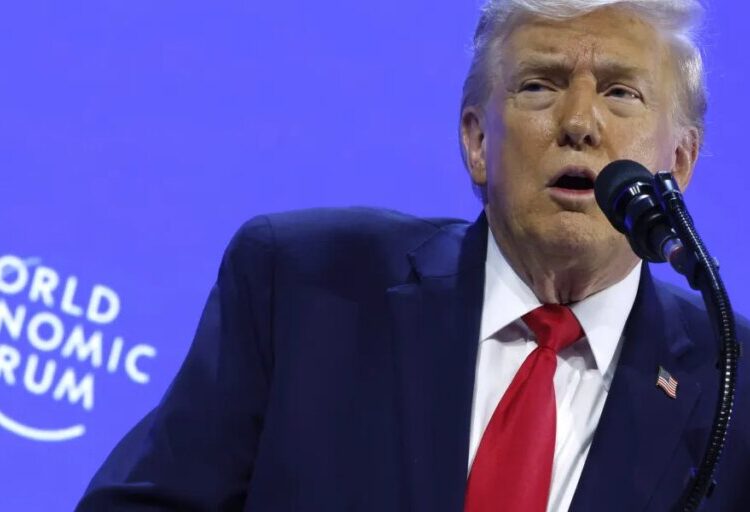
I was chief economist at President Donald Trump’s Office of Management and Budget during his first term, and I agree with Matthew Lynn’s Jan. 15 online op-ed, “We should feel nostalgic for the first Trump term.”
What made the first Trump administration successful on affordability was supply-side reforms that trusted markets to work. Cutting regulations, boosting domestic energy production, providing tax relief and promoting competition to lower prices all proved effective.
That’s why it is troubling to see the president flirting with policies straight out of the Democratic Party’s playbook in his second term, particularly over the past few weeks.
Price controls on credit card interest rates may sound populist, but decades of evidence show they reduce access to credit, especially for lower-income and higher-risk borrowers.
Banning institutional investors from buying single-family housing would reduce capital flowing into housing markets, shrink supply, and ultimately raise costs for renters and buyers. Housing affordability improves when we build more homes, not when we restrict who can finance them.
Trump’s first term showed that market-driven solutions work. Returning to those principles is the surest path to restoring affordability and economic growth.
Vance Ginn, Round Rock, Texas
Heirlooms without price
Bob Brody’s Dec. 30 op-ed, “Every family has a history. Here’s how to hand it down.,” encouraged children to interview their parents and grandparents. Post Opinions asked readers: “How has your family preserved its history? What have you discovered?” Here are some of the responses.
My daughter was tasked in middle school to “interview an immigrant,” and she chose my father. He had never told us the story of his escape from the Nazi occupation of Holland as a college freshman, but, spurred by my daughter’s assignment, he sat at his Royal typewriter, typing out nine single-space legal-size pages. What a harrowing story it was. How grateful I am that my dad “made it” across the Pyrenees on foot, surviving many a narrow escape. His manuscript is now housed, in perpetuity, at Yad Vashem, in part of the Gathering the Fragments collection that’s devoted to those who were not Jews but were nevertheless persecuted by the Nazis. If not for my daughter’s middle school teacher, we would never have heard about it.
Margaret Lee, Charlottesville
Growing up in New Zealand, I was interested in interviewing my parents but did not find the time. I finally had time after graduate school but was married and living in Pennsylvania. By then, my octogenarian father was ravaged by dementia and was of no use trying to interview. There was hope with my mother. She was starting to show signs of dementia, but I was talking to a well-known New Zealand historian about interviewing her. Weeks later, before I could hire the historian, my mother died as a pedestrian in a vehicle accident — mostly due to her dementia — while visiting a sibling of mine in Australia. She was 68.
My point is: Do it sooner rather than later. One’s teen years are a perfect time before life takes over. I know snippets about my father’s years as a railroader, and my mother’s time as a midwife, but not nearly as much had I done what I meant to do.
Jonathan Ah Kit, Plains Township, Pennsylvania
Interview your parents on video while showing them a slideshow of family photos as far back as you have them. Then intersperse the edited video with the pictures they’re talking about.
I learned a lot about my grandparents and great-grandparents this way — and now the video is available to future generations on YouTube.
Eric Greene, Annapolis
One of our New Year’s resolutions at my continuing care facility is to share the stories of our lives before they are lost. We were inspired by an editor of American Mother magazine who asked 50 mothers what they really knew about their own parents — not much, for the most part.
So, in our own handwriting in journals, essays on computers, video recordings and audio vignettes, we are addressing our early lives and backgrounds: special moments, family traditions, oft-repeated phrases, treasured folk songs, religious beliefs, wedding customs, burial sites, educations, careers, remembered recipes and insights into our personalities. No one worries about grammar or historical accuracy or input from others. It’s the real “You” being recorded and what a gift for family members and for each other.
As we tell our children where we’ve been, what we’ve learned, who we’ve become, what we believe — our manners, our faults and our strengths — we realize that the stories of our lives are our finest legacy. And only we have the power to tell them.
Kathy A. Megyeri, Washington
My father wrote a journal starting in 1980 when he was 82 years old. He wrote of his life in Russia when the Bolsheviks came and soldiers were in the street. He wrote of coming to the United States when he was 18. He wrote of the Depression, of Herbert Hoover ruining the country, of Franklin D. Roosevelt “saving us.” He was very smart, but he did not have the advantage of an education, so he wrote phonetically. Reading his handwriting is tedious. But as I transcribe every page, I hear his voice.
He was two weeks short of his 100th birthday when he passed. I am 96 and, before I “leave this planet,” as my father would say, I am determined to finish transcribing his journal and preserving his story.
Irene Tritel, Palm Springs, California
The three-dollar menu
The Jan. 19 Economy & Business article “A healthy meal for $3? Agriculture secretary says it’s easy.,” reported that Brooke Rollins claimed her department ran “over 1,000 simulations” and found that “it can cost around $3 a meal for a piece of chicken, a piece of broccoli, you know, a corn tortilla and one other thing.” Madame Secretary, please invite me and my kids to your $3 dinner party!
Jim Stiegman, Washington
Making a play for football fans
The Jan. 19 news article “Trump plans order to TV networks on Army-Navy game” reported on President Donald Trump’s plan to sign an executive order requiring “television networks to block other college football games from airing at the same time as the annual Army-Navy football game.” I think this is great. The president’s next “football move” should be an executive order fixing a blatant calendar inefficiency: Make Presidents’ Day a floating holiday that immediately follows the Super Bowl.
Doing so would fully allow Americans to enjoy the midwinter game knowing they would have the next day off from work. As things stand, U.S. businesses lose $3 billion in productivity because the day after the Super Bowl is one of the least productive workdays of the year.
Coincidentally, the 2027 Super Bowl is scheduled for Sunday, Feb. 14, and Presidents’ Day will be Monday, Feb. 15, allowing for a rare test run. Better yet, Trump should issue this order before the midterms to drive up his approval ratings. Making the day after the Super Bowl a federal holiday is supported by seven-time Super Bowl champion Tom Brady. And we all know how much Trump likes celebrities joining in jubilant Oval Office photo ops.
Freddie Dunn, Glen Burnie
Years ago, Republicans mocked President Barack Obama when his rhetoric veered into historical grandiosity. Today, they serve a president who sees himself making history by the hour, whether he’s channeling Andrew Jackson’s fights with coastal elites, pushing to expand U.S. territory like James K. Polk or privatizing world peace like Iron Man. Yet his concern for football TV schedules reminds us that Donald Trump’s vision for America is as granular as it is grand.
Yes, Obama mused that his 2008 Democratic primary victory marked “the moment when the rise of the oceans began to slow and our planet began to heal.” But the water in our dishwashers and showerheads didn’t find a champion until eight years later.
Michael Smith, Georgetown, Kentucky
Post Opinions wants to know: Are youth sports in America broken? What could be done to improve them? Share your response, and it might be published as a letter to the editor. wapo.st/youth_sports
The post I worked for Trump. He has changed. appeared first on Washington Post.