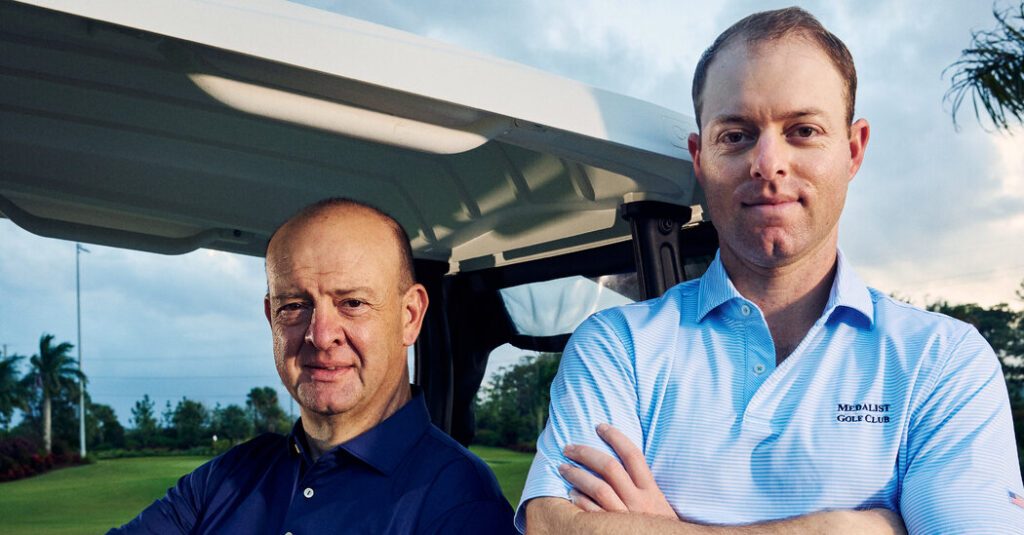
Early last year, when we were walking Pebble Beach on a wet, windy day and watching his son Max play in a PGA tournament, Alex Greyserman burst into an impassioned discourse on the strategy of “pulling the goalie” in hockey — replacing him with an extra skater when you’re behind late in a game. It took me a second to realize what sport he was talking about because, even on that frigid day on the Central California coast, Pebble Beach felt a very long way from an ice rink.
“Statistically, if you’re down by two goals, you should be pulling the goalie with something like eight minutes left, not with a minute and a half,” Greyserman said. “But if you do that and the other team scores two empty-netters, you look like an idiot. Right now, they pull with 90 seconds left, and if they lose, everyone says, ‘Well, you had to try.’ You pull with five minutes left and lose 5–1 and the announcers say, ‘What the hell is this guy doing?’”
Greyserman is a data guy, a quant who made a fortune on Wall Street, trained to seek patterns in markets and to trust what numbers tell him. He has no particular fondness for hockey. It interests him mainly as a vehicle for explaining his real passion, which is how decision-making gets distorted by biases, glitches, gut instincts and, yes, optics. These hockey coaches, when they wait too long to pull the goalie and lose the game, they are choosing to be wrong rather than look wrong.
Crazy, I said, only to see Greyserman furrow his brow.
No, Greyserman explained, it’s normal. Flawed, yes, but normal. Uncertainty messes with our heads; it sets us up for poor decision-making. We ignore probabilities in favor of our feelings. Even those who buy airport best sellers on behavioral economics — OK, maybe I have a few myself — can’t help acting in our everyday lives like vain, stubborn hockey coaches.
What does any of this have to do with golf? Well, everything, it turns out. Greyserman and his wife, Elaine, have four children, three of whom have developed into elite golfers — Dean, a senior at Stanford; Reed, who made all-Ivy as a freshman last year at Princeton; and Max, who was then about to start his second season on the PGA Tour.
Max is ranked No. 33 in the world, not a star but tantalizingly close. In his rookie season of 2024, his average score over 18 holes was 69.998; if he had improved that by .085 — or less than one-tenth of a stroke per round — he would have passed Rory McIlroy and cracked the top five on the tour. It’s not a perfect comparison; McIlroy played some harder courses. But it’s an indicator of how scarily slim the margins are in pro golf — in both directions.
All it takes to slip back into the middle of the pack, maybe even to lose your tour card, is a string of small errors made under pressure, plus some bad luck. Success in golf rides on physical skill, of course, but the closer you get to the top, the more it becomes about intangibles, like the ability to deal with these hairsplitting variations in performance and not lose your grip on probabilities.
That’s why I became interested in Max and ended up out there at Pebble Beach talking to his dad about pulling the goalie. What sounded at first like a digression turned out to be more of a nudge: This is how to watch sports. Don’t get stuck on outcomes. Avoid the knee-jerk determination of good or bad. Look for the patterns, the process, the decision-making, the mind-set, the systems for dealing with risk. This is how sports can actually reveal something to you about human nature.
As I tracked Max over the course of the 2025 season, that’s what I looked for. Not merely how many fractions of a stroke he could ultimately shave from his score, but the underlying elements of that performance and what it takes to keep making good decisions in the face of uncertainty.
I first heard about the Greysermans from a friend who runs 3i Members, a network of several hundred rich guys who invest through their family offices and crave alternatives to the boring, boilerplate decks they get from Wall Street pros. They pitch one another ideas and discuss topics of mutual concern such as longevity, the impact of A.I., off-the-radar vacation destinations and how to raise children so they don’t turn out to be entitled brats. In late 2024, Alex and Max made a presentation to 3i Members about the overlap between golf and investing, which naturally thrilled the group.
Even among this crowd, few knew much about Max. Though he is a year older than Scottie Scheffler, the PGA Tour’s dominant player, Max took a slower route, emerging from obscurity at the 2024 Wyndham Championship in Greensboro, N.C., where he headed into the final stretch with a four-stroke advantage and a 96.8 percent chance of winning, according to Golfbet. But his tee shot on 14 struck a cart path and flew out of play, resulting in a quadruple bogey and a second-place finish.
That stunning collapse might have been all anyone remembered about Max — if not for his unexpectedly ebullient post-round interview, in which he not only credited himself with playing “really, really good golf” but gave every indication of fully believing it. In a sport famous for self-flagellation, the interview left a lasting impression, evidence of a skill that Max had honed for years: maintaining an awareness, even in emotionally fraught moments, that the one opponent you can never beat is randomness. No matter how polished your skills, no matter how hard you train, some shots will land in terrible spots, and should that happen at a critical moment, there will be an overwhelming urge to judge yourself and the quality of your decisions accordingly. “Outcome bias” is a trap that ensnares the entire sports establishment — players, commentators, fans, everyone.
It’s also the exact kind of subject matter the Greysermans wanted to talk to 3i about. Alex opened the presentation by outlining the Dunning-Kruger effect, named for the Cornell psychologists who, in 1999, revealed the peculiar tendency of people with high skills to doubt their abilities while those with lower skills overrate theirs. It’s knowing what you don’t know versus not knowing what you don’t know. People love to credit themselves with the former while criticizing others for the latter. But Alex advised a down-to-earth application of Dunning-Kruger. Use it as a starting point for your own thinking. Assume there’s a lot you don’t know — and plenty more you don’t know you don’t know.
Max then laid out how analytics have changed golf over the last decade. Each shot comes with a checklist of decisions. Players used to be taught to direct their tee shots in a way that gave them an ideal angle into each green; the numbers show that, generally speaking, aiming down the middle of the fairway produces better outcomes over time. When it comes to approach shots and chipping, the old wisdom was to leave the ball below the hole, because uphill putts are supposedly easier to make than downhill putts. But the data show that a longer uphill putt is still harder than a shorter downhill one. From eight feet to three feet, every inch closer to the hole bumps up your make rate by about 1 percent.
In the “Moneyball” revolution that remade baseball, the stats guru Bill James famously posited the avoidance of outs as the basis of offensive value, thereby recasting the unloved ability to draw walks as a vital skill. Golf underwent an equivalent reframing when the Columbia Business School professor Mark Broadie introduced “strokes gained,” a metric that calculates the expected value of every shot. Like James, Broadie turned folk wisdom on its head. Putting, it turns out, is less important than people thought. Driving distance is more important than accuracy. And hitting good approach shots is the essence of high performance.
When the data revolution came ripping through the sport, Max was just entering college, mature enough to grasp the math but young enough for it to influence his game. He embraced the teachings of the analytics pioneer Scott Fawcett, whose data-based approach to golf — shot patterns, dispersion cones and expected value — sounded to Max a lot like the way his father talked about investing. Fawcett’s key concept is “trusting the variance,” an acceptance that even a robot cannot hit the ball in the same place every time. Randomness is an unavoidable feature of the game. By sticking to data analysis and not resorting to hunches or gut instinct in the moment, you make certain the percentages stay on your side even when weird stuff is happening.
Any halfway-serious golfer knows the gist of all this. But it is the nature of the game to sow self-doubt, or what Alex calls the “hot potato” of uncertainty, into every player. That’s why the Greysermans framed their presentation with the language of behavioral economics, listing the cognitive biases that disrupt good decision-making. Because bogeys hurt more than birdies feel good, you get timid on the green and leave your putts short. That’s loss aversion. When a great shot sends your confidence soaring, that’s recency bias. Or when you convince yourself that a string of bad shots is sure to end with the next one, that’s the gambler’s fallacy at work.
Merely learning the terminology is hardly a solution to anything. Behavioral economics is, at best, a science of educated guesses; at worst, it’s an academic sleight of hand. In real life, cognitive biases distort our thinking as we confabulate narratives out of randomness. Subduing your cognitive biases means digging deep, changing how your mind works. And that may be possible only through painful lived experience.
The Greyserman family’s dance with data began in the early 1990s, when Wall Street started pouring money into computer-trading models. Alex Greyserman, an immigrant from Ukraine who earned a Ph.D. in statistics from Rutgers, stumbled into a job at a hedge fund called Mint Investment Management Company. He knew nothing about finance. He merely liked the idea of a $4,000 raise.
Specializing in commodities and currency trading, Mint was one of the first hedge funds to clear $1 billion under management. It was run by a legendary trader named Larry Hite, who believed that markets were driven by momentum, in both directions. He hired math whizzes like Alex to write algorithms to capture that momentum while minimizing risk.
This style of investing is known as “trend following,” and though the mantra is simple — ride your winners, cut your losses — the behavioral demands can be severe. Analysts comb through historical price data for patterns, construct mathematical rules for trades based on those patterns and then usually watch as their algorithms fail. So they try and try again, racking up lots of pinprick losses while waiting for big winners to emerge and make up the ground, the extreme opposite of the adrenaline-fueled mythology that Wall Street loves about itself. “When I get together with other traders and they start exchanging war stories about different trades, I have nothing to say,” Hite told Jack Schwager, the author of “Market Wizards.” “To me, all our trades are the same.”
Alex struggled to adapt. His first batch of trades fizzled. This was normal, even healthy, and Hite was not worried. But Alex was. “Everything seemed chaotic,” he said. Brilliant colleagues bailed out because they couldn’t stand feeling wrong so often. “You have to learn not to be attached to anything,” he said. “Not even your own intelligence.” For an immigrant who’d made it on little more than his own wits, this was a huge ask. What, you’re saying I’m not smart? But he learned to tolerate the discomfort, and before too long, he was among Hite’s most dependable moneymakers and, eventually, his partner. He also taught the mathematics of investing to grad students at Columbia for almost 20 years and co-wrote a textbook on the subject. This was a secret he wanted everyone to know, including his own children.
After Alex and Elaine took up golf while on vacation in Florida, they could not keep Max, then a toddler, away from their clubs. “He would literally grab them every chance he got,” said Elaine. Before he turned 10, he was trouncing both parents. Like many children learning a difficult game, Max would lose his composure when he played poorly. He’d yell at himself, throw clubs, the usual stuff. Rather than merely try to calm his son down, however, Alex steered him toward a deeper insight — that a lot of what happens, good and bad, in golf, as well as in life, is random and beyond your control. Stay neutral and analytical.
Even after Max made all-American on the junior circuit, won the New Jersey state championship and had his pick of colleges, he lacked confidence. “I was always pretty good,” Max said, “but I never really believed in myself as a player.”
After a solid but unspectacular career at Duke, Max decided to go all in on a pro career. He moved to Las Vegas, to be near his swing coach, and lived like a monk, or as close as one can in Vegas. “I would get back to the house when it was dark, wake up the next day and do it all over again,” he said. “Sunrise to sundown. Day after day after day. I had an objective and I had a task.” Friends started calling him “the Machine.”
“Were you happy?” I asked.
“I wasn’t going make any excuses,” he said. “Was I happy? I don’t know. I don’t think I was happy.”
Max’s rise through the underworld of golf was uneven. He came perilously close to losing his status on the second-tier Korn Ferry Tour and sat out a whole year with a wrist injury. But as his father had done as a young quant analyst, Max tried to learn from his feelings of inadequacy and rely on math to steady him through his ups and downs. His ninth-place finish on Korn Ferry in the 2023 season earned him elevation to the PGA Tour, where he had a stellar debut in 2024. He was a finalist for the rookie-of-the-year award and 48th overall. Heading into 2025, he seemed to have momentum on his side — but that, as his father would tell you, can be deceiving.
I reconvened with the Greysermans a month after Pebble Beach at the Players Championship, the first marquee tournament of the PGA Tour season, played at the spectacular TPC Sawgrass course outside Jacksonville, Fla. In the first round, Max started on the back nine, which meant that the 17th hole was only his eighth of the whole tournament. This par 3 is TPC Sawgrass’s iconic flourish, the one they love to show on television. The flag sits on a little emerald island, a mere 141 yards from the tee. It’s a simple iron shot over the pond, but a ridge in the middle of the green creates what Cory Jez, Max’s stats and strategy coach, calls “a massive risk-reward scenario.” If a pro wanted merely to hit the green, he could do it easily. But for a good chance at par, his actual target is a small fraction of the island, close to the pin, which is often positioned near the water. And the stadium configuration of the viewing area around the hole makes it hard for golfers to judge the wind.
Standing behind Max as he struck the ball, I thought there was no way he would miss. The shot looked right on target — until it dropped from the sky and into the water. Max later speculated that a passing breeze was to blame. In the moment, it was impossible to tell. It was just … random. Moving to the drop zone, he hit the green too low and the ball rolled back into the water. He wrapped up with a quadruple bogey, his first since Wyndham.
The Players Championship, like most PGA Tour events, is four consecutive days of the same 18 holes, and after two rounds, the field is cut in half. Coming into the tournament, Max had made the cut 18 straight times, one of the longest active streaks on the tour. Now, after Day 1, he stood at four over par and was going to need to play fantastic golf on Day 2 to stay alive into the weekend.
Before each tournament, Jez emails Max a detailed packet on how to play every hole, with specific recommendations on yardage, aim and club choice. An incredible volume of data about Max’s game, the course and its shot histories is compressed into these reports. Nothing is left to chance. That’s the whole point.
In the morning, I’d been texting Jez about how the plan changes when Max is in danger of missing the cut. Is there a risk-on option, a more aggressive approach? The answer was no, not really. “It’s very very rare situations that we would want to increase the variance (i.e. play risky) to try and reach for a birdie,” Jez texted back. “Simply put: The optimal way to play each hole is the optimal way to play each hole.”
That sounded weird to me, like a football coach calling run plays when his team is down two touchdowns in the fourth quarter. But golf is different. The reason to do all this data work is to not get fooled by your emotions into heaving Hail Marys. Max’s bet had to be that his game would revert to its normal level and that if the luck was with him, he stood a better chance of making up those three strokes than if he altered his approach. This is what “trusting the variance” is all about.
I walked TPC Sawgrass that whole second day with Alex. This time, I understood the protocol. Do not ask about how Max is playing. Talk about anything else. Hockey, football, whether to take the Holland or Lincoln Tunnel when commuting into Manhattan. It dawned on me that Alex’s role out there is neutralizing drama, which reflects both a protective paternal instinct and a philosophy of life. There is nothing special about any one shot, or any one hole or even any one tournament. Resisting the impulse to dramatize every data point is how you succeed.
Regardless, on Day 2, Max had a triple bogey on four and a double bogey on five, quickly sinking his chances of making the cut. I went back to my motel and spent the evening reflecting on my own decision-making.
In deciding to come down to TPC Sawgrass and do a story about Max and Alex, I had made a bet of my own. It wasn’t a crazy bet. I didn’t need him to win the whole thing, although that would have been awesome. But I did expect him to build on the run of good play from the second half of his rookie season, which was a calculated gamble, like buying a stock. I had data to support the decision — his elite putting numbers, his 18 straight cuts — and I had a defensible theory about why his improvement would continue. With the help of his father, he had trained himself to tolerate uncertainty. Who on the tour could beat him at this aspect of the game? That had to be an advantage.
Well, on a single hole at TPC Sawgrass, a gentle breeze blew apart my bet. But what did that mean?
I thought about something Alex had once explained to me at length — that deciding when to sell an asset is way more important than when to buy one. The endless chatter on Wall Street, the stuff you see on television and social media, gets this exactly backward. There, everybody always talks about what to buy. They’re marketing the fantasy of perfect timing, of getting in just before the liftoff. But the principles that Alex learned from Larry Hite emphasize the exit. The first questions they ask are: Where do I set the floor? How much can I afford to lose? By aggressively pruning their unprofitable positions, they zero in on the elusive assets that have momentum on their side. It’s not so much about picking winners as getting rid of the losers.
I tried to think about Max in those terms. How long should I wait for the positive momentum to kick in? Was this just a passing cloud of bad luck? I started to understand, in a way I never had before, the weird, almost contradictory effects of loss aversion. It compels us to hold on to losers — like a stock or the subject of a magazine assignment — because we don’t want to admit, to ourselves or anyone else, that we have failed. It’s not technically a loss until we give up, so we don’t give up. Think of how many things in your life are governed by this single cognitive bias. Or maybe don’t.
On the day after Thanksgiving, Max took his brothers out for a 12-hour training session that started with a workout in his garage at 5:30 a.m. Every minute was planned, a mix of drills, modified games and trips to three golf courses to play under different conditions. Max’s own daily regimen rarely goes quite that long, but he wanted Dean and Reed to appreciate just how much of a difference there is between playing in college and making it as a pro. You need consistency. You need stamina. You need to be willing to make golf your life. Their reward for a full day’s work, noted on the agenda, would be a single beer apiece.
Both Dean and Reed say they are determined to follow Max’s path and play on the PGA Tour. The odds of making it, even for golfers from elite college programs, are prohibitive and only getting steeper as tour organizers seek to cut the field size and number of events, making the big names stand out more. Aficionados love the coming-out-of-nowhere-to-win stories that the golf world is famous for, but casual fans want to see the stars, or so the prevailing theory goes.
After the Players Championship, Max’s second season on the tour didn’t match the consistency of his first year. He did more than respectably at his first Masters, finishing tied for 32nd, and did even better at the U.S. Open, coming in a tie for 23rd place. Then, on a sunny July weekend in Detroit, he went on a sensational tear at the Rocket Open, playing the last 31 holes without a single bogey. He ended up in a three-way playoff, agonizingly missing a couple of putts by inches that would have given him his first tournament win since he was a teenager. He promptly missed five of the next six cuts, his worst stretch by far on the PGA Tour. And then, when it looked like he would end his year in a slump, Greyserman dueled Xander Schauffele, one of the best in the world, at the Baycurrent Classic in Yokohama, Japan, firing a 65 on the final day, capped off with a birdie on 18. Schauffele shot 64 and won.
“If I looked up the history of all PGA Tour events with final group on a Sunday,” said Alex, “everybody who shot 65 probably won 80 or 90 percent of those events.” So Max was one of the 10 or 20 percent who didn’t — a meaningless blip. Through a statistical lens, the difference between winning and losing can look almost random. And yet nothing in sports is quite as agonizing as coming in a close second.
I told Alex that there is a certain irony in Max (and probably his brothers, too) pursuing a career that has such long odds against success. “There is nothing wrong with making a low-probability bet, especially if the potential payout is high,” he said. “You just need to always know what you can afford to lose.”
The post Can You Achieve Sports Greatness by Thinking Like a Wall Street Trader? appeared first on New York Times.