Nadine Cooper was 12 when her music teacher gathered a group of students to sing around the piano.
“I started singing, I thought I was doing really well. … But he turned around and put his hand on my arm and said, ‘Please stop singing, you are spoiling it for everyone else,’” Cooper recounted.
She had always loved singing, but she took her teacher’s words to heart — for decades after, she pretended to sing along to the hymns at weddings and funerals. She would quietly mouth the words to “Happy Birthday” during parties.
“I went to Cambridge University, which is well known for its choir, and I would hear them practicing from my room,” Cooper said. “Whenever singing came up, I knew I couldn’t be part of it.”
But then Cooper started to hear about the mental health benefits of singing — and in particular, singing in groups.
Around that time, she met Bernie Bracha, a local choir leader in her hometown of West Bridgford in Britain. Bracha encouraged her to come along to her choir, insisting that it didn’t have auditions and was open to everyone. But Cooper felt that people there would still be trying to make beautiful music and she didn’t want to feel like she was “spoiling it” for anyone, she said.
The idea for Tuneless Choir was born.
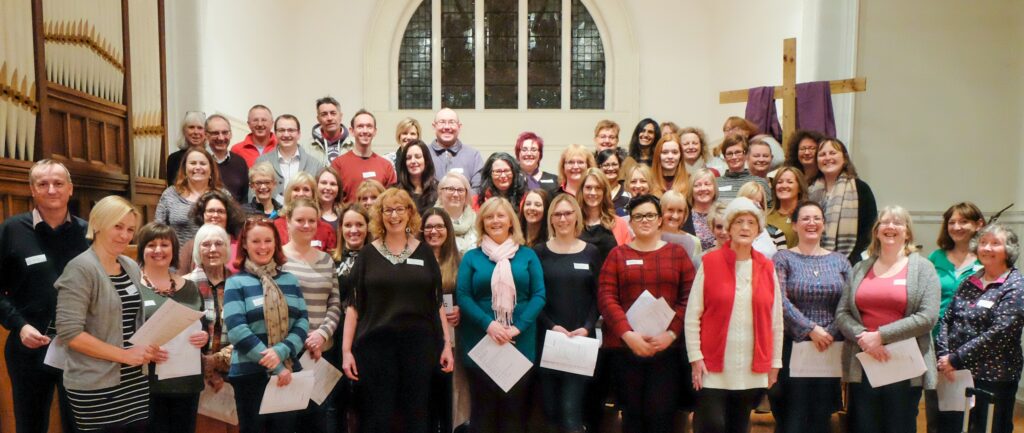
It started as a one-off. Bracha and Cooper organized an event at a church 10 years ago, expecting a dozen people at most. About 60 showed up that first night — and everyone wanted to know when the next one was. There are now more than 30 groups in the United Kingdom and recently two groups started in Canada. Most have weekly sessions.
“It’s just so much fun,” Bracha said. “We say, ‘Sing like no one’s listening.’ And that is what they do.”
On social media, the Cambridge Tuneless Choir explains: “For people who love to sing but do it badly! There’s no parts, no tuition, no judgement which means no pressure & no expectations!”
Many of the participants are in their 50s, 60s and 70s, though there have been members as young as 18 and others in their 90s, Cooper said. The choirs’ favorite artists tend to be hitmakers from the 1960s, ’70s or ’80s: ABBA, Madonna, Queen, the Beatles, Bon Jovi, Elton John.
During the pandemic, the weekly choirs moved to Zoom, and now a “Virtually Tuneless” choir still happens regularly online, with participants joining from Auckland, New Zealand, to Amawalk, New York. Most of the time everyone’s mic is muted except the choir leader’s, who sings to a backing track. But at the end of each song everyone unmutes for a moment of “glorious cacophony,” as Cooper called it.
“Actually it provided a lot more humor,” said participant Raeshel Hutchinson of the virtual sessions.
Hutchinson worked in a care home during the pandemic, and the weekly online choir became her release, she said, “to de-stress and to just connect with people… It was just fabulous.”
For many Tuneless members, the in-person sessions have provided solace and community when they needed it.
“I was looking for things to do. It was almost a year down the line since losing my dear husband,” said Tina Balsdon, 68, who has been with the choir almost since it started 10 years ago. “Evenings in on your own suck.”
In Tuneless, she found a new group of friends who welcomed her and her joyful, off-key warbling.
“I’ve never been to a group where you feel as though you belong so quickly, but I think that a lot of that is to do with singing,” she said.
Fellow crooner Jacqueline Kent went to the first gathering in 2016, which happened to fall on the anniversary of her son’s death.
“I was like, actually it feels to me like this is something that has been sent for me to do for myself,” she said.
Studies have shown that making music with other people not only boosts mood and decreases stress, but also makes us feel closer to the people we’re making it with.
For Kent, this led to her falling in love with and marrying another Tuneless singer, who surprised her by proposing to her at a choir session in 2019 after leading the group through their song, Billy Ocean’s “Suddenly.”
The Tuneless Choirs don’t have concerts in the traditional sense — “We wouldn’t have the gall,” Cooper said — but they have performed at festivals and nightclubs, on the radio and on television. The choir went on the BBC’s “Today” program and sang, prompting the host after a few minutes to say, “Well, I think that’s enough of that,” according to Cooper.
Next month in honor of the group’s 10th anniversary, hundreds of Tuneless singers will gather for a choir weekend in York. The highlight of every Tuneless weekend is a flash mob, which often starts with Cooper singing alone with a microphone, turning heads, and then others around her joining in.
“We did it in a shopping center, a big shopping mall once,” Bracha said. “And we just had the whole place singing along with us.”
The post Can’t sing? Neither can they. That hasn’t stopped the Tuneless Choir. appeared first on Washington Post.