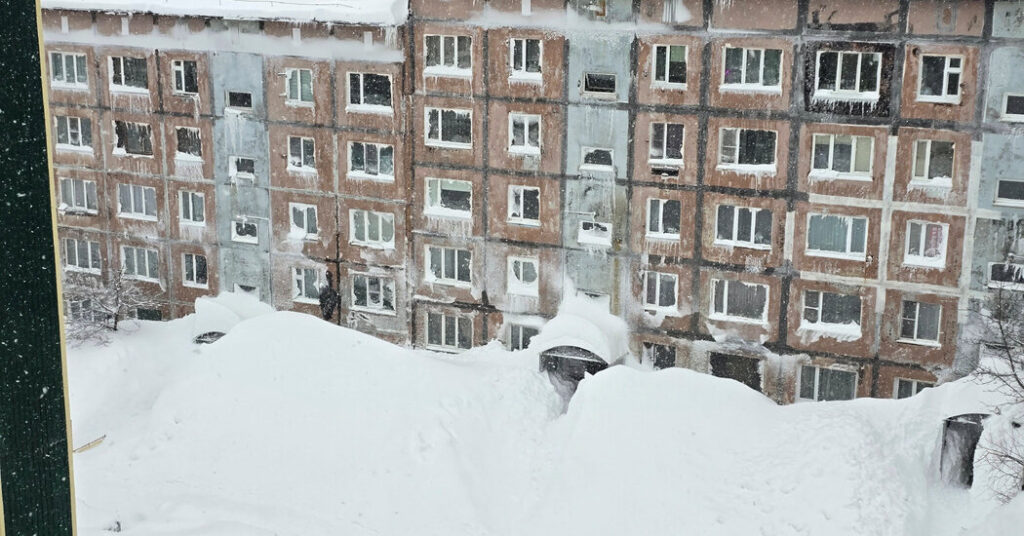
People on the Kamchatka Peninsula in Russia have been clearing massive piles of snow this week after several days of severe weather.
Mini mountains of snow buried cars, blocked entries to buildings and covered roofs, bringing life to a standstill in Petropavlovsk-Kamchatsky, a small city on the remote arm of land jutting out from Russia’s Far East into icy seas.
Emergency services reported that two people had been killed by snow falling from rooftops on Jan. 15, according to RIA Novosti, a Russian state news agency. A state of emergency was announced in the city.
The snowfall totals on the peninsula have been unusually high this year, but the situation is not as extreme as depicted in some A.I.-generated videos circulating on social media, which show apocalyptic scenes of snow rising to the tops of buildings.
Some of the clips feature “ridiculously unbelievable snow scenes” that were created with A.I., while some of the footage is probably authentic said David Robinson, who leads the Global Snow Lab at Rutgers University in Piscataway, N.J.
Andrey Stepanchuk, who lives in Petropavlovsk-Kamchatsky and works for a local travel adventure company, also said some of the videos were not authentic . In reality, he said, the snow was rising no higher than the third floor of buildings. He described the snow as “nothing catastrophic” but said it was a challenge to clean up so much.
An official snow depth of about 5 ½ feet was recorded in Petropavlovsk-Kamchatsky on Jan. 16, with that number dropping to five feet by Jan. 21, according to the Hydrometeorological Center of Russia.
Videos and photos that were verified by The New York Times showed hills of snow that appeared taller than that. They showed snowdrifts, formations created by the wind piling the snow up against obstructions like buildings and fences.
“Snow does not fall down uniformly flat,” said Vladimir Alexeev, a research professor with the International Arctic Research Center at the University of Alaska Fairbanks. “Wind will make those huge snowdrifts.”
The January snow dump happened after the region had several times its usual amount of snowfall in December. Vera Polyakova, head of the Kamchatka Hydrometeorological Center said the area had not received that much snow in nearly 60 years, according to RIA Novosti.
The Kamchatka Peninsula stretches out into the Sea of Okhotsk and the North Pacific Ocean for nearly 800 miles, nearing the length of California. Its wild and rugged landscape is dotted with active volcanoes and traversed by rivers filled with salmon.
It is often the scene of natural disasters. On July 29, a magnitude 8.8 earthquake struck offshore; it was the sixth largest earthquake globally since 1900, according to the U.S. Geological Survey. Then the Krasheninnikov volcano erupted on Aug. 3 for the first time “at least in 400 years,” with ash spewing four miles into the air, according to the Kronotsky Nature Reserve.
In January, the snow has taken center stage. Marty Ralph, the director of the Center for Western Weather and Water Extremes at the University of California, San Diego, looked at visualizations of data from weather models and found that Kamchatka Peninsula received heavy snowfall from Jan. 12 to 16.
A strong storm pulling an atmospheric river of moisture from the northern Pacific Ocean initially swept the peninsula, followed by a weaker storm. Very low temperatures and strong winds moving over a warmer ocean probably generated more snow, Dr. Ralph said.
A similar situation unfolded in the upper portion of lower Alaska this winter, said Dr. Robinson, the Rutgers snow expert. Juneau recorded 82 inches of snow in December, breaking the monthly record, as frigid Arctic air interacted with storms pulling atmospheric rivers, according to the National Weather Service. When another storm arrived Jan. 9 and 10, a mix of snow and rain fell on the snowy landscape, leading to flooding.
“These are the types of systems you see along the West Coast of the Lower 48 at times most winters,” Dr. Robinson said. “The key to the heavy totals was not only the amount of moisture entrained in the ‘rivers,’ but also their persistence over the same locations for multiple days.”
Amy Graff is a Times reporter covering weather, wildfires and earthquakes.
The post Towering Snowdrifts Bury City on Remote Russian Peninsula appeared first on New York Times.