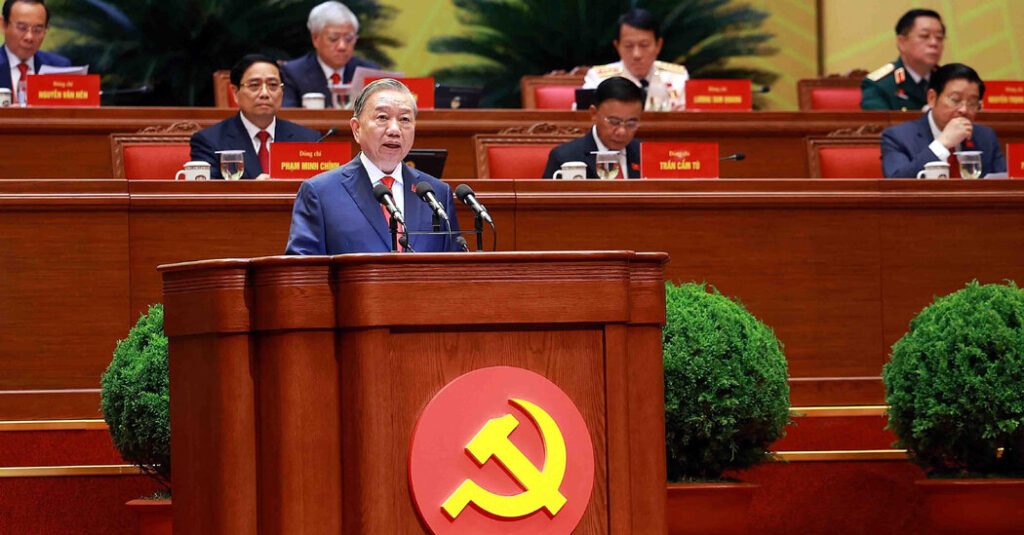
Vietnam’s Communist Party bolstered the power of the country’s top leader, To Lam, on Friday, making him both party chief and president at its party congress.
While Vietnam’s political process to formally announce the move has not yet taken place, the twice-a-decade congress ended two days ahead of schedule with a new list of Politburo members that indicates Mr. Lam’s dual role has been approved — evidence of what officials described as his forcefulness and consolidation of support.
“We pledge to stand united,” Mr. Lam said in one of his final speeches on Friday.
“Comrades,” he added, “the road ahead still holds many major tasks, requiring high determination, strict discipline and unceasing effort.”
The supercharged elevation of Mr. Lam, 68, a former minister of public security whose mild-mannered mien obscures his track record of embracing risk and reform, upsets Vietnam’s traditional sharing of authority among four leaders. Barring a sudden reversal, it moves Vietnam closer to the strongman model of China, which Hanoi has long avoided.
It also highlights the country’s growing sense of economic urgency and a willingness to bet big on change in a moment of global uncertainty. Mr. Lam’s agenda — laid out in resolutions and speeches that followed his rise to party secretary in 2024 — focuses on unleashing the private sector, digitizing government and getting bureaucracy out of the way of business.
His “streamlining of revolution,” as state media sometimes calls it, is widely seen as a framework for the most significant economic reforms since Vietnam’s first liberalization wave near the end of the Cold War in the late 1980s.
Then, and now, the country worried about falling behind. Vietnam used to fear poverty and isolation. Now it sees itself as playing catch up to Asian success stories like South Korea. For years, it has been experiencing war-delayed, breakneck industrialization, claiming an economic growth rate of 8 percent in 2025 that Mr. Lam has promised to drive to double digits.
Few countries remain as optimistic or as eager as Vietnam to squeeze upward mobility from globalization — while U.S.-China trade dynamics allow for it, and while Vietnam’s population of 102 million still has a bumper crop of young workers.
Even party members who worry that Mr. Lam may be amassing too much power for himself and his acolytes in the country’s state security apparatus or large state-favored conglomerates said they concluded that a very strong leader represented Vietnam’s best chance to reach its goal of becoming a rich, developed country by 2045.
Mr. Lam has pledged to make the most of that opportunity. In his main congress speech, at a convention center in Hanoi flush with communist symbols, where the scent of red and yellow flowers greeted delegates, he focused on “breakthroughs and action.” He called on the government to “choose correctly, deploy quickly, do thoroughly, measure by results.”
“Unlock and liberate productive forces and all resources,” he said. “Establish a new growth model; synchronously implement digital transformation, green transformation and energy transition; improve human resource quality; attract and utilize talents; develop new productive forces.”
His dual role makes him the top official overseeing these goals at home and the head of state representing Vietnam overseas. His predecessor, Nguyen Phu Trong, briefly held both roles as did Mr. Lam, temporarily, after Mr. Trong’s death.
Now, however, the Politburo named alongside Mr. Lam includes several members viewed as his strong allies. Among the “four pillars” that have now become three, there will be a new prime minister, Le Minh Hung. At 55, he is the youngest member of the Politburo, and he has a background in finance. Tran Thanh Man, 63, who became chair of the National Assembly when Mr. Lam was promoted two years ago, will stay in his position.
Several other Politburo leaders either worked for Mr. Lam at the ministry of public security or have ties to him through his home province of Hung Yen.
“The key point is that To Lam is now given a strong mandate to accelerate his reforms across multiple areas, from governance to economic policies,” said Nguyen Khac Giang, a visiting fellow at the ISEAS-Yusof Ishak Institute in Singapore. “We’re going to see a Vietnam which is more developmental than ideological in the next five years.”
And yet, he added, great power comes with a heavy burden.
“More power can help him carry out the reforms faster,” Mr. Giang said, “but can lead to greater risks of making wrong choices.”
The country faces many challenges. State-supported firms significantly drag down the economy’s productivity, according to economists. Pollution is worsening. Housing costs are rising in cities while luxury developments on the outskirts are ghost towns, leading to fears of a property bust. Banking, environmental protection and airport immigration lines still feel years behind for a country that wants to be seen as a peer to Asia’s developed economies.
Outside pressures add even more complex dilemmas.
Chinese investment in factories has surged, a boon for short-term growth that also threatens Vietnam’s domestic industrial base at a time when Hanoi is seeking to move up the value chain of manufacturing. Competition for factory workers is becoming more intense, as Vietnam’s work force becomes older and more middle-class.
At the same time, the United States has been more standoffish than Hanoi had hoped after signing a comprehensive strategic partnership in 2023. Mr. Lam had pushed for the upgrade in relations, according U.S. officials. More recently, he has expressed disappointment in what has become a mixed bag of American foreign policy.
Defense Secretary Pete Hegseth recently visited Hanoi to reaffirm security ties, but the Trump administration’s tariffs have stung. They have slowed growth in many industries (furniture, for one) while the lack of a finalized trade deal has paused some foreign investment.
Mr. Lam has been frank about many of these issues. He receives praise, especially from young, Western-educated Vietnamese, for being the first party leader to talk in public about the problems Vietnam needs to solve at home and with partners.
But if things go wrong, how will he respond?
Analysts and many citizens continue to wonder if the tactics Mr. Lam used to get to the top, which included his execution of an anti-corruption drive that ended up purging many of his rivals, would return with a vengeance.
Mr. Lam spent nearly his entire career in state security. Along with his economic reforms, he has further empowered the police, expanding their reach into business and surveillance.
Alexander Vuving, a professor at the Asia-Pacific Center for Security Studies in Honolulu, said the greatest risk for Vietnam’s top leader was, behind the scenes, a “lack of consensus and lack of legitimacy, which may cause him to embrace more authoritarianism.”
The end of the congress showed no signs of visible discord. The meeting featured higher levels of security control than in the past, with extra efforts made to keep the media from delegates. In the convention hall entrance, officials could simply be glimpsed gathering in small groups near an exhibit promoting the party’s accomplishments.
Black-and-white photos of a country still struggling just a generation ago led to color spreads of gleaming infrastructure and bar charts, tall with economic growth.
There were also quotes in bold from Mr. Lam on what he promised to deliver: “renewal and development,” along with “a new era of prosperity.”
Damien Cave leads The Times’s new bureau in Ho Chi Minh City, Vietnam, covering shifts in power across Asia and the wider world.
The post Vietnam’s Leader Consolidates Power, Pledging ‘New Era of Prosperity’ appeared first on New York Times.