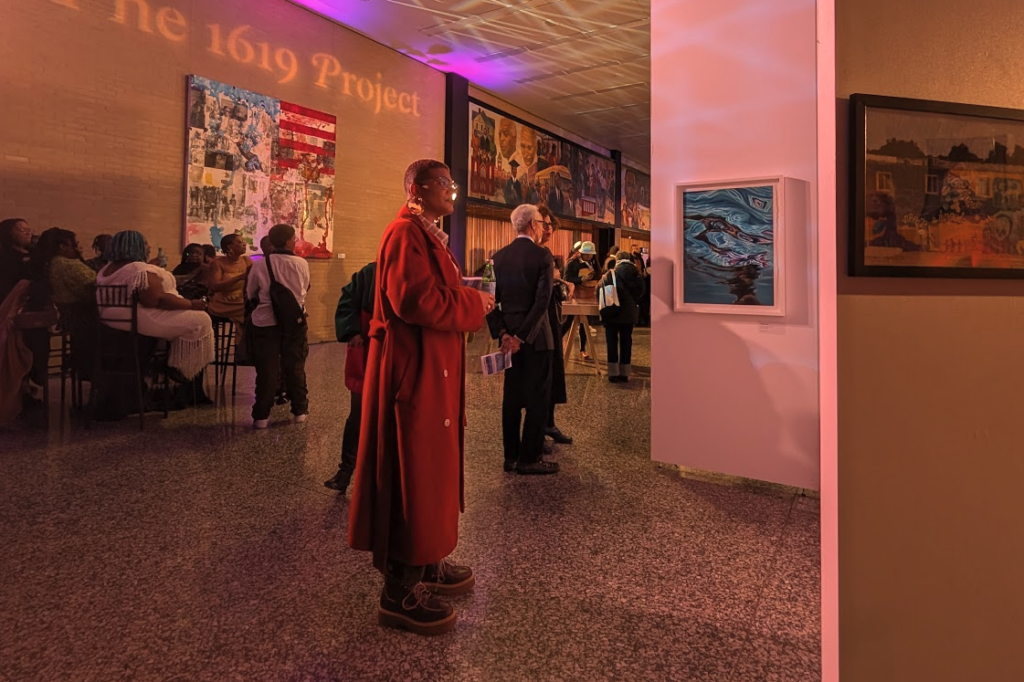
The VIP crowd shivered in a line that snaked around a downtown D.C. block, about 1,650 patrons who had tickets to a limited access opening Friday night.
They weren’t headed to an exclusive nightclub or concert, but to the Martin Luther King Jr. Library, where they would get a first glimpse of art and American history inspired the 1619 Project, the journalism and literary collection published by the New York Times in 2019.
The 1619 Project explored American history through the lens of when the first enslaved Africans arrived in Virginia in the 17th century. “Freedom & Resistance,” which will be on display at the MLK Library until March 15, presents artwork from the project and dives into slavery’s impact in D.C.
From oils on canvas to jewelry sculpting, the artwork depicts images of liberation, icons of oppression and explores themes of striving for black freedom in America.
At the opening salon Friday night, the exhibit’s artists and architects expressed that America’s past provides perspective on the current political climate.
“We gather here tonight in a nation crumbling under its myth of its own exceptionalism,” Pulitzer Prize winner Nikole Hannah-Jones, the principal creator of the 1619 Project, told the crowd that night.
“We must determine to tell the truth, even if it costs us; to engage together in freedom dreaming, and collective acts of remembering as resistance,” Hannah-Jones said.
In an interview, Hannah-Jones said the original project was designed to utilize journalistic essays, poetry, prose and art to help as many people as possible contemplate a key question about America’s founding. She said it was especially meaningful to have a conversation in the nation’s capital during President Trump’s term, and in the year that marks the 250th anniversary of the country.
“Does our origin story really begin with 1776 and these white men claiming that all men are created equal, even as they enslave one-fifth of the population, or does it begin with 1619 in the practice of slavery?” she said. “That’s been the question, and that tension between those two dates and those two ideas have gotten us the America that we have right now.”
The salon featured short “lightning talks” scattered throughout the building, including many that focused on the District’s Black history, slavery’s lasting influence in the area, as well as topics that highlighted resistance against racial oppression and how that applies to today’s America.
Fahamu Pecou, a featured artist and a panelist for the opening discussion, told the crowd that he welcomes today’s political challenges because it forces American society to “confront the reality of the schizophrenic nature of this country and its politics.” He also shared a popular quote.
“In the future, historians will tell what happened. Artists tell how it felt,” Pecou said, adding that being an artist in this moment in history is invigorating.
On Friday night, crowds glided through the library as the main lobby was lit up like a nightclub, complete with a stage that housed a go-go band performance. A portion of the Great Hall transformed into a makeshift market for small businesses like Mahogany Books and other Black-owned enterprises. Some patrons dressed to impress, others brought family or used the event to anchor a date night.
Dominique Hazzard, a doctoral candidate in history at Johns Hopkins University, guest curated “Echoes of 1619: Freedom and Resistance in Washington D.C.,” a portion of the exhibit that highlights the presence and resistance of people enslaved on plantation land on what is now in Prince George’s County and the District.
“What I hope people will take away from the exhibit is that the legacies of slavery in our nation, and particularly our nation’s capital, are real,” Hazzard said.
Exhibit designer Adrienne Gaither said she hoped the exhibit will allow patrons to become intimate with content that is “heavy” but critical to grappling with slavery’s legacy and how it resonates today, particularly with the federal government’s immigration enforcement methods.
“We’re still dealing with people being kidnapped and being disappeared. And that was happening during slavery, too,” Gaither said. “The cycles of history are repeating themselves, and I think this is the opportunity for us to really confront that that reality and that history.”
Alongside the pieces from professionals, the exhibit houses work from dozens of D.C. students, several who stood nearby to offer insights into their art.
DC International School eighth grader Ophelia Hadley nervously rocked from toe to heel in front of a panel that included her portrait, “Founding Folks, Reimagined.”
With colored pencils on oil pastel, Ophelia depicted 18th-century leaders, similar to George Washington and John Adams, complete with powdered wigs and ruffled tunics. But she replaced the famous faces with those of Black men.
Ophelia said the work was inspired by Hannah-Jones’s essay in the 1619 project, in which the writer realizes that the American flag displayed by her father didn’t simply represent White founding fathers.
“In the excerpt she realizes that really it’s more of a tribute to all the work that black Americans have actually done to build our economy, our society, the culture that we live in, and everything,” Ophelia said. “In the end of the article, she claims Black people and black ancestors as like founding fathers, so I decided to take the idea and put it into reality.”
Jordan Roebuck towered above Ophelia and carefully listened as she explained the work for a few minutes. The 23-year-old said he spent his Friday night seeking inspiration for his work fundraising for a nonprofit.
“Youth like Ophelia, that gives me hope for our future. And it also gives me motivation to fight for their future,” Roebuck said.
The D.C. transplant from Detroit said the exhibit offered surprising facts about history, such as Alexandria’s role in the enslavement trade, and inspiration from Black history as a guide.
“This is nothing new,” Roebuck said. “And it’s important that we draw back and understand where we come from to help us make decisions for how we will resist today.”
The post At MLK Library, artists consider America’s past through the lens of slavery appeared first on Washington Post.