Back in 1963, Richard Nixon needed to rehabilitate his image after he lost his race for California governor. He went on the “Tonight” show with Jack Paar and played the piano.
Bill Clinton’s appearance on “The Arsenio Hall Show,” where he delivered a rendition of “Heartbreak Hotel” on the saxophone, was considered a breakthrough moment in his successful 1992 campaign for the White House.
Those memorable segments demonstrated how the desk-and-sofa format could be a tool in the politician’s arsenal for shaping public opinion away from the pesky probing of journalists. It became a way to reach viewers who did not regularly watch TV news.
But those days may become a relic of broadcast history as Federal Communications Commission Chair Brendan Carr is calling for stronger enforcement of a broadcast regulation rule requiring TV and radio broadcasters to offer equal time to all legally qualified opposing political candidates.
With the new guidance — which legal and media experts said would be hard to enforce and could stifle free speech — the FCC questioned whether late-night and daytime talk shows deserve an exemption from the equal-time rules for broadcast stations using the public airwaves.
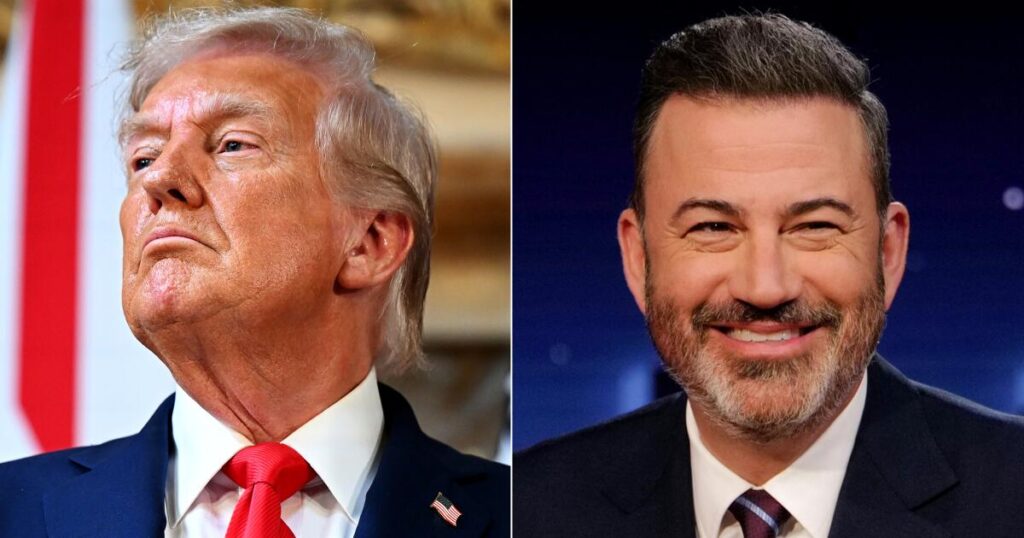
It’s the Trump White House’s latest salvo against the network late night talk show hosts, primarily Stephen Colbert, Seth Meyers and Jimmy Kimmel, who pound away at President Trump nightly in their monologues and offer ample airtime to his political opponents. The rule also would affect daytime shows such as ABC’s “The View,” which is under the purview of the Disney-owned network’s news division.
The equal-time rule has been around for decades but rarely has been enforced in recent years. It did come into play during the 2024 presidential campaign when NBC’s “Saturday Night Live” booked Democratic candidate Kamala Harris to appear in a sketch.
NBC filed an equal-time notice with the FCC stating that Harris had appeared on the network for one minute and 30 seconds. Campaign officials for Trump contacted the network and asked for time and they were given two free 60-second messages that appeared near the end of its telecast of a NASCAR playoff race and during post-game coverage of a “Sunday Night Football” telecast.
Experts consider the rule to be antiquated, designed for a time when consumers were limited to a handful of TV channels and a dozen radio stations if they lived in a big city. The emergence of cable, podcasts and streaming audio and video platforms — none of which are subjected to FCC restrictions in terms of content — have greatly diminished traditional broadcast media’s dominance in the marketplace.
“I think it’s very hard to look at trying to regulate over-the-air broadcasters in the same way today as the FCC would have done, you know, 50 years ago,” said Jeffrey McCall, a communications professor at DePauw University. “The rule was put in place in an era of scarcity which we really don’t have anymore.”
Michael Harrison, a media consultant and publisher of the radio trade journal Talkers, said the equal-time rule will unfairly burden radio and TV broadcasters that are struggling to compete against tech companies that largely have unfettered access to consumers and are not subject to FCC rules.
“Carr’s plan would even further handicap federally licensed television and radio platforms that are already facing an existential crisis as they are being eaten alive by unregulated digital media in an increasingly noisy marketplace,” Harrison said. “Carr’s plan is just rhetoric to give the impression that the FCC still has relevance in programming regulation.”
McCall expressed doubts as to whether the equal-time law would stand up if it were challenged in the courts.
“The Supreme Court, under Chief Justice Roberts, has been pretty supportive in providing robust 1st Amendment protections,” McCall said. “I think they would say free speech is free speech. The media landscape has changed so much over the years and we don’t want the government trying to make decisions as to what counts as political speech and what doesn’t and what counts as fairness and what doesn’t.”
No network executive contacted was willing to comment on the record, but privately they say it’s an attempt by Carr to use the government’s regulation of the free public airwaves to keep the president’s critics in line. Trump has frequently called for TV licenses to be pulled when he’s unhappy with a network reporter’s question or a late-night monologue.
They also believe that Carr wants to create a wedge between the broadcast networks and their affiliate stations, which are responsible for providing equal time if a candidate makes a request. Carr has said he wants to examine the network-affiliate relationship and how much influence is exerted by Hollywood and New York on local broadcasters.
Enforcing the rule also would be a major headache for TV stations as all legally qualified candidates on minor party tickets could ask for airtime. Under the rule, if a candidate appears on a TV or radio program, their opponents have seven days to request equal time.
“It can be a headache for sure,” said one TV station executive not authorized to discuss the matter publicly.
At Trump’s behest, Carr has been aggressive in suggesting the use of FCC rules to punish late-night hosts in Trump’s crosshairs. He threatened the TV station licenses of ABC in September after Kimmel made remarks on his program about slain right-wing activist Charlie Kirk that upset conservatives. Two major TV station groups pulled the program and the network suspended Kimmel‘s program for a week.
Trump on Wednesday posted a link to a news story that said the FCC was focused on ABC daytime talk show “The View” and ABC late-night talk show “Jimmy Kimmel Live.”
Carr’s call for greater enforcement of the equal-time rule also could have an effect on conservative-leaning broadcasters. Although right-leaning hosts are largely nonexistent on broadcast network TV, they are the dominant draws on talk radio. Those hosts would also have to abide by the rule as well when they give unfettered platforms to Republican candidates.
“If the FCC pushes this on the television and not radio, they’re going to be opening themselves to all kinds of claims of trying to protect certain messages, but not others,” McCall noted.
Conservative Fox News host Sean Hannity, who does a daily radio program carried on more than 500 stations across the U.S., told The Times in a statement that he is opposed to further government regulation of broadcast content.
“Talk radio is successful because people are smart and understand we are the antidote to corrupt and abusively biased left wing legacy media,” Hannity said in a statement. “We need less government regulation and more freedom. Let the American people decide where to get their information from without any government interference.”
Interestingly, it’s the rise of Trump and his unorthodox approach to campaigning and governing that has made political commentary and humor such a dominant part of late-night TV. His emergence as a presidential candidate after being a major prime-time TV star through NBC’s reality hit “The Apprentice” pushed politics into the center of the national pop culture conversation. Sen. Bernie Sanders (I-Vermont) has been a guest on “The Late Show with Stephen Colbert” 19 times.
In a fragmented media landscape, politicians have become some of the most broadly recognizable figures on TV and have since become fixtures as late-night guests. For years, the executive producer of Stephen Colbert’s “The Late Show,” was Chris Licht, whose background was in news. He left the job to briefly run CNN.
Trump himself was a beneficiary of the late-night platform. He hosted “Saturday Night Live” twice — even in 2015 when he was already running for the Republican presidential nomination.
The post FCC chair’s call for ‘equal time’ could have chilling effect on TV and radio appeared first on Los Angeles Times.