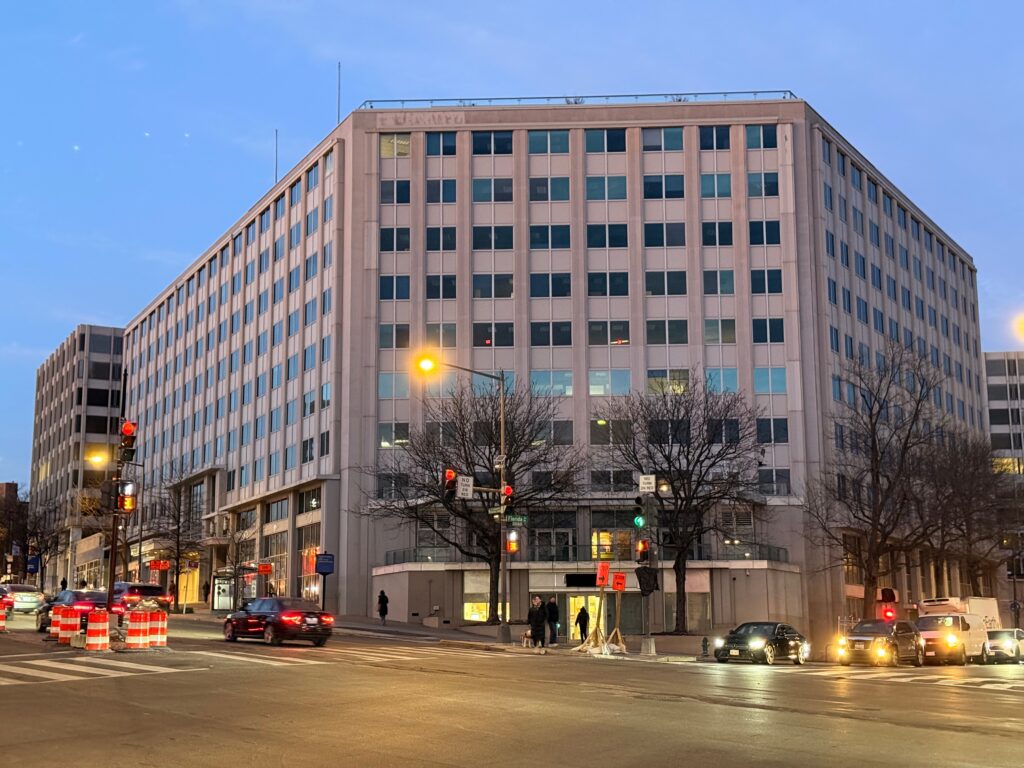
A pair of large office buildings in Washington D.C.’s Dupont Circle neighborhood have begun to transform into 532 apartments, marking the largest ever office-to-residential conversion in a city whose financial future hinges on reviving a downtown decimated by the rise of remote work.
Developers of the project, called The Geneva, will receive two decades of tax breaks from the D.C. government in exchange for a promise to transform the former Universal Plaza office buildings into a 15-story residential property, including 60 affordable units, with commercial space as well.
D.C. officials are hoping that tax breaks for developers will bolster the movement to transform vacant office buildings into housing, hotels and commercial space — and so far, they’re happy with the results, even as new construction in the city has slowed due to high interest rates and other challenging economic conditions.
Office conversions have produced 1,900 residential units and 264 hotel rooms across 11 projects since 2024, according to estimates from the Washington DC Economic Partnership, a public-private organization focused on local development. Another 10 conversion projects are under construction, and 24 possible projects are in the planning phase — which could add an additional 6,000 units of housing and nearly 600 hotel rooms over the next several years if all are built.
“The program is working, it’s gaining momentum, and we’re really excited about it,” Nina Albert, D.C.’s deputy mayor for economic development and planning, said at an event Thursday announcing the launch of construction at The Geneva.
Commercial office space makes up about 90 percent of real estate in D.C.’s downtown neighborhoods, Albert said — a setup that has posed immense economic challenges for the city since the pandemic upended work habits and shifted commuters away from the city’s core. D.C. officials say that the city’s most economically resilient neighborhoods have closer to 50 or 60 percent office space, and that the city’s economic future depends on its ability to convert vast expanses of empty office buildings to different uses.
More changes may be on the way for downtown as the Trump administration plans to downsize its footprint in the city. D.C. officials see that as another potential opportunity to bring residents and businesses to swaths of the city that currently house massive federal buildings and little else.
The office conversions are not without challenges. Residential buildings require different plumbing and electrical systems. They also need natural light and high enough ceilings, which can require some creativity.
“When we started this discussion, you know what everybody said?” D.C. Mayor Muriel E. Bowser (D) remarked Thursday. “‘It’s so hard. Conversions are so hard, it not enough air, it’s not enough light, it just so hard — we can’t do it.’ And then we started hearing from developers that said, ‘We can do it, we’ve done it, and we’re going to do it in D.C.’”
The Geneva project sits on Connecticut Avenue in Dupont Circle, a residential hub just north of city’s downtown center. The conversion, helmed by a Philadelphia-based firm called the Post Brothers, will cost $750 million. The developers will benefit from loans for energy-efficiency upgrades, administered through a program called C-PACE that allows the money to be paid back over a longer period. The $463 million in C-PACE financing set a record and required a change in city regulations to accomplish. The building will be LEED-certified.
The D.C. government is supporting the project through an estimated $95 million in tax breaks over the next two decades, according to a spokesperson for Albert’s office, though the award may drop as the developers secure additional financing.
It was challenging to secure private financing. The Post Brothers acquired the buildings in April 2022 — just as interest rates began to shoot up, which threw a wrench in many construction projects — and did not secure enough funding to start construction until late last year, when they finalized the clean energy financing and an additional $110 million loan from Mavik Capital Management.
“We bought this project and interest rates went from zero to 5 percent in about six months,” said Matthew Pestronk, co-founder and president of Post Brothers. “It was a curve ball, but here we are, they’re going down again, and everybody forgot the middle,” he joked.
At Thursday’s event, he and his brother — the company’s other co-founder — boasted of a grand vision for the project.
“Probably the best way to summarize what this building is going to be is, it’s going to the greatest apartment building in the history of the world,” CEO Michael Pestronk said. “We’re going to create a grande dame building that just kind of reeks of sophistication, for lack of a better way to say it.”
Albert’s thesis is that when residents come, other businesses follow. She said she is already seeing other housing conversions attract additional business downtown. “Grocery stores are interested in coming downtown now because they’re seeing that uplift and that demand from new residences,” she said. “So while 2025 was a tough year in many different ways, we also saw so much positive change.”
But Albert added in an interview Thursday that these conversions are no cure-all for the city’s economy, which is facing a predicted $1 billion downturn due in large part to the Trump administration’s mass layoffs of federal workers. As the Bowser administration winds down (the mayor announced last year that she would not seek a fourth term), the city’s top officials are focused on seeing through what they call the Bowser “growth agenda” — a plan to revitalize downtown and attract new employers to replace the 40,000 jobs projected to vanish under President Donald Trump.
“Residential conversions is a component of that, an important component, but so is business attraction and diversifying our economy,” Albert said. “We know that D.C.’s a great place to live, it’s a great to work, and so we want to make sure that both federal workers as well as the rest of our workforce seeks new opportunity — that we are replacing those lost jobs with new jobs.”
Thursday’s event was not a groundbreaking, per se, because there were no shovels. Instead, as a symbolic gesture of the new beginning, the Bowser officials and executives took sledgehammers to a cardboard rendering of the old Universal Plaza office buildings — revealing the renderings of their “grande dame” behind it, with massive windows and a green roof.
The post D.C.’s largest office-to-residential conversion is officially underway appeared first on Washington Post.