Subscribe here: Apple Podcasts | Spotify | YouTube | Overcast | Pocket Casts
Joan Brugge has worked for nearly 50 years as a cancer scientist, studying the earliest signs that someone might become sick. Then the Trump administration canceled her lab’s funding. The administration’s attacks on medicine, culture, and education—which include verbal threats and funding cuts—are about more than just budgeting and bravado. Ruth Ben-Ghiat is a professor of history and Italian studies at New York University and the author of Strongmen: Mussolini to the Present. She argues that this effort is part of a larger autocratic project to maintain power.
The following is a transcript of the episode:
Joan Brugge: I was actually at a breast-cancer retreat. And during the coffee break, I looked at my emails to see, you know, if there’s anything that I had to deal with. And I got this email from the university, and it was a real gut punch. My knees basically buckled, and I had to sit down.
[Music]
Brugge: I never imagined that it would be possible that funding for lifesaving research would be terminated for issues that were totally unrelated to the quality of the work or the progress that we had made in the work.
Anne Applebaum: From The Atlantic, this is Autocracy in America. I’m Anne Applebaum. In this new season, I am asking how the Trump White House is rewriting the rules of U.S. politics, and talking to Americans whose lives have been changed as a result.
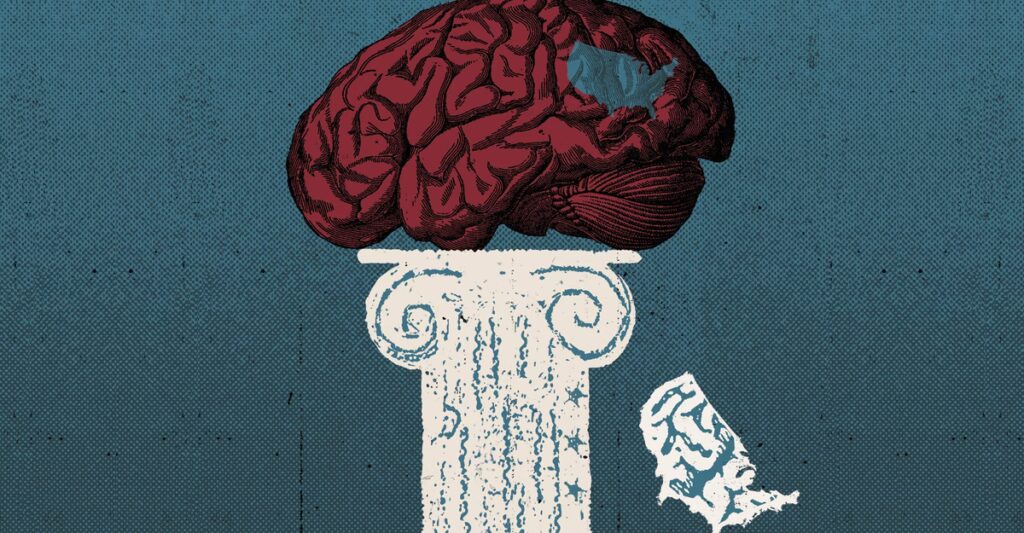
Today’s episode examines the administration’s attacks on science, medicine, culture, and education—a combination of verbal threats and funding cuts that look very much like an attempt to control knowledge. Maybe there’s a broader goal, too: to build distrust, and, ultimately, to reshape all Americans’ perceptions of reality. I know that sounds dramatic, but I spent many years writing about authoritarian regimes, and almost all of them try to undermine admired institutions, in order to radically alter the way people think.
Let’s start with the attacks on science. Joan Brugge was stunned when her research became a target:
Brugge: I’ve been doing cancer research for almost 50 years now, not just at Harvard. When I was at undergrad, my sister was diagnosed with a highly aggressive brain tumor. I’ve been moving forward from that ever since. It’s definitely been a compass that’s been directing my life’s work.
The research projects in our lab involve studies of finding better ways to detect and destroy cells that are the earliest precursors of breast cancer, and to design treatments that can eliminate them so that we could try to prevent them from progressing to cancer. It’s like we’re detectives, like, you go in and there was a bank robbery, and you gotta figure out who did it. We’re trying to figure out what genes are responsible for causing this cancer, and how do they do it?
It was May of 2025 when I found out that both of my research grants were terminated. A few days after we first got the notices, it was like walking through a morgue, because all the faculty and staff from the labs were, just, almost paralyzed by the consequences of this.
It’s shocking and demoralizing to have to deal with this.
One of the impacts of the terminations was that instead of guiding my lab towards the studies to prevent or treat cancer, I’ve been extremely distracted by efforts to try to raise money to support the lab. Since last May, seven people have left the lab, but I only have sufficient funding to be able to replace two of them.
It’s funny; I think it gets emotional here, just ’cause this is what we’re living with and it’s just so difficult. It doesn’t feel right that Americans are going to be deprived of the outcome from this research.
[Music]
Ruth Ben-Ghiat: We have a very focused and intense effort across the board to set America back a generation, at least, for education, health, research, climate policy.
Applebaum: Ruth Ben-Ghiat is a professor of history and Italian studies at New York University and the author of Strongmen: Mussolini to the Present.
Ben-Ghiat: The thing many people don’t understand is that autocrats think about governments in a totally different way. Public welfare and accountability are not of interest to autocrats. It’s about amassing power, staying in power as long as you can, and enriching yourself.
Applebaum: Ruth, of all the changes made by this administration, it seems to me that the attack on science is the strangest. I can’t even think of other places where this has happened in recent memory.
Ben-Ghiat: I’ve been trying, since the start of this administration in January 2025, to figure out where it is following the classic autocratic playbook and what, instead, is new or novel. There are two things that stand out as new to me. One is the speed of change, really the speed at which institutions have been destroyed.
Applebaum: And the second?
Ben-Ghiat: Research has been destroyed. Whole areas of knowledge and policy have been set back. It doesn’t correspond to any other example I know where the leader came to power via elections.
It doesn’t correspond to the first 10 months of Putin, Orbán, Erdoğan—none of them.
Applebaum: To a lot of Americans, it feels like these attacks are coming out of the blue. How do you explain them? How do you explain their origin? Why are these things the focus of Trump or his acolytes’ interest?
Ben-Ghiat: Well, they only come out of the blue if you ignored what was going on during Trump 1.0. Many of these fanatic causes and the people involved in them, such as Stephen Miller and others, were active then. And it was simply that they were only able to push these things so far, and now they feel free and empowered to push this through. The speed at which these parallel wars on American institutions and science and knowledge are happening resemble not the aftermath of an election, but when people come to power via coup. And, in fact, in some areas, like the universities or science, the Trump administration has acted more swiftly than people did, for example, Pinochet’s regime after a coup. They didn’t start a lot of their large-scale changes to the economy and education for a year or two. So here we have something that’s been planned for a long time.
And then the other thing I would mention is that they used their power when they were out of office beautifully. And by partnering with the Heritage Foundation—Project 2025—when he won the election, they were able to hit the ground running.
Applebaum: And is the purpose of this attack to diminish academic institutions themselves, or is it to do with the people who work for them?
Ben-Ghiat: It’s both. If we take the example of education institutions, of course you wanna go after individuals. And so every autocrat ends up purging any kind of critic. Certain fields of knowledge must go, and others are actually replaced. So you have a reform of institutions at the curricular level, such as Italy and Germany under the fascist period, made huge investments in demographics, in eugenics, racial engineering, and other subjects—and people who taught them had to go. But also, at a structural level, you want to change the tenor of the institution. You want to make educational institutions into places where you don’t have free thinking, critical thinking, and curiosity, as you would in democracies. Instead, the education institution itself becomes a place that breeds the values of authoritarianism: suspicion, hostility. And so every regime invests in having student informers.
And when I start my classes now at New York University, the first day, if they’re about authoritarianism or fascism, I look out at the students and I say, If this were an authoritarian state, one of you or two of you would be informing on each other. And another would be assigned to inform on me, as the instructor.
So it’s curriculum; it’s personnel. But the very conception of the institution must change, and it must become realigned and recast to fit in with the larger goals of that state.
Applebaum: And in this case, what do you mean by “larger goals”?
Ben-Ghiat: Well, this is what I call, and others call, personalist rule, under the Trump administration. Under personalist rule, you have, obviously, a very strong leader, and everyone has to pay tribute to him. Some people call this patrimonialism. I use personalism. And so educational institutions have to be compliant to him.
Applebaum: Ruth, several academics have told me that they believe cuts in funding for university-scientific research are really not about science but about the humanities. They fear that the administration thinks it can use federal funding to influence the kinds of courses universities teach, the students they enroll, the people they hire, ultimately the thoughts that they generate. But still, this doesn’t quite explain why an American president would want to destroy the most powerful engine of innovation in our economy, and maybe the world, which is our universities and their research departments. Why would they want to stifle lifesaving cancer research? Also, why would any government want its people not to be vaccinated? I’m not sure there are any other examples in the modern world, or even in recent history.
Ben-Ghiat: I agree. I can’t find any examples either, although we have examples of people such as [Jair] Bolsonaro, when he was president [of Brazil], trying to dissuade people during COVID that—he said, it was just “a little flu.” So this is a way to attack science, most obviously; a way to spread conspiracy theories.
We’ve seen attempts to smear and discredit scientists, librarians, teachers, judges, journalists. Anybody who works with empirical-research protocols, fact-based methods, scientific methods, investigations—all of them must go. And a very terrifying void opens up that is filled by fear, by conspiracy theories, or by nothing, where people don’t have any recourse against disease—creating conditions so that with the CDC and NIH and all the other infrastructure of science, if there is an outbreak of mass disease, we’ll be completely undefended. So it’s really, almost, a totalitarian—I don’t use that word lightly—effort to change the mindset of people away from science and fact-based research, across the board.
Applebaum: Of course, totalitarian leaders in the past did try to use schools and universities and research institutions to create an alternative reality. Stalin wanted to build a world in which everything he said was automatically accepted as true and nobody ever questioned him. Hitler manipulated science to prove his theories about race. But still, both of them were interested in engineering, in nuclear technology, in energy technology. They weren’t cutting research funding across the board.
Ruth, as we heard from Joan Brugge at the top of this episode, huge cuts in federal support have already been impacting research labs across the United States, including labs that don’t have anything to do with politics. Can you think of an example, prior to this administration, of a very advanced society with very advanced scientific institutes, simply threatening to cut off funding?
Ben-Ghiat: The only example I can think of is China, during Mao.
Applebaum: I was just gonna ask about that.
Ben-Ghiat: During Mao’s long-tenured Cultural Revolution, et cetera, science was put back by generations. Scientists were among the intellectuals and researchers who were killed and imprisoned and purged.
And so you had some of this winnowing-out because of loyalty. You had ideological obedience to the party and to the revolution over fact-based knowledge, and fact-based research became the enemy. Universities were destroyed. Experts were sent to the countryside for reeducation.
So really, people who have studied this talk about an entire lost generation of scientists, and engineers as well. And instead, you had institutions, including scientific ones populated with guards and people who were inexperienced, fanatics, reckless. And so even people who were heroes of the nation, they were beaten, tortured, taken for reeducation. It didn’t matter who they were and what kind of contribution they could make. The entire enterprise of science had to be wrecked. That’s the only example I can think of where you have an intention, an intensity. And, of course, the scope was bigger, but this is just beginning in the United States, and it’s really, really frightening.
Applebaum: Why do you think Harvard has been such a focus? What is it about that institution that has attracted the attention not really just of Trump but of the Project 2025 crowd.
Ben-Ghiat: Well here we get into the logic of authoritarian bullying. The more powerful an entity is, the more they must be made an example of. And the higher, more prestigious your target, the more bringing them down, or trying to, sends a message to everybody else.
And so that’s how authoritarian shifts in culture—and I’m talking about culture as turns of behavior, values—that’s how they can be jump-started, because then universities with far smaller endowments and power and clout would say, Oh, if Harvard’s capitulating, well, what can we do?
Applebaum: Yeah, when I saw the attack on Harvard, I also thought: They’re doing this to show that they can do anything. If they can destroy Harvard, they can destroy anyone.
Ben-Ghiat: That’s right.
Applebaum: There are quite a lot of people out there who like some of what Trump is doing, and maybe they’re worried by some pieces of it, but they wouldn’t see this as some kind of deliberate destruction. What would you say to them, to convince them of your point of view?
Ben-Ghiat: I think that it’s a question of time. When you take away pandemic planning, when you take away scientific research, when you take away accessibility for vaccines, the results aren’t seen immediately.
It takes time for these things to develop. And so, unfortunately, I believe we’re going to have a reckoning, that eyes will open as things fall apart in America. And then people who did not want to believe who Trump was will see the light.
[Music]
Applebaum: The erosion of these institutions, the attempt to undermine our faith in the scientific method—these things could be part of a larger autocratic effort to maintain power.
Ben-Ghiat: Why is he militarizing everyday life? He wants to build fear in people about going to vote. There’s both a work of discrediting elections and a work of intimidation that’s going to intensify as the midterms grow closer.
Applebaum: That’s after the break.
[Break]
Applebaum: Let’s talk a little bit about cultural institutions. Why would an American president be interested in dictating the content of exhibitions at the Smithsonian, a beloved American institution. It belongs to all of us. Its governing board has all kinds of worthy people on it: the chief justice of the Supreme Court; it’s usually had the vice president; many other important figures in public life—bipartisan, I should say. What is it about the Smithsonian that’s attracting his interest or, again, the interest of the people around him?
Ben-Ghiat: Autocrats engage in a mix of utopia and nostalgia, so the Smithsonian is a perfect target if you truly are aiming big. And authoritarians like Trump, they think big; they think long-term. They’re very obsessed with their legacy.
You purge the content of histories that you no longer want, or people you no longer want featured—and instead, you promote your own sanitized, mythological version of history. It’s not enough to just fire people you are smearing who are “radical left,” even though they’re not. You have to go after the whole thing.
Applebaum: For people listening for whom this is a new idea: Why would a leader be trying to reshape or rewrite history? How does it serve the president to erase Black history, or to eliminate stories of the immigrants who have come from all over the world? What does that do for him?
Ben-Ghiat: So every leader, especially authoritarians, want to situate themselves within the flow of the nation. And they need to show that they are on the right side of history. History itself has to be rewritten. And in this case, we have white-Christian-nationalist history, which in a totalitarian framework does not permit the coexistence with other histories. You can’t read the history of institutionalized racism or slavery. And so the entire history, and this translates down to what’s been banned first in Florida and Oklahoma and other states. All of this has to go. And cultural and political icons—people who might be enshrined in the Smithsonian—have to go. At stake is rewriting the entire history of America as a multiracial, multifaith democracy.
Applebaum: The administration has also halted some federal-government cultural spending—for example, on small museums or monuments, and indeed scholars—and redirected it instead to the upcoming 250th-anniversary celebrations of the signing of the Declaration of Independence. Why do you think the Trump administration cares about that anniversary, and what distinguishes that from teaching civics or the history of the American Revolution?
Ben-Ghiat: Well, Trump in particular is a man of spectacle. He knows how to stage a spectacle, and ideally, of course, he is at the center of this.
This is a classic appropriation of what would be a very important national milestone. It will become an excuse to intensify a kind of rewriting of American history, but also remapping of the way that Washington, D.C., looks as the power center. And he’s already done this with the White House. That’s leaving his mark. So it’s never just a superficial transformation when you have authoritarians. They can change countries so that even in the space of just a decade, it can take generations for that country to recover.
Applebaum: Ruth, we know how this worked in the past. Dictators have built monumental palaces, or reconstructed their capital cities, as a way of proving they can defeat death, make their power last forever. Famously, Stalin built skyscrapers in Moscow, as well as in Riga and Warsaw, after he occupied those cities, too.
Ben-Ghiat: Yeah, I agree. What autocrats really want is to feel safe, because they of all people know how hated they are. They know who their enemies are, and the depth of hatred that they foster with their violence and their corruption. And so they build these safe spaces for themselves, both at the level of governance where they have these, they’re called inner sanctums, with sycophants and family members.
And they also put their mark on the capital. I think, in America, because we haven’t had a national dictatorship, it’s hard to envision that autocrats truly don’t care about public welfare. They have totally different priorities.
Applebaum: How does that make sense even from the point of view of the authoritarian? I mean, if they continue to strive to damage America, how long can their destruction continue before it reflects the failure of the leader himself?
Ben-Ghiat: That’s a risk they take. But one thing about authoritarians is—although, as I’ve just described, they’re very fearful—they also come to believe in their own omnipotence. In part, because, all day long, if they’ve done their job and gotten enough sycophants around them—we’ve seen this daily in America—all day long,they’re having praise from people. Without you, we wouldn’t be anything, Mr. President. And after a while of this, and we’ve seen this, they start to believe their own propaganda. And then they take risks, and they exceed; they overreach. And that often is their downfall.
Applebaum: Ruth, finally, how does this change the conversation about the midterms in 2026? Is the rewriting of history or attacks on universities—are these part of an attempt to persuade Americans to think differently about elections? Do you connect these attacks on science, on medicine, on culture to the midterms?
Ben-Ghiat: There’s been a concerted and very relentless attempt to change the way that Americans feel about authorities, to change the way that they feel about American institutions. And elections are the most important of those institutions because it is the way that we express our voice and have our agency in the world.
And so, already, as we well know, with his election denial in 2020, he had managed—he actually pulled off a historic feat—he managed to convince tens of millions of people of a very easily verifiable fact that he lost the election. Instead, he convinced tens of millions that he was the rightful winner. And he kept up the distrust in elections all these years. The churches allied with him; the manosphere; all of his enablers and allies. They’ve done a beautiful job from the autocratic point of view of discrediting not only elections but the whole way you think about democracy. So that’s part of it.
The other is: Why is he militarizing everyday life? He wants to build fear in people about going to vote. There’s both a work of discrediting elections and a work of intimidation that’s going to intensify as the midterms grow closer.
Applebaum: So part of the point of attacking institutions that collect and promote knowledge, whether scientific or cultural, is just to reduce Americans’ trust in everything. If we don’t know what’s true and what’s not true, then when Trump argues that the results of the 2020 election are fake, we believe him. There isn’t any evidence, but we don’t care about evidence. And they might also persuade Americans not to accept the results of elections this year either, if they aren’t favorable to the Republicans.
Ben-Ghiat: Yes.And it’s so nice to speak with you because you’ve studied these things too. That’s a big point. It’s destroying trust, which is really trust in each other, too, because what is an election? It’s everybody casting their vote, their preference, and then based on that collective will, you can change a leadership.
And so by convincing people that, Oh, it’s just all gonna be rigged, you’re really giving up on each other. And when you don’t vote, you’re also kind of giving up on your own voice.
[Music]
Ben-Ghiat: Ultimately, destroying trust is the currency of autocrats, and it’s one of the saddest things. And we know, when autocracies finally fall, rebuilding that trust is one of the most difficult things to do.
Applebaum: Thank you very much, Ruth Ben-Ghiat.
Ben-Ghiat: Thank you, Anne.
Applebaum: Autocracy in America is produced by Arlene Arevalo, Natalie Brennan, and Jocelyn Frank. Editing by Dave Shaw. Rob Smierciak engineered and provided original music. Fact-checking by Ena Alvarado and Sam Fentress. Claudine Ebeid is the executive producer of Atlantic audio, and Andrea Valdez is our managing editor. I’m Anne Applebaum.
Next time on Autocracy in America:
Kathleen Walters: The decision to leave the IRS was the hardest thing I’ve ever done. We all have boundaries in life. I also am the mom to a 9-year-old, who I’m responsible for caring for and paying for.
Applebaum: The dismantling of the civil service. That’s next time.
The post Defund Science, Distort Culture, Mock Education appeared first on The Atlantic.