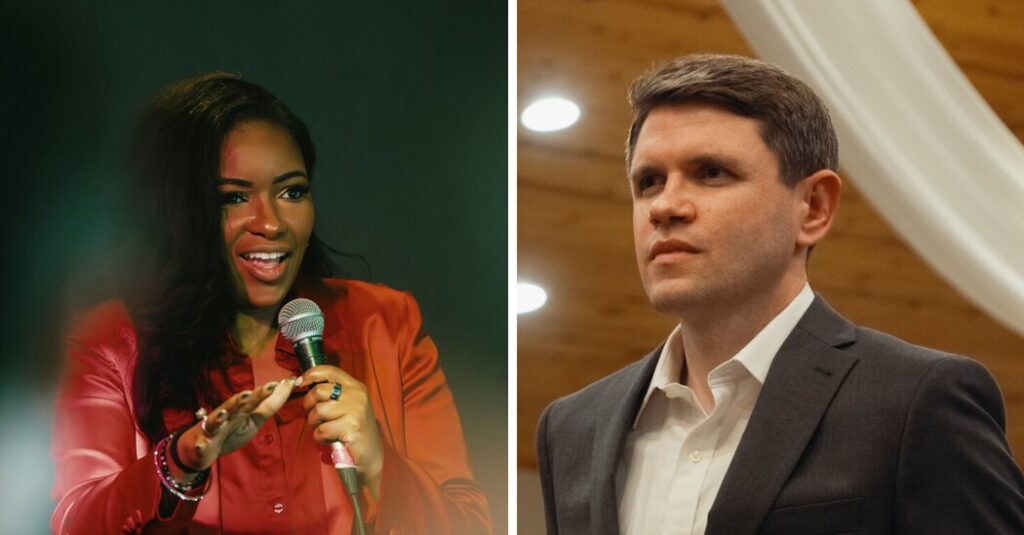
In a county that President Trump won by 45 percentage points, hundreds packed an event hall this month to hear James Talarico, a Democratic state representative and soft-spoken Christian seminarian who is running to replace Texas’ senior Republican senator, John Cornyn.
Scores more, who did not fit inside, watched through the windows.
A few days later, in deep blue San Antonio, Jasmine Crockett, a fiery Democratic congresswoman from Dallas who stormed into the Senate primary last month, filled more than 2,000 seats at a Black church.
Early voting for the March 3 primary begins Feb. 17, meaning the next four weeks will be an all-out sprint between these two young, social media savvy Democrats. The contest has drawn national attention and raised the party’s hopes that 2026 could be — finally, maybe, after 30 long years — their best chance for victory in Texas.
“Two young stars in the Democratic Party emerging from a place that is existential to the future of the country and the Democratic Party,” said Rick Fromberg, a Democratic political consultant with clients in Texas, “it’s what people have been looking for.”
It has also raised concerns, in Texas and across the country. The two campaigns have sharply different ideas about what it will take to flip a Senate seat in Texas, making their primary a kind of high octane referendum on what direction the party should take, not only in a deeply red state but in swing states the party lost in 2024, like Michigan, Georgia and North Carolina, all of which have crucial Senate campaigns.
Ms. Crockett, 44, a former public defender and skilled partisan brawler, has promised to bring more Democrats to the polls in November, particularly Black and Hispanic voters who have soured on her party in recent years. At a recent lunchtime event in San Antonio, she urged a mostly Black audience to help flip political control of Texas, where most leaders are white though a majority of the residents are not.
“It is time for minority rule to stop in Texas,” she told the gathering of a few dozen people.
Mr. Talarico, 36, a former schoolteacher, believes he needs to not only energize the party’s base but also widen its appeal to voters who are turned off by the angry state of politics. He has argued for a return to political decency and made his brand of progressive Christianity central to his message.
“We can’t just yell, we can’t just scream,” he told the packed room in New Braunfels, Texas, outside of San Antonio. But, he added, “we have to win,” and that means “going everywhere and talking to everyone, not just Democrats, but independents, some disillusioned Republicans and new voters.”
Both approaches have their champions. Both have created worries.
Demika Devers, 52, an elementary schoolteacher who brought her mother to Ms. Crockett’s event, said she liked how the congresswoman was “fiery” and a “go-getter,” but she pointed to the number of Trump supporters in her San Antonio neighborhood and fretted over Ms. Crockett’s chances against a Republican.
“I am concerned,” she said.
During Mr. Talarico’s town hall, a questioner asked whether his talk of “love” was too “weak” for the current bare-knuckled political environment.
“My faith teaches me that love is the most powerful force in the universe,” Mr. Talarico answered.
Their first debate will be on Saturday.
For Democrats, retaking the Senate will be daunting. They must hold Democratic seats in the difficult states of Georgia and Michigan, win Republican seats in the blue state of Maine and the purple state of North Carolina, and win seats in at least two deep red states. Their targets: Iowa, Alaska, Ohio … and Texas.
Texas has drawn outsized attention in part because of Ms. Crockett — a social media star among Democrats and a lightening rod for Republicans — whose run has put a spotlight on Democrats’ internal disagreements over electability.
In truth, Texas Democratic voters are choosing between two candidates whose biggest differences are stylistic — not substantive. Both hold progressive positions on issues like immigration and abortion, and have developed networks of small donors. Mr. Talarico’s campaign has raised more than $13 million so far.
For both, prevailing in the general election may have at least as much to do with the Republican primary as the Democratic one. Senator Cornyn has already spent tens of millions of dollars trying to fend off a strong challenge from the state’s attorney general, Ken Paxton. With a third candidate now in the race, Representative Wesley Hunt, the Republican primary is likely to result in a runoff, extending the contest until late May.
Democrats believe they have their best shot if Mr. Paxton prevails, with his hard right positions and the ethical baggage of an impeachment and an acrimonious divorce. Regardless, they hope the Republican winner will emerge hobbled.
But the Democratic primary has highlighted the fragile and sometimes uneasy state of the state party’s coalition, which relies on turning out Black voters and progressive white voters while also winning with Hispanic voters, some of whom have been turned off by left-wing messages.
Public polls of likely primary voters have found Mr. Talarico, who is white and represents parts of Austin, leading among white and Hispanic voters, while Mr. Crockett, who represents a deep blue Dallas district, held an overwhelming advantage with Black voters.
The tension erupted this month because of comments by a pair of comedians.
“Don’t waste your money sending to Jasmine Crockett,” one of the comedians, Matt Rogers said during his podcast with Bowen Yang, formerly of Saturday Night Live. “Do not do it.”
“I have to agree,” Mr. Yang said.
Amid the backlash, both men walked backed their comments, but for some, the damage may have been done.
“I was supporting Talarico,” Juli McShay, a professor and political podcaster in Houston, said in an interview. “But what has pushed me away from James is not James,” she said; it was some of his supporters, whose “voices are saying that I as a Black woman am not welcome.”
Ms. Crockett has faced scrutiny over comments she made in a December 2024 interview with Vanity Fair in which she described Hispanic voters who supported President Trump as having a “slave mentality.” She has been asked about the comments in news conferences, and at least one Hispanic voter at the Talarico event in New Braunfels said the comment was reason enough for him not to support her.
“There was never an intent to actually offend somebody,” she told reporters before the church event. “I have always stood with all people.”
For both campaigns, Texas’s large Hispanic vote will be critical.
Last month, Mr. Talarico rallied in South Texas with Bobby Pulido, a star of Tejano music from the Rio Grande Valley who is running for the House as a moderate Democrat in a largely Hispanic district now held by a Republican. The two candidates endorsed each other — likely a bigger boost for Mr. Talarico.
Ms. Crockett spent her first major campaign swing this month visiting the Rio Grande Valley and Corpus Christi, both areas with large Hispanic populations.
But in San Antonio, it was mainly Black voters who filled the pews at New Creation Christian Fellowship.
“She’s not being so quiet, like other Democrats are,” said Terrance Brown, 62, an army veteran. “It’s good to see a Black female running for office.”
His friend, Sid Miller, 77, a fellow army veteran, said he wanted to hear from Ms. Crockett because of all the national turmoil. “This country is going to hell in a handbasket!” he said, pointing to the killing of Renee Good in Minnesota.
Ms. Crockett spoke from a stage, with a large glowing cross suspended overhead, and wondered aloud if the nation had become “soulless,” referring to recent unilateral U.S. military actions and the Minnesota shooting.
“Are we OK with what’s happening in our country?” she asked.
“No!” a woman shouted from the crowd.
Ms. Crockett later explained her view of problem: “We can have voting rights, we can have reproductive access, we can have nice things in general, if we would just change the numbers in the Senate.”
At Mr. Talarico’s event in New Braunfels, so many people filled the event space that local police officers said they had to cap the number of people inside at 300. More than 100 others listened on speakers outside.
Mr. Talarico lit into the Trump administration’s mass deportation tactics. “We need to ban them from kidnapping people off our streets,” Mr. Talarico told the crowd. “We aren’t supposed to be afraid of our government. Our government is supposed to be afraid of us.”
Howard Harrison, a 70-year-old Air Force veteran, watched. He said he hadn’t voted for a Democrat since the 1970s, but that he would back Mr. Talarico. “I like his moderation,” he said.
Caleb Goldstrom, 18, a theology student and Christian who once saw himself as conservative, found himself nodding along as Mr. Talarico spoke.
“I see him as a better Jimmy Carter,” Mr. Goldstrom said. “I was the one clapping when he said he was going to preach the Bible.”
J. David Goodman is the Houston bureau chief for The Times, reporting on Texas and Oklahoma.
The post A Senate Primary in Texas Tests the Future of Democratic Politics appeared first on New York Times.