The families rooted frantically through the piles of corpses, so crammed together that the living had to take care not to step on the dead.
Wailing and cursing, they searched the body bags for the number assigned to their loved one for burial — a surreal veneer of bureaucracy imposed onto a chaotic nightmare.
But the breaking point only came when weary-looking cemetery workers arrived in refrigerated trucks to dump still more corpses on the ground. The body bags landed with sickening thuds in front of onlookers who had come to bury their children, siblings, fathers, mothers.
“That moment — it broke people. People couldn’t just watch them throwing the bodies out like that,” said Kiarash, a witness who described the scene this month at Behesht-e Zahra, the largest cemetery in Tehran. “There was a mother lying on her child’s body, begging for help so they wouldn’t throw him somewhere,” Kiarash added.
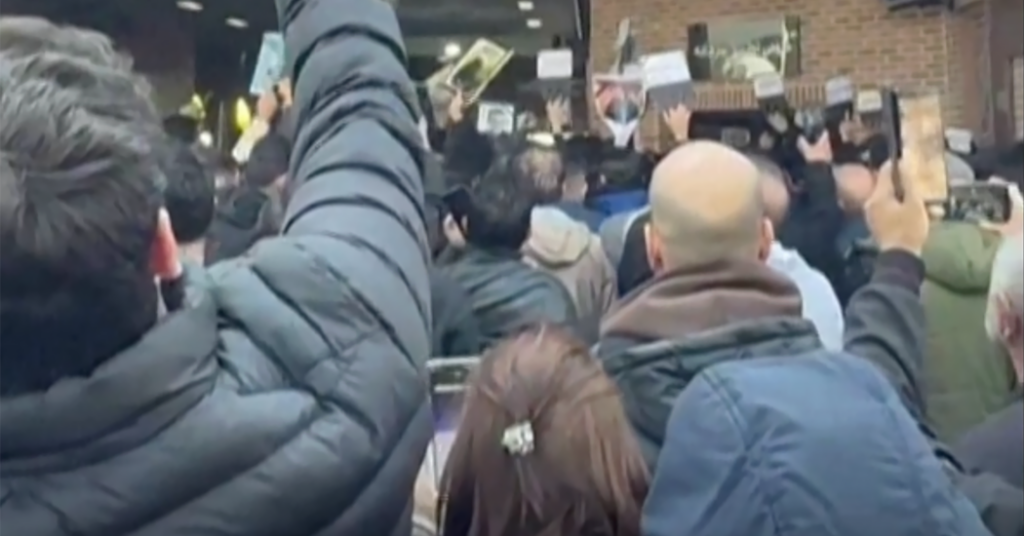
Enraged, the crowds began pushing their way into the hallway of the mortuary, cursing Iran’s supreme leader, Ayatollah Ali Khamenei — a criminal offense in the country — as security forces looked on.
“Mothers were crying, shouting,” Kiarash said. “And all the people were shouting things like, ‘Death to Khamenei.’” As Kiarash reached for his phone to film them, he said, security forces quickly stopped him. Others, however, did manage to surreptitiously film and share the protests that day, in videos that have been verified by The New York Times.
Kiarash, who, like others interviewed, asked to be identified only by his first name to protect his relatives, gave The New York Times rare, detailed testimony of his experiences during a visit to his family in Iran, which coincided with the anti-government protests that roiled the country for weeks. A violent crackdown unleashed by the government has stifled those demonstrations for now, residents say.
The staggering toll of this suppression has only begun to emerge — obscured by a government shutdown of the internet and telephone lines for more than a week. Though some communications are slowly being restored, reliable testimony and evidence is emerging piecemeal.
Human rights groups say they have gathered so many individual testimonies of people who witnessed large numbers of bodies collecting at morgues and cemeteries across the country that they expect the death toll to rise far beyond the current estimates of up to 4,500.
And, like Kiarash, three rights groups interviewed by The Times recounted shocking treatment of the dead.
Mahmood Amiry-Moghaddam, director of Iran Human Rights, an advocacy group based in Oslo, said that his team had also received witness accounts of bodies being piled on top of one another in Tehran and in the coastal city of Rasht. The group documented testimonies from people who said that they had been forced to search through trucks loaded with bodies to find their loved ones in Tehran and in the northeastern city of Mashhad.
In Mashhad’s poorest neighborhoods, some families recounted being asked to pay impossible sums, sometimes as high as $6,000, to retrieve the bodies of protesters, according to testimonies gathered by the Center for Human Rights in Iran, an organization based in New York.
“These people cannot pick up their loved ones’ bodies because they can’t pay that kind of money,” said Hadi Ghaemi, the head of the center. “So the bodies are just being dumped and buried in mass graves.”
The practice of imposing a “bullet price” on the families of dead dissidents dates to the Islamic Republic’s brutal crackdown on its opponents in the 1980s, when the authorities required a fee to return the bodies of those it executed.
Some of the evidence that rights groups are now piecing together comes from travelers smuggling out information when they leave Iran.
A doctor told The Times that he spirited out videos and testimony from medics in the central city of Isfahan. They shared information about a heavy death toll from that city alone from Jan. 8-10, at the height of the government’s crackdown.
“Now everyone knows someone who was killed,” said the doctor, Mohammed. “The silence imposed on people is not normal — it’s a silence that carries the dust of death.”
Kiarash said that he had seen hundreds of bodies during his visit to Behesht-e Zara, on the afternoon of Jan. 10, when he had joined his brother to bury a family friend. The friend, a 41-year-old mother of two, had been shot in the neck at a protest the night before, Kiarash said.
The mourners at the cemetery started at a reception area, where they received a number that matched the tag on their loved one’s body, Kiarash recounted. Then they made their way toward the mortuary, where cemetery workers perform the Muslim rites of washing the corpses and covering them in a simple white shroud before returning them to their loved ones for burial.
As the families waited outside the mortuary, they noticed that piles of bodies had been stacked in warehouses nearby, Kiarash said. The sight prompted a frenzy as people broke past the security forces to see if their loved ones were among the piles.
“It was rows upon rows” of bodies, he said.
Dian, an Iranian in exile abroad, said that his family had undergone a similar experience to Kiarash’s at the same cemetery. Dian’s father was shot dead at a protest, his family told him, and they buried him at Behesht-e Zahra a day after Kiarash was there.
Dian’s family also described scenes of corpses stacked on top of one another and of cemetery workers insulting the families of the dead.
What unnerved Kiarash most, he said, was watching cemetery workers carelessly handling tiny body bags — for children, he guessed, no more than 10 or 12 years old.
“Throwing bodies on top of each other, throwing the children in small bags — they’d get crushed beneath them,” he said. “Every time I say this, my heart breaks.”
Young conscripts overseeing the crowd looked as stunned as the people they were meant to be controlling, Kiarash added: “Some of them were crying.”
Behesht-e Zahra holds a powerful resonance for Iranians.
Ayatollah Ruhollah Khomeini, the founder of the Islamic Republic established after the 1979 revolution, is entombed there. It is also the final resting place of thousands of soldiers who lost their lives in the Iran-Iraq war during the 1980s.
Last year, the authorities bulldozed over a plot there holding many political prisoners, who were executed by the thousands during the ’80s.
Many rights groups estimate that the toll from Iran’s latest unrest could pass 10,000.
Footage from Jan. 10, taken at a forensics laboratory a short distance away from Behesht-e Zahra, has also emerged.
The videos show sobbing crowds searching through bodies piled on the floor as 40-foot-long refrigerator trucks, similar to those Kiarash described, arrive to unload still more dead.
The final indignity is the burial itself.
Arina Moradi, who works for the Norway-based rights group Hengaw, said that the authorities in Tehran had forced her family to pay money to retrieve the body of her cousin, Siavash Shirzad, 38. But they denied Mr. Shirzad’s family the right to bury him in his birth city, Bukan, in western Iran, where his family lived.
The family was forced to bury him in a remote ancestral village instead.
“They paid the money, then they had to agree they would not allow any demonstrations or anything, that they would bury him in silence,” Ms. Moradi said.
Tightly restricting burial rites, Mr. Ghaemi said, is a lesson that the Islamic Republic learned from the 1979 revolution. Then, funerals for protesters and the customary Shiite Muslim memorial services conducted 40 days after a person’s death became critical to maintaining the momentum of demonstrations that ultimately overthrew the shah.
“The reason authorities are so sensitive about where bodies get buried is that they become symbols to the people they live among — and the potential for gatherings at the cemetery that could ignite larger protest,” Mr. Ghaemi said. “They basically deny people the right to mourn.”
At Behesht-e Zahra, Dian said that security guards had accompanied his family to their burial plot to monitor them. In a video shared by the family, the mourners simply chanted, “Honorable one! Honorable one!”
Kiarash said that security guards had rushed his family friends through their final goodbyes.
“One officer was standing over us: ‘You have 30 minutes to do whatever you need,’” Kiarash recalled. The friend was lowered into the grave; the dirt poured over her body was quickly watered to tamp down the dust.
Kiarash says that the silence imposed by the government’s crackdown cannot last.
“The word hatred is not strong enough to signify what people are feeling,” he said. “It’s over.”
Sanam Mahoozi, Monika Cvorak and Artemis Moshtaghian contributed reporting
The post The Final Indignities Inflicted on Iran’s Protest Victims appeared first on New York Times.