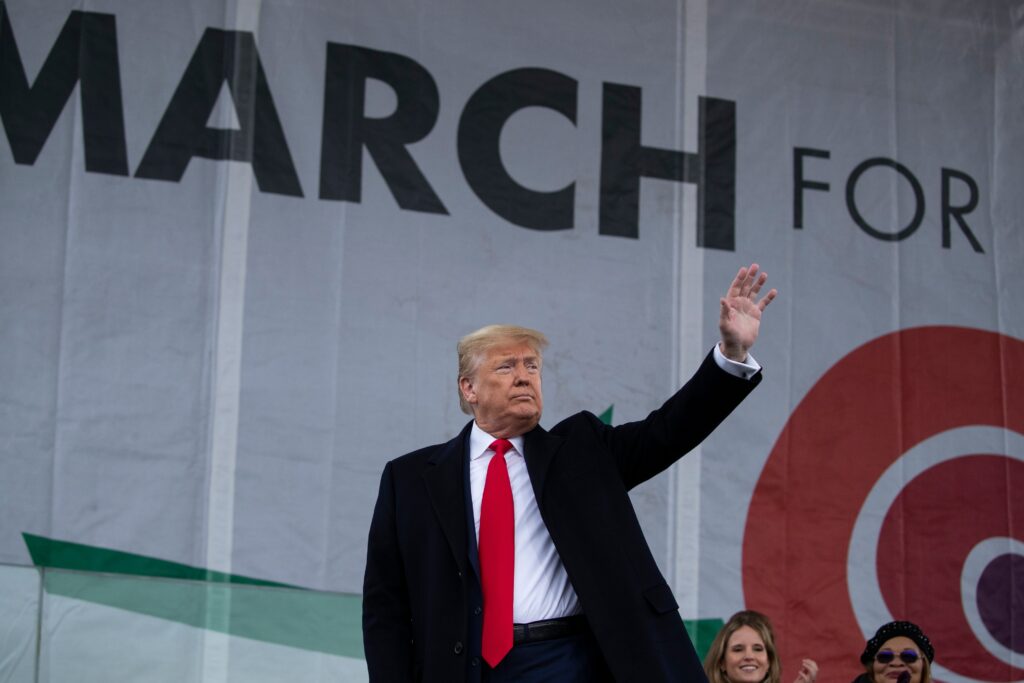
President Donald Trump made history in 2020 as the first sitting president to appear in person at the antiabortion movement’s annual March For Life, declaring there that “unborn children have never had a stronger defender in the White House.”
But ahead of this year’s event, top leaders of the movement that took credit for helping propel Trump to the presidency say they see a lack of urgency from the administration on further curbing abortion access — a complaint White House officials have taken steps to address in recent days.
More than three years since Supreme Court justices he nominated helped strike down the federal right to an abortion, Trump and his administration have been more restrained when it comes to championing abortion restrictions. It started with Trump on the campaign trail in 2024 refusing to call for Congress to pass national abortion restrictions, despite supporting a 20-week limit during his first term. He then stripped the Republican Party’s platform of its most aggressive antiabortion policy provisions. And earlier this month, Trump said Congress should “be a little flexible” on the Hyde Amendment, a nearly 50-year prohibition on federal funds being used for abortions.
That moderation has left antiabortion leaders grappling with what it means that the self-proclaimed “most pro-life president” in history is no longer responding to all their demands — and warning that socially conservative voters won’t unconditionally have his party’s back in November’s midterm congressional elections. On Friday, tens of thousands of antiabortion activists are expected to gather in Washington for the annual March For Life.
“It’s hard to say someone is ‘the most pro-life’ when they are allowing the abortion pill [to remain accessible] and they could stop it, or they’re saying things like they could be ‘flexible’ on Hyde, or they’re taking things actively out of the Republican Party platform that defended life and saying, basically, some abortions are acceptable,” said Lila Rose, a prominent antiabortion activist and founder of Live Action, a nonprofit that has conducted undercover investigations into Planned Parenthood.
Her organization celebrated when Trump’s legislative package last summer included a provision to stop all Medicaid funding to abortion clinics for a year, though antiabortion activists say they would have preferred a more permanent policy. And Rose and other top antiabortion leaders credited Trump for last year pardoning antiabortion activists charged with breaking into and blocking access at women’s health clinics, and for reinstating a ban on sending federal funds to international organizations that provide or encourage abortion services.
But other abortion-related policies by the Trump administration “have been a huge disappointment,” Rose said.
Beyond Trump’s recent Hyde comment, top of mind for antiabortion leaders is what they see as the Trump administration delaying a study on the safety of mifepristone, a pill that can be used to induce abortions at home, and anger over the approval of a new generic version of the drug last year.
After the Supreme Court overturned Roe v. Wade, the landmark ruling that for decades protected the right to have an abortion, the number of procedures did not dramatically decline as activists had hoped. Antiabortion activists blame the continued availability of abortion pills that can be legally prescribed remotely and mailed to women living in states with abortion bans, and fault the Justice Department for not seeking to block mail delivery.
On Thursday, the White House held a private briefing for a few dozen antiabortion leaders, announcing several new policy initiatives that include an investigation by the Small Business Administration into Planned Parenthood’s receipt of covid loans, and an end to funding research that uses aborted fetal tissue, according to leaders in attendance. Antiabortion leaders publicly and privately praised the new announcements, but reiterated that concerns about the abortion pill and Hyde remain paramount. One antiabortion leader who attended, speaking on the condition of anonymity to discuss the private meeting, described the briefing as “cleanup on Aisle 5” by the White House, and questioned why the new policies hadn’t been implemented sooner.
Vice President JD Vance will attend this year’s March For Life on Friday, speaking to the crowd as he did last year days after taking office. But the environment is different after a year of Trump’s policy rollouts, and antiabortion leaders say they’re unsure how committed the Trump administration is to further curbing abortion access.
“We are concerned about lethargy we see right now” said Kristan Hawkins, president of Students for Life of America. The Biden administration, she said, “ruthlessly used federal agencies” to expand abortion access, including making it easier to obtain abortion pills and covering military members’ travel for abortions. “We are not seeing that same vigor from the Trump administration,” Hawkins said.
Trump officials have said the Food and Drug Administration was legally required to approve the generic version of the abortion pill, and that a study the administration pledged to conduct on its safety remains underway. The Trump administration has not sought to block access to the drug by mail.
“If the White House had time to reclassify marijuana, they have time for this,” Hawkins said. Trump announced the easing of restrictions on marijuana last month in the Oval Office. “That, to me, was a slap in the face,” Hawkins said.
After the Trump administration’s announcements of new policies Thursday, Hawkins posted to social media that “tremendous progress has been made,” including the SBA investigation that could begin the process of “debarring” Planned Parenthood from receiving federal funds, which her organization has long called for. But Hawkins said “more must be done” to address distribution of the abortion pill. And Rose posted a photo Thursday with Health and Human Services Secretary Robert F. Kennedy Jr., saying she had met with him to discuss the abortion pill.
In a statement to The Washington Post, White House spokesman Kush Desai called Trump “the most pro-life and pro-family president in American history,” and said “the spate of actions that the Trump administration has taken this week alone on abortion reaffirm the President’s commitment to life.”
White House press secretary Karoline Leavitt said earlier this month that Trump’s comment about flexibility on Hyde was not a suggestion to “change the administration’s policy” opposing federal funding of abortion, and noted that Trump signed an executive order last year to enforce the Hyde Amendment. Trump himself has not clarified his comment, however.
One Trump administration official said it was “fair to say” that the president doesn’t deeply care about further curbing abortion access, and because he is not seeking election again, doesn’t have to “placate any segment he doesn’t want to.”
“He’s doing what he wants to do,” the official said, referencing a recent comment Trump made about his “own morality” guiding his decisions on foreign intervention. “He’s going to go as far as his moral clarity, his conscience, is going to take him on this.”
Marjorie Dannenfelser, president of Susan B. Anthony Pro-Life America, described antiabortion activism as the “third leg of the stool in the conservative base,” after fiscal and national security conservatives. She has warned that these socially conservative voters may lose their incentive to show up to help Republicans win tight races in this year’s elections.
“A demotivated pro-life movement,” Dannenfelser said, “would spell disaster for midterm battlegrounds.”
She likened the current Trump administration to Rhett Butler, the fictional character in “Gone With The Wind” who walked out of his marriage to Scarlett O’Hara with the famous line, “Frankly my dear, I don’t give a damn.”
SBA Pro-Life, which pledged to spend about $80 million in the midterms through door-knocking, ads and other efforts, has warned Republicans in the House and Senate that they are unlikely to support anyone who votes for health care legislation — including a fix to the expired Obamacare subsidies — that doesn’t also block federal funds for organizations that provide abortions.
Students for Life has similarly said they’ll factor in politicians’ vote on Hyde protections as they conduct their own midterm outreach.
When pressed on the likelihood of antiabortion activists actually sitting out the election, movement leaders conceded there’s no clear indication that will happen. But their organizations’ deciding not to spend time or money campaigning for certain Republicans in swing districts, they say, could make a difference in races that determine control of the House and Senate.
“Every poll I’ve checked tells me 2026 is going to be a very hard election for the Republicans,” Hawkins said. “You lose 2 percent of sold-out GOP voters who are pro-life … you lose just a little percentage of them, and some of these swing state swing elections, you’re going to lose the election.”
Multiple antiabortion leaders and operatives said it was unclear whether anyone in the current White House was the point person for antiabortion issues. During Trump’s first term, they said, Vice President Mike Pence seemed to play a critical role in keeping the administration closely aligned with antiabortion groups. On Thursday, Transportation Secretary Sean P. Duffy and Jay Bhattacharya, director of the National Institutes of Health, met with the antiabortion leaders, along with White House policy and political staff, a White House official said.
During his 2024 campaign — and aware of Democrats’ sustained attacks on Republicans for the erosion of abortion rights through the Dobbs decision ahead of the 2022 midterms — Trump sought to distance himself from strict antiabortion policies. He sharply criticized Republican states with six-week bans, which included his home state of Florida, and waffled on how he would vote on a state abortion referendum that fall before saying he would oppose the effort to expand abortion access.
Acknowledging that in-the-know antiabortion activists are publicly pushing back on the administration’s stance on the abortion pill and Trump’s Hyde comments, the administration official said these recent developments still don’t seem to have captured average evangelical voters, even though they largely remain opposed to abortion rights.
A KFF poll from last fall found that only half of the public had heard of mifepristone, the abortion pill, though two-thirds said they opposed banning its use nationwide or making it a crime for health care providers to mail the pills to patients in states where abortion is banned. Republicans, though are split on the issue, with about half supporting and half opposing banning mifepristone.
And most adults had heard little or nothing about the FDA’s study to reevaluate the abortion pill’s safety. The FDA previously determined it was safe to take as directed by a doctor
Jennie Bradley Lichter, the president of March For Life, said she is focused on galvanizing the young people who gather Friday.
“This issue is not going away,” Lichter said.
Praveena Somasundaram contributed to this report.
The post Trump administration seeks to curb antiabortion leaders’ ‘disappointment’ appeared first on Washington Post.