In President Donald Trump’s crusade to bring Greenland under the control of the United States, he has repeatedly invoked the danger posed by a Chinese or Russian takeover of the massive resource-rich, icebound island.
In a speech to the World Economic Forum in Davos, Switzerland, on Wednesday, Trump described Greenland — which is part of Denmark, a NATO ally — as an “almost entirely uninhabited and undeveloped territory, sitting undefended in a key strategic location between the United States, Russia and China.”
Experts on China’s Arctic, defense and foreign policies say that Beijing has neither the ability nor any obvious plans to imminently conquer the island of 57,000 people that sits around 4,800 miles away from Chinese waters, beyond the ice sheets of the North Pole.
What Beijing does have, however, these analysts said, is wide-ranging ambition to expand its presence across the Arctic region in ways that pose new security concerns for Europe and North America.
“Naturally, Greenland features in China’s Arctic security agenda because it is important to U.S. and European security, just as it was in World War Two,” Anne-Marie Brady, an expert on China’s polar policies at the University of Canterbury in New Zealand.
Rather than deterring Chinese activity, Trump’s showdown with Europe over his plans to annex Greenland will likely give Beijing an opening to reengage with Nordic countries that have become increasingly wary of Chinese activities, analysts said.
European nations have already shown they are willing to meet almost all U.S. demands short of handing over sovereignty — including strengthening Arctic security and allowing access to Greenland’s resources, said Adam Lajeunesse, an associate professor of public policy at St. Francis Xavier University in Nova Scotia, Canada.
But “a break in the relationship with the United States” could get Arctic countries working with China again, Lajeunesse said.
Trump Wednesday appeared to back down from his threat to impose tariffs on European allies when he announced a “framework” deal to bolster security in Greenland and across the Arctic.
Why is China interested in the Arctic?
Despite the fact China’s northernmost point sits 900 miles from the Arctic Circle, Beijing considers itself a “near-Arctic state” and has been active in trying to shape international rules and norms governing activity in the region.
Beijing likes to emphasize the scientific, environmental and commercial dimensions of its Arctic ambitions, but it has also officially designated the region a “strategic new frontier” to be secured under Chinese leader Xi Jinping’s drive to match U.S. military capabilities even in peripheral domains.
“It’s very difficult to split the economic interests that China has from its strategic or security-driven interests,” said Helena Legarda, an analyst at the Mercator Institute for China Studies, a Berlin-based think tank. “They’re all interlinked.”
As China’s economic interests in the region grow, so does its desire for a greater security footprint.
“They want to first expand its presence through economic and scientific and diplomatic means,” said Matti Puranen, an associate professor at the Finnish National Defence University in Helsinki. “Then, in the future, they could argue that they have to be able to also project military power in the region to safeguard those interests.”
How does Beijing view Trump’s plans for Greenland?
Beijing, which is angling to secure and extend a trade truce with the U.S. when Trump makes a state visit to China this Spring, has tried to distance itself from the furor over Greenland’s future.
The U.S. should stop using the pretext of a “China threat” to pursue its own interests, a Chinese Foreign Ministry spokesperson said on Thursday.
Chinese analysts, however, are hopeful that Trump’s brash tactics will demonstrate to Arctic nations that Beijing is the more reliable partner.
The U.S. revival of “imperial-style political logic” is starkly different from China’s approach in the region, said Wang Chuanxing, a professor at the Centre for Polar and Oceanic Studies at Tongji University. He described Beijing’s effort as “neither unilateral or exclusive but rather working within existing international rules.”
Chinese analysts have also voiced concern that Trump may want to revisit Greenland’s Cold War role as a secret base for American nuclear-armed bombers. That concern will only be heightened with Trump’s assertion Thursday that the U.S. would “have all military access that we want” in Greenland under a new framework deal.
This is likely to be seen as a significant provocation and a reason for China to accelerate its already extensive efforts to match American nuclear weapons capabilities, including by developing nuclear-powered ballistic missile submarines.
“China remains highly alert to the possibility that the United States could use Greenland and its control over the Arctic to build forward bases” that would improve U.S. abilities to launch “preemptive” nuclear or conventional strikes on China, said Zhao Minghao, deputy director of the Center for American Studies at Fudan University in Shanghai.
What has China achieved in the Arctic?
After more than two decades of gradual progress, China is now on the cusp of establishing itself as an Arctic power.
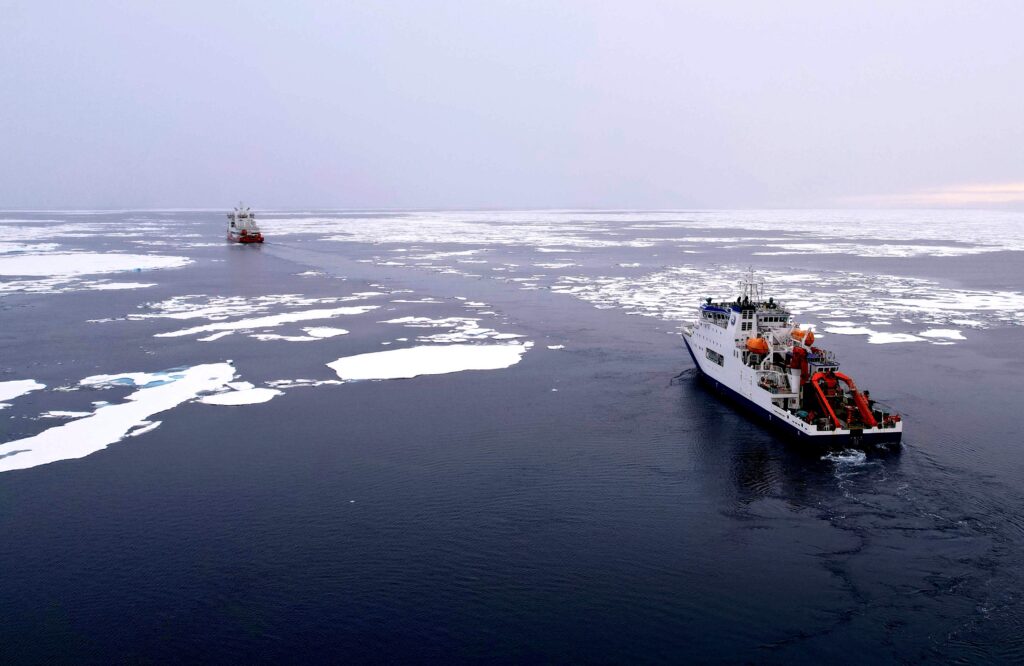
From two permanent research bases in Norway and Iceland, and with a fleet of five research icebreakers, Chinese researchers have started pushing the boundaries of exploration below the sea ice.
Chinese researchers have also expanded efforts to map out fishing grounds, subsea oil and gas reserves, and critical mineral deposits along the underwater volcanic vents of the Gakkel Ridge, as part of global efforts to dominate deep-sea mining.
Over a 98-day mission last year, crewed submersibles completed 43 dives up to depths of 5,277 meters, in what state media hailed as a breakthrough for China’s ability to navigate and surface amid thick ice floes.
These increasingly advanced capabilities give Beijing an edge in the scramble for the control of resources and shipping lanes that are being made accessible as global warming melts ice caps.
They also come with security implications for the U.S. and other Arctic countries. Knowledge of seabed topography, weather patterns and ocean currents could be critical as China looks to expand its military presence in Arctic waters, including potentially patrols of nuclear-armed ballistic missile submarines.
As summer lengthening thins the ice, China has sent more ships through the Northern Sea Route that connects Asia to Europe via Russia’s northern coast, where Chinese companies have expanded infrastructure investment to help build what it calls the “Polar Silk Road.”
For now, the prospects of a trade boom are limited. Chinese container ships made 14 voyages along the route in 2025, up from 11 the year before and seven in 2023.
But, when the weather permits, the 20-day journey can take about half the time needed to send goods through the Strait of Malacca and the Suez Canal. That not only gives China faster access to European markets, but it also serves as a backup plan for accessing oil and gas if southern maritime choke points are one day blocked.
Does China have a presence in Greenland?
Despite Beijing’s growing presence elsewhere in the Arctic, Greenland is one place where Chinese companies have consistently failed to establish a foothold.
In 2017, Denmark, citing security concerns, rejected an attempted takeover of an abandoned naval base by a Chinese company. A Chinese bid to expand three airports was withdrawn in 2019 after it drew scrutiny from the Danish government. Several attempts by Chinese mining companies to extract iron ore or rare earth metals have stalled or been blocked by local authorities.
Across northern Europe, “the stated ambitions of Chinese investment into the Arctic and the number of proposed projects far superseded the number of realized projects,” said Anders Christoffer Edstrom, a researcher at Nord University Business School in Norway who has studied these projects. “Greenland is a stark example of that.”
Where is China gaining its Arctic foothold?
When it began its foray into the Arctic, China hoped to partner with European nations. But Xi’s increasingly assertive foreign policy and his intensifying competition with the U.S. have led to far more scrutiny of Chinese deals in Europe, exacerbated by Beijing’s indirect support for Russia’s invasion of Ukraine.
As a result, China’s Arctic activity has focused on the waters along Russia’s northern coast and around to Alaska. Russia’s historical resistance to partnering with Beijing in the region has waned as Moscow has become more dependent on Beijing for economic support and components with military applications to sustain its assault on Ukraine.
In early 2023, the China Coast Guard signed a deal with Russian counterparts to strengthen cooperation on maritime law enforcement in polar regions. The two countries have increasingly conducted joint patrols and research missions in areas of the Bering Sea northwest of Alaska patrolled by the U.S. Coast Guard.
There is plenty of room for future cooperation that would match Beijing’s industrial prowess with Russia’s Arctic experience. With Russian shipbuilders struggling to secure parts and financing, Beijing is well-placed to renovate or replace its aging icebreakers or provide components and investment in the small nuclear reactors used to power remote bases, analysts have said.
“Previously, a big barrier to China maintaining a military presence in the Arctic was Russia,” said Brady, the New Zealand academic. “Since Russia’s invasion of Ukraine, this barrier has been removed.”
The post Trump says China is a threat to Greenland. What’s Beijing doing in the Arctic? appeared first on Washington Post.