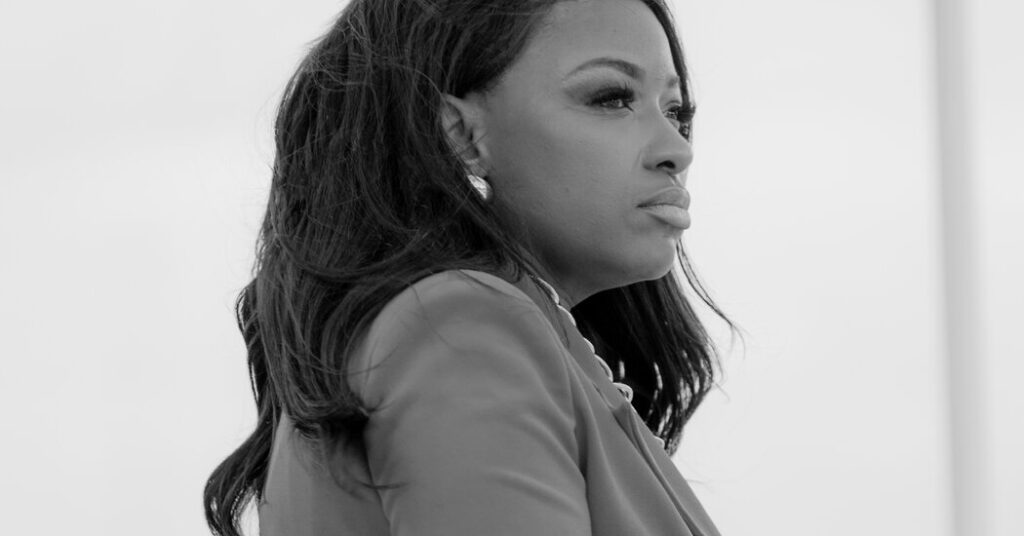
This month, some of the worst elements of 2020-style online progressive politics made a brief return, thanks to a controversy involving a couple of comedians and U.S. Representative Jasmine Crockett of Texas. It merits attention, despite its seeming triviality, because the underlying issue could cost Democrats the Senate this fall.
The contretemps started with an offhand comment on “Las Culturistas,” a podcast hosted by the actors and comedians Bowen Yang, until recently a star on “Saturday Night Live,” and Matt Rogers. Rogers was dunking on Gov. Gavin Newsom of California, arguing that Democrats need genuinely populist leaders, not those who simply excel at trolling Donald Trump. From there, he dismissed Crockett’s campaign to move up to the Senate.
“Anytime a politician is making it too obviously about themselves, I’m already done,” he said. “And don’t waste your money sending to Jasmine Crockett. Do not do it.” Yang added, “I must agree.”
Online, there was a backlash from Crockett fans, many of whom accused the “Las Culturistas” hosts of racism and misogyny. The reaction was intense enough that both Rogers and Yang issued abject apologies. “I have great respect and admiration for Rep. Crockett,” wrote Rogers, who promised to “be better.” Yang pledged to use his platform “more responsibly.”
But Rogers and Yang were right to be skeptical of Crockett, who almost certainly cannot win a general election in Texas. Those who disagree have every right to criticize them, and me. But progressives shouldn’t let a retrograde style of internet discourse inhibit them from pointing out the obvious.
It can be tricky, of course, to discuss electability concerns about Black women candidates. It’s not always easy to draw the line between analyzing the voters’ putative prejudices and reifying them. If liberals decide in advance that Black women are at an electoral disadvantage, they risk making that disadvantage real. But it’s not race and gender that make Crockett a bad candidate, though both obviously shape perceptions of her. The problem with Crockett is that her theory about how Democrats can win Texas is wrong.
I understand why lots of Democrats adore Crockett. She’s charismatic and often funny and knows how to command attention. “I think that we have to take a page or two, or three or four, out of Donald Trump’s book,” she told Vanity Fair in 2024. Some of her insults are in bad taste — she has called Texas’ governor, Greg Abbott, who uses a wheelchair, “Hot Wheels” — but it’s easy to see why Democrats who feel brutalized by Trump want champions willing to go low.
Still, Democrats cannot win Texas, a state where Trump beat Kamala Harris by almost 14 percentage points, without flipping at least some Republican voters. James Talarico, Crockett’s opponent in the Democratic primary, showed that he could do that in his 2018 election to the Texas House, turning a red seat blue and winning a district that was also carried by Abbott. Crockett, by contrast, has always represented a deep blue district and has never had to run a seriously contested general election.
She has been openly contemptuous not just of Trump, but also of the Texans who cast their ballots for him. In that Vanity Fair interview, she described Latino voters who agreed with Trump’s pitch on immigration — a demographic where Democrats need to make inroads — as having a “slave mentality.”
Rather than focusing on peeling off Trump voters, Crockett is staking her candidacy on a promise to motivate Texans who rarely if ever go to the polls. “The theory of my case has always been that we could expand the electorate,” she told a Texas news station last month. “We could get people that normally don’t participate in politics to be excited about getting involved.”
.op-aside { display: none; border-top: 1px solid var(–color-stroke-tertiary,#C7C7C7); border-bottom: 1px solid var(–color-stroke-tertiary,#C7C7C7); font-family: nyt-franklin, helvetica, sans-serif; flex-direction: row; justify-content: space-between; padding-top: 1.25rem; padding-bottom: 1.25rem; position: relative; max-width: 600px; margin: 2rem 20px; }
.op-aside p { margin: 0; font-family: nyt-franklin, helvetica, sans-serif; font-size: 1rem; line-height: 1.3rem; margin-top: 0.4rem; margin-right: 2rem; font-weight: 600; flex-grow: 1; }
.SHA_opinionPrompt_0325_1_Prompt .op-aside { display: flex; }
@media (min-width: 640px) { .op-aside { margin: 2rem auto; } }
.op-buttonWrap { visibility: hidden; display: flex; right: 42px; position: absolute; background: var(–color-background-inverseSecondary, hsla(0,0%,21.18%,1)); border-radius: 3px; height: 25px; padding: 0 10px; align-items: center; justify-content: center; top: calc((100% – 25px) / 2); }
.op-copiedText { font-size: 0.75rem; line-height: 0.75rem; color: var(–color-content-inversePrimary, #fff); white-space: pre; margin-top: 1px; }
.op-button { display: flex; border: 1px solid var(–color-stroke-tertiary, #C7C7C7); height: 2rem; width: 2rem; background: transparent; border-radius: 50%; cursor: pointer; margin: auto; padding-inline: 6px; flex-direction: column; justify-content: center; flex-shrink: 0; }
.op-button:hover { background-color: var(–color-background-tertiary, #EBEBEB); }
.op-button path { fill: var(–color-content-primary,#121212); }
Know someone who would want to read this? Share the column.
This theory is dubious. In a detailed article last month, Texas Monthly called the idea that Democrats can prevail in the state simply by juicing turnout “the biggest lie in Texas politics.” It noted that in 2018, when Beto O’Rourke came close to defeating the Republican senator Ted Cruz, he did so by winning over hundreds of thousands of Abbott voters who split their tickets. In that year’s midterms, races across the country saw presidential-level turnout. But much of the reason there was a blue wave, according to the Democratic data firm Catalist, was that swing voters who’d opted for Trump in 2016 then supported Democrats two years later.
Of course, some candidates have succeeded in part by inspiring low-propensity voters, most notably Donald Trump and Zohran Mamdani. Both were outsider candidates who were able to motivate people who distrust conventional politicians. Crockett, however, isn’t offering an alternative to the Democratic Party’s status quo.
In Vanity Fair, she described Harris as a “perfect candidate” who “did everything right” and whose main flaw was a failure to get her message across. The video announcing Crockett’s candidacy featured a close-up of her face with audio of Trump insulting her. Trump’s disdain is indeed a badge of honor, but it is probably not enough to activate voters who couldn’t be bothered to vote against him when he was on the ballot.
Texas is a difficult environment for Democrats, but there are a lot of disaffected Trump voters in the state; according to the Texas Politics Project, the president’s approval ratings are underwater there by seven percentage points. Crockett, however, is poorly positioned to pick up Trump defectors. In November, 49 percent of Texas voters told pollsters they would definitely not vote for her. Only 40 percent said that of Talarico.
Such numbers may explain why Republicans, according to the political news site NOTUS, worked behind the scenes to push Crockett into the race. The National Republican Senatorial Committee disseminated polls showing her winning a potential primary. Further, an anonymous source told NOTUS, Republicans ran an AstroTurf phone and text campaign urging Democrats to contact Crockett and ask her to run. Those efforts may have worked. “The more I saw the poll results, I couldn’t ignore the trends which were clear,” Crockett said in her announcement speech.
Speaking to The Washington Post this week, Crockett seemed to suggest that the race was such a long shot that Democrats could afford to take chances. Addressing her critics, she said: “If you think it’s a losing cause, then who cares? But at least you could say we tried something new and we learned something from this experience.”
This gets things backward. Texas is not a lost cause, and Democrats cannot afford to treat it like one, given that they must flip four Republican seats if they are to retake the Senate.
If people hesitate to make the case against Crockett because they fear online pile-ons, only Republicans benefit. There is very little that’s good to say about Elon Musk’s transformation of Twitter into a white nationalist propaganda factory, but one tiny silver lining is that it has lessened the platform’s malign influence on progressive politics. As Politico reported this week, now Republicans are the ones dealing with the site’s toxic dynamics, as esoteric debates and influencer feuds tear at the MAGA movement.
But social media is much bigger than X, and the “Las Culturistas” episode shows that bad-faith social justice arguments still have a lot of power on the internet. The fault for this lies not with the people making those arguments, but with those who let themselves be cowed by them.
The Times is committed to publishing a diversity of letters to the editor. We’d like to hear what you think about this or any of our articles. Here are some tips. And here’s our email: [email protected].
Follow the New York Times Opinion section on Facebook, Instagram, TikTok, Bluesky, WhatsApp and Threads.
The post Two Comedians Told the Truth About Jasmine Crockett’s Campaign appeared first on New York Times.