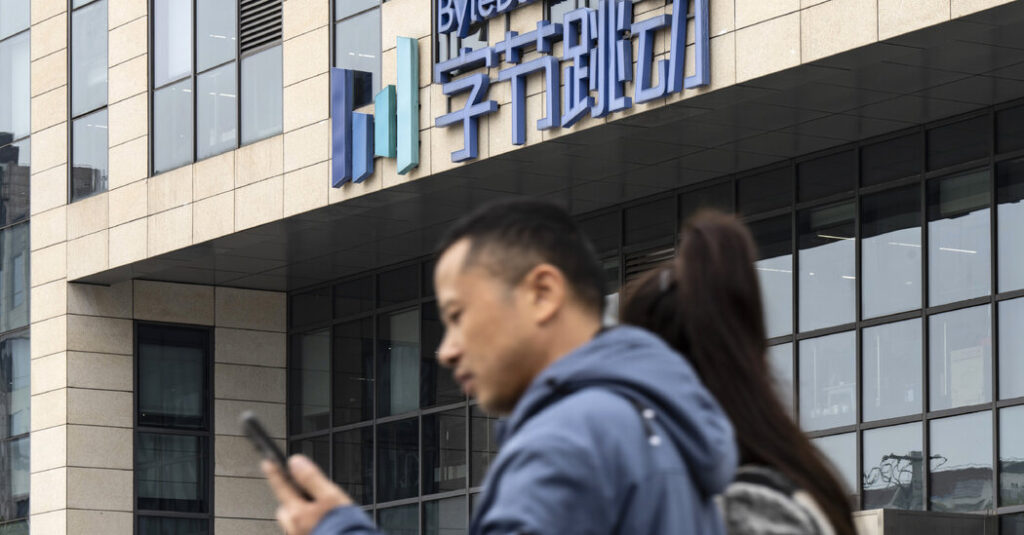
When Chinese internet giant ByteDance officially split TikTok into separate entities for America and the rest of the world on Thursday, the deal marked a final capitulation for the survival of its popular social media app in the United States after an arduous six-year fight.
The outcome of a fractured TikTok underscores the difficult choice facing Chinese technology companies with global aspirations. In the United States, they must contend with shifting geopolitical fault lines, drawn-out legal battles and mistrust of any company with Chinese roots. Alternatively, they could chart a different international path — one with potentially less hassle but without access to the world’s largest economy.
Over the past six years, as TikTok became a flashpoint between China and the United States, some Chinese tech companies thought they found a blueprint to make themselves more palatable to American officials and investors.
A handful of companies, including TikTok, moved their headquarters out of China to locations like Singapore. Others spent millions on marketing to foster familiarity among American consumers. Some firms blocked access to users in China, adding credence to the argument that they are not Chinese companies.
Last month, it seemed like artificial intelligence start-up Manus had found a way to circumvent geopolitics when Meta announced it had acquired the company for a reported $2 billion. Manus was founded by Chinese engineers and has affiliated offices in China, but moved its headquarters to Singapore last year. Its products are no longer accessible in China.
Manus drew attention from Silicon Valley last March when it introduced an A.I. agent that could be directed to build websites and do other basic coding tasks with limited human intervention. By December, Manus said it had surpassed $100 million in annual recurring revenue.
Online in China, tech industry commentators and investors said that Manus had cracked the code for raising cash from American investors, seemingly without much regulatory scrutiny.
But only days later, the Chinese government said it was investigating whether Meta’s acquisition had violated the country’s laws on technology exports and outbound investment.
China has intensified its oversight of the technology industry, especially in key sectors. In 2020, China amended its rules on what companies can export to include a range of software technologies. This amendment gave the Chinese government the power to approve or reject any deal involving the licensing of TikTok’s technology.
Some in the tech industry have taken to calling the efforts to downplay Chinese roots “China shedding.” Despite the regulatory scrutiny, they say, the Manus acquisition shows other start-ups how it can be done.
“Manus is the first successful exit of China shedding for a start-up,” said Kevin Xu, the U.S.-based founder of Interconnected Capital, a hedge fund that invests in artificial intelligence companies.
Chinese companies face an urgent need to find new markets. The collapse of the real estate market has left consumers reluctant to spend. Across industries, from food delivery to electric vehicles, Chinese start-ups compete intensely for increasingly smaller returns, a state of cutthroat competition that policymakers have dubbed “involution.”
Many Chinese entrepreneurs have concluded that “when you build a business outside China, you are able to have better margins and to sleep more easily,” said Jianggan Li, chief executive of Momentum Works, a consultancy in Singapore.
While Chinese start-ups contend with stiff competition at home, they face mounting scrutiny in the United States. In 2019, a U.S. government committee forced the Chinese company that owned the dating app Grindr to divest from the app over concerns that the Chinese government could access sensitive data about Americans, including their locations and dating preferences.
These days, storing American users’ data in the country and closer oversight from regulators are expected for Chinese companies operating in the United States, said Wei Sun, a principal analyst in A.I. at Counterpoint Research in Beijing.
But the regulatory and political scrutiny is prompting some Chinese companies to reconsider doing business in the United States and turn to other large markets instead.
Last May, Meituan, China’s largest food delivery company, said that it would spend $1 billion to set up operations in Brazil.
Meituan is known for its no-holds-barred approach. It operated at a loss for years, offering shoppers steep discounts and undercutting competitors. Meituan deployed similar tactics in 2024 when it rolled out its food delivery service, Keeta, in Saudi Arabia, where it quickly became a dominant delivery platform in most major cities.
Brazil is also one of the largest markets for the fast-fashion retailer Shein, which has built three warehouses near São Paulo.
Shein was founded in China before moving its headquarters to Singapore in 2022. But last May, President Trump cut off a lifeline for companies like Shein and Temu when he closed a longstanding loophole that had allowed Chinese goods worth less than $800 to be mailed directly to shoppers in the United States without any tariffs.
U.S. lawmakers had also raised concerns about the supply chains and labor practices that underpin Shein and Temu’s business models.
Chinese electric car companies, some of the country’s fastest-growing start-ups, have been effectively locked out of the U.S. market after Washington imposed a 100 percent tariff. Last year, China’s BYD surpassed Tesla to become the world’s top seller of electric vehicles, but its vehicles are absent from the streets of New York and Detroit. Instead, BYD has targeted markets like Brazil and Thailand, where its lower-priced models sell for under $15,000.
For ByteDance, the split marked a full-circle moment. The company launched TikTok in 2016 after acquiring Musical.ly, a Chinese app that let users lip-sync and dance to create their own music videos. However, the founders of Musical.ly eschewed the Chinese market and its internet restrictions, instead targeting teenagers in the United States and Europe.
TikTok has waged legal battles around the world as governments have grown alarmed by its ties to China and its wide influence, especially among young people. The app has been partially banned or blocked outright in at least 20 countries.
Analysts said ByteDance’s arrangement to license TikTok’s technology in the United States presents a middle ground: neither a total ban nor a forced sale of the company itself.
The deal “opens the door for more critical, strategic and advanced technologies to flow from China to the United States,” said Mr. Xu, citing potential opportunities for battery technology and rare earth metals — segments dominated by Chinese companies.
Meaghan Tobin covers business and tech stories in Asia with a focus on China and is based in Taipei.
The post After TikTok Deal, Chinese Companies Search for a New Global Path appeared first on New York Times.