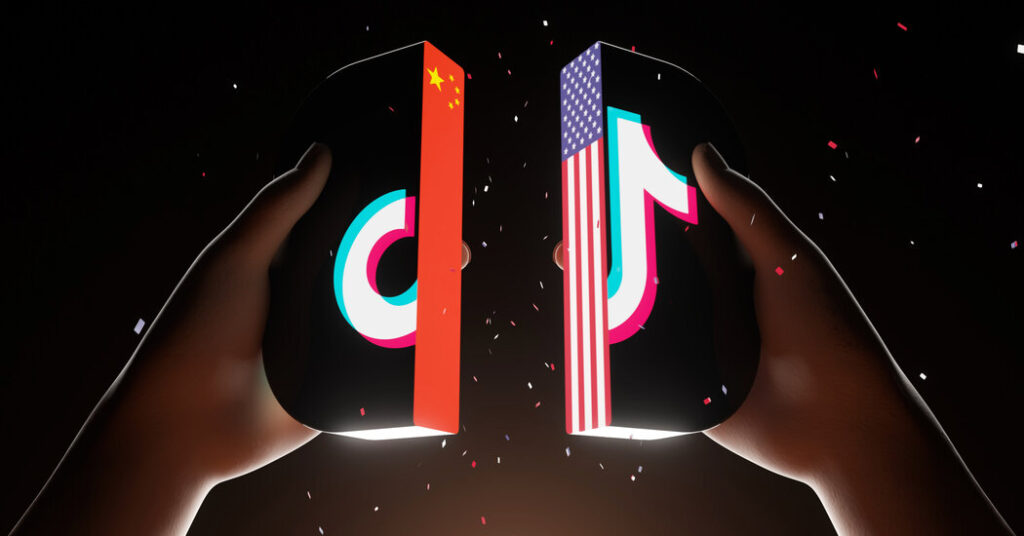
TikTok said on Thursday that its Chinese owner, ByteDance, had struck a deal with a group of non-Chinese investors to create a new U.S. TikTok, concluding a six-year legal saga that saw the app banned by Congress and ensnared in politicking between two global superpowers.
Investors including the software giant Oracle; MGX, an Emirati investment firm; and Silver Lake, another investment firm, will own more than 80 percent of the new venture. That list also includes the personal investment entity for Michael Dell, the tech billionaire behind Dell Technologies, and other firms, TikTok said. Adam Presser, TikTok’s former head of operations, will be the chief executive for the U.S. TikTok.
The deal is intended to loosen TikTok’s ties to China and address national security concerns that Beijing could use the app to surveil or manipulate its more than 200 million users in the United States. The changes enable “our U.S. users to continue to discover, create and thrive as part of TikTok’s vibrant global community and experience,” Shou Chew, TikTok’s chief executive, said in an internal memo that called the move “great news.”
The agreement, which was hammered out over more than a year, resolves existential questions about TikTok’s future. The app — with its unceasing feed of lip-syncs, political endorsements, conspiracy theories and skin care tutorials — would have had to leave the American market if it did not separate from ByteDance.
It was also the end of a legal odyssey. Since 2019, universities, several branches of the U.S. military, the vast majority of the House of Representatives and both President Trump and President Joseph R. Biden Jr. had tried to ban or block TikTok, with unanimous support from the Supreme Court. Influencers, mobilized by the app, lobbied politicians and mounted protests to save their feeds and follower counts. TikTok became embroiled in a trade war between the United States and China, as the nations engaged in a heated contest over technology and industrial supremacy.
But the drama dragged on for so long and with so little consequence that even some who once fought to save the app had stopped worrying about it.
Naomi Hearts, a 28-year-old content creator in Los Angeles who twice traveled to Washington as part of TikTok’s lobbying efforts, said she felt “detached” from the platform after years of upheaval.
“I feel like it’s going to be another day,” Ms. Hearts said in an interview this week, anticipating the deal’s completion.
It was unclear how much, if anything, the deal will change the experience for TikTok’s users in the United States. Since the outlines of the plan were released months ago, users have raised concerns about whether the new owners will overhaul the algorithm that personalizes their feeds. And experts have cautioned that the arrangement may fail to address the national security concerns.
The driving force behind the deal is a federal law, passed in 2024 and upheld by the Supreme Court, that would have banned the app if it did not separate itself from ByteDance by early 2025. The app even went dark for 14 hours as the law’s deadline approached, sending some users into a tailspin. But Mr. Trump formally delayed the enforcement of the law several times after he took office again last January, as he pushed the company to reach a deal for new ownership.
Mr. Trump celebrated the announcement in a post on Truth Social, the social media platform he owns, calling it a “dramatic, final, and beautiful conclusion.”
“I am so happy to have helped in saving TikTok!” he wrote, adding, “I only hope that long into the future I will be remembered by those who use and love TikTok.”
Under the new arrangement, Oracle, MGX and Silver Lake will each own 15 percent of TikTok’s U.S. operations. ByteDance will own just under 20 percent.
The other investors include Mr. Dell’s office and a long list of investment firms, including affiliates of General Atlantic and Susquehanna, both of which previously invested in ByteDance.
The majority of the seven-member board for the new U.S. TikTok will be American, according to a December memo to TikTok employees. Mr. Chew has a seat on the board.
The new venture will moderate content in TikTok’s feed, deciding which posts to leave up and which to take down. It’s unclear what the value of the American version of TikTok will be. Vice President JD Vance said in September that a U.S. TikTok company would be valued at $14 billion. ByteDance, by contrast, has been valued at $480 billion in the private markets.
Mr. Trump signed an executive order in September that gave formal approval to the arrangement, a move required under the 2024 law.
The Chinese government has not publicly commented on TikTok’s announcement. For years, Beijing had been a major obstacle to completing a deal. When the United States first pushed to force a sale of TikTok, China amended its export control list to include technologies like algorithms and source codes, giving it the power to weigh in on any deal involving the app.
Last year, Trump administration officials said they had won Beijing’s support for a deal. China’s statements were more vague.
Several of the new investors have ties to Mr. Trump, raising concerns for some TikTok users that the app could start showing more content aligned with the president’s views or the positions of the U.S. government.
Larry Ellison, Oracle’s billionaire co-founder, has a close relationship with Mr. Trump and lobbied the president directly on behalf of the current bid by his son, David Ellison, to buy Warner Bros. Discovery. MGX has done business with the Trump family’s cryptocurrency firm, World Liberty Financial.
Anupam Chander, a law and technology professor at Georgetown University, said the TikTok deal allowed for “more theoretical room for one side’s views to get a greater airing.”
“My worry all along is that we may have traded fears of foreign propaganda for the reality of domestic propaganda,” he added.
There are also lingering concerns that ByteDance will still influence the app’s content. In addition to its stake, ByteDance will keep TikTok’s coveted algorithm, which it will license to the new U.S. entity.
That arrangement may fall short of the 2024 law, which required the divestment to end any “operational relationship” between ByteDance and TikTok in the United States, critics said.
“They may have saved TikTok,” said Michael Sobolik, a senior fellow at the right-leaning Hudson Institute. “But the national security concerns are still going to continue.”
Thursday’s announcement is something of a mash-up of two earlier proposals aimed at distancing TikTok from ByteDance.
The app’s troubles in the United States accompanied its stratospheric rise in popularity, which accelerated during the Covid-19 pandemic as the housebound masses turned to their phones to distract themselves with dance trends and memes.
Soon after, Congress and the first Trump administration grew increasingly anxious that under Chinese law, ByteDance could be forced to provide personal information about Americans to Beijing’s military and intelligence apparatus.
In 2020, Mr. Trump threatened to ban TikTok. He then unsuccessfully tried to force ByteDance to sell the app to a consortium that included Oracle and Walmart.
TikTok spent years pushing an alternative to a sale. Under that proposal, which the company called Project Texas, Oracle would oversee the app’s American user data on servers in the United States. ByteDance would still produce the app’s code, but its work would be audited by Oracle.
Six years later, negotiators have settled on a consortium arrangement. Oracle is still a major player, and ByteDance remains involved, too.
“We’ve gone round and round and ended up not too far from where we started,” said Lindsay Gorman, a former senior adviser in the Biden administration.
Madison Malone Kircher contributed reporting.
David McCabe is a Times reporter who covers the complex legal and policy issues created by the digital economy and new technologies.
The post TikTok Strikes Deal for New U.S. Entity, Ending Long Legal Saga appeared first on New York Times.