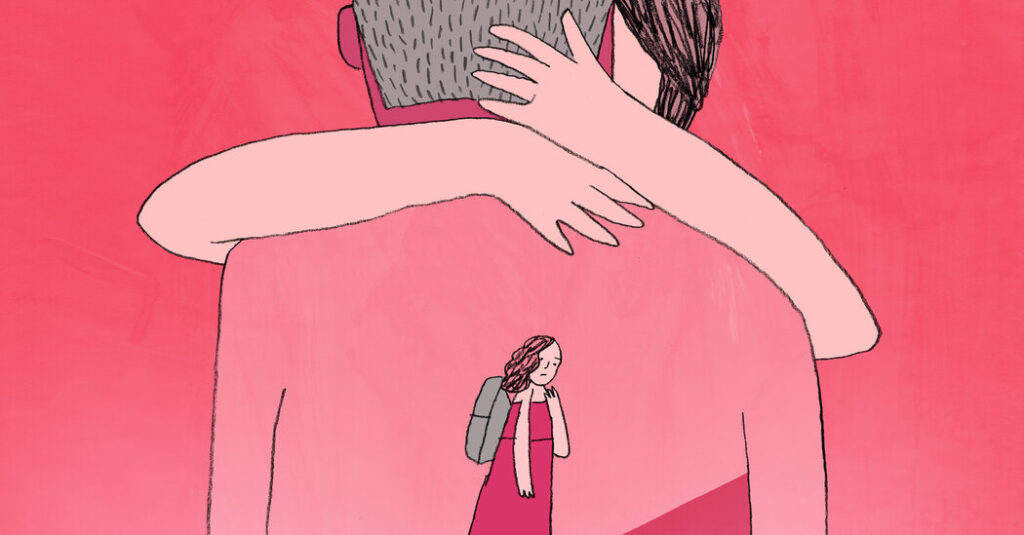
He stopped in the center of the street — Washington Avenue, a major Minneapolis thoroughfare — and kissed me so hard and so well for so long that traffic stopped, lights changed and the bustling city went silent as the drivers, instead of honking or hollering at us to get a room, began slowly, almost apologetically, steering around us.
This kiss had been building. This was the kiss we hadn’t been having for three days straight, spending almost every waking hour together at a professional retreat. He was a collegial friend; I didn’t know him well.
This was the kiss we didn’t have when I picked him up at the airport and the kiss we didn’t have when we stopped for lunch, over which the air became suddenly electric. Lunch lasted for hours. By the end, we were both so addled that we got lost on the way to his hotel. This was the kiss we didn’t have when he handed me a key to his room and I looked at him, befuddled, and asked, “What’s this for?”
This kiss didn’t happen and didn’t happen. It didn’t happen when we went to get a bite the first night and got kicked out of the bar when they closed at 2 a.m. It didn’t happen the next night when we rode through the darkened countryside with the stereo blasting “Rattle and Hum.”
It didn’t happen when we went back to his room after midnight and I sat at the desk editing a project for him and, when I was done, turned to see him lying on the bed, watching me with exactly the wrong kind of smile — too gentle, too warm — his hands folded behind his head.
I stood up and hastily gathered my jacket and purse.
This was the kiss we didn’t have when he sat up on the bed and said, “You don’t have to go.”
I said, “I do have to go.”
He laughed softly and said, “Because you never regret leaving.”
I hesitated. I said, “I do regret leaving. Sometimes.”
He reached for me.
“But not until later,” I said, and I left.
I am a full-time “nomad.” I live in a 16-foot camper I tow with a pickup, have no home base, and limit my possessions to those I can carry. And I don’t date. By the time I left what travelers call the “sticks-and-bricks” life for good, I had been solo for several years, by choice.
That doesn’t mean I have rejected love wholesale. It doesn’t mean I sit in my garret pining after someone or healing from a broken heart. It doesn’t mean I’m lonely or bitter or never have sex. I have deep and lasting friendships that are the beating heart of my life, and I have lovers scattered like pins in the map who understand that while I may visit their bed from time to time, I’ll be out of it before dawn.
I have seen enough romantic love and domestic bliss to know they can be powerful bonds. I also have learned that bonds are what they are. I have been married more than once. Marriage strikes me as a beautiful and valuable discipline that nourishes something in many people — just not me.
Romantic love has curtailed my solitude and self-determination, my freedom of movement and sovereignty over my life. When my last partnership ended in 2020, I chose a more solitary — not isolated, not loveless, not celibate, not lonely — life. I packed up my sticks-and-bricks life — its safety and warmth, security and clutter, its claustrophobic sameness — and left.
I thought it would be easy to leave behind a life that was shaped by the habit of romantic partnership. I was wrong. As soon as I decided I was done with it, romance was everywhere I looked, so familiar it felt like fate. I didn’t know yet that solo life and road life require a discipline of their own. You meet someone, there’s a spark, you have a nice night or two, and when it’s time to hit the road, you have to say good luck, travel safe, goodbye.
But the rogue wave of romance kept catching me off guard, pulling me under, carrying me back out to sea.
Love’s look-alike was everywhere that first year of nomadic life, waving at me from a mossy rock in Shenandoah and peeling up at a West Texas truck stop on a noisy hog. It offered things I missed — warmth, shared laughter, touch — and came with all the rules and riders I knew too well. It offered happiness with caveats and fairy tale endings with unspoken demands I kept running afoul of at 3 a.m. when some fool wouldn’t get out of my camper.
Romance came a-calling in every imaginable guise. It showed up between the ages of 29 and 73, swaggering in smiling and cocky or scuffing its boots in the dust all shy. It rolled in with big old boomer bank accounts, fixed its millennial hair in my sunglasses and demanded that I validate its many millennial feels, stripped down to show off its Gen-X back tats and rough-cut rage and bellied up in the blue glow of Gen-Z screen-light, sharp eyed and pale. It crept in all sneaky. It broke in by force.
The only thing it always brought was a need I couldn’t meet: I had to stay.
They believed that one day I would. I always knew I wouldn’t.
The summer of the kiss, as I drove east on I-80, I was torn between wants. Like any mammal, I was tempted by the promise of companionship and the warmth of touch. I missed the comforts of home, missed having a home at all. There was an aching appeal to the life these people kept sketching out.
Let’s do this together, they said. Move in, they said. I’ll give you your own room. See, there’s a bathtub. The fridge is always full. Here is a well-built box into which you can fit if you curl up small. Climb in.
This time, I almost did.
Sunday afternoon, the conference over, I drove him back to the city. He was flying out the next day. I planned to drop him off and hit the road that night.
Idling in front of his hotel, he said, “Let’s go for a walk.”
I parked my truck and we walked toward the river. Then, as we crossed Washington Avenue, everything stopped for the kiss.
Klimt painted this kiss. I’d had a kiss like this only once before in a life crowded with kisses. More than 20 years before, in a short-skirted leather suit and a string of pearls, on the sidewalk in New York City, in the golden hour when the light shifts and the work-a-day world drops its dress to the floor and steps out of it, shimmering. Then, too, a city’s current of bodies simply adjusted course, eddying around us as if we gave off some force field that was as natural and necessary as the flow of water itself.
This kiss should have been different: We were older, knew better. This should have been nothing more than a chance encounter between two people who had crossed paths in a city where neither one lived. It didn’t have to mean anything or be anything more than an epic roll in the hay, a story he would tell about the latest one that got away and that I would tell about the latest bed I had fled.
We were well past the age of falling for the foolishness we think is the provenance of young love, both of us silver haired with the work-roughened hands and sun-hardened hides of people who spend a lot of time outdoors. We saw ourselves as solitary people, lone wolves who liked the pack well enough but were at our best when we ran alone.
This kiss ended the same way the first did and found me in the same place, plucking whatever clothes I could find from the wreckage of a hotel room.
And this kiss had the same effect. It dragged me under into something I wanted and didn’t want, something I sometimes craved but had weaned myself off and learned to avoid, something I understand is both deeply human and an existential threat to the kind of life I live — love.
At 4 a.m., more than 12 hours after the kiss, I zipped up his hoodie, jogged down the hotel’s steps, got in my truck and headed east.
As the sun came up, my phone dinged with a text.
There he was, a photograph in black and white. The sharp edges of his weathered face, his mane of white hair, his dangerous eyes.
I saw the word — “love” — and threw the phone in the back.
Marya Hornbacher lives on the road. She is the author of “Wasted” and a new work of nonfiction, “Solo,” forthcoming next winter.
Modern Love can be reached at [email protected].
To find previous Modern Love essays, Tiny Love Stories and podcast episodes, visit our archive.
Want more Modern Love? Watch the TV series, sign up for the newsletter and listen to the podcast on iTunes or Spotify. We also have two books, “Modern Love: True Stories of Love, Loss, and Redemption” and “Tiny Love Stories: True Tales of Love in 100 Words or Less.”
The post The Kiss That Stopped Traffic appeared first on New York Times.