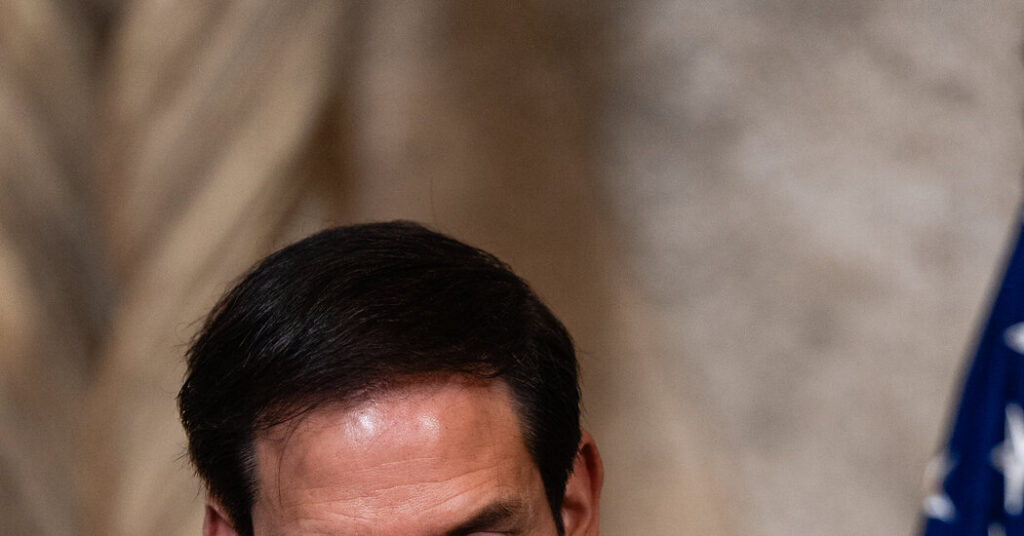
Secretary of State Marco Rubio personally approved the deportation of five student activists last year after receiving memos largely describing their participation in pro-Palestinian protests and their writings about the war in Gaza, according to internal government documents unsealed by a federal judge on Thursday.
The documents reveal new details about how the Trump administration decided to target the activists, who were all foreign students visible in campus protests. They had been in the United States legally but were arrested and threatened with deportation last spring.
The several hundred pages were submitted as evidence in a trial held in Massachusetts in July over noncitizen students’ freedom of expression.
After hearing testimony and examining the documents, Judge William G. Young, an appointee of President Ronald Reagan, ruled last year that the Trump administration had illegally targeted the students for deportation based on their speech — in particular their opposition to the Israeli government and its military operations in Gaza.
Judge Young had acceded to requests from the government to seal the documents because of details they contained about federal investigations. But last week he agreed to a request from The New York Times and other media outlets that they be released as a matter of public interest.
The documents include several batches of memos, prepared by the Department of Homeland Security and sent to the State Department, which contained the formal recommendations that five students — Mahmoud Khalil, Rumeysa Ozturk, Mohsen Mahdawi, Badar Khan Suri and Yunseo Chung — be deported.
The documents indicate that in nearly all instances, the arrests of the students were recommended based on their involvement in campus protests and public writings, activities that the Trump administration routinely equated to antisemitic hate speech and support for terrorist organizations. They also show that officials privately anticipated the possibility that the deportations might not hold up in court because much of the conduct highlighted could be seen as protected speech.
“Given the potential that a court may consider his actions inextricably tied to speech protected under the First Amendment, it is likely that courts will scrutinize the basis for this determination,” read one memo describing the effort to deport Mr. Madhawi, who had a green card and was an undergraduate at Columbia University at the time of his arrest.
A spokesman for Mr. Rubio did not immediately respond to a request for comment on Thursday evening.
In one set of documents with the referrals, officials acknowledged that almost no grounds existed for deporting the students other than a rarely used 1952 law that says the secretary of state may deem noncitizens deportable for reasons related to foreign policy.
“D.H.S. has not identified any alternative grounds for removability,” agents wrote of several of the students, “including the ground of removability for aliens who have provided material support for a foreign terrorist organization or terrorist activity.”
In justifying the attempt to deport the students, Mr. Rubio and other administration officials repeatedly asserted that they had supported terrorist organizations.
“We will be revoking the visas and/or green cards of Hamas supporters in America so they can be deported,” Mr. Rubio wrote online in March, referring to the militant Palestinian group in Gaza.
The students have denied that charge. They sued over their arrests, and judges last year ordered each of them released, citing concerns that their arrests had been based on protected speech.
The case before Judge Young, brought by two national academic organizations, argued more broadly that the arrests had chilled academic speech on the nation’s college campuses. Judge Young agreed, describing the behavior of Mr. Rubio and Kristi Noem, the homeland security secretary, as an “unconstitutional conspiracy” to “pick off” a few students with an eye to “violating” the free speech rights of thousands of noncitizen scholars.
“These cabinet secretaries have failed in their sworn duty to uphold the Constitution,” Judge Young said last week in an emotional denunciation of the government from the bench.
The government had argued in court that Mr. Rubio was exercising his sole authority to determine which activity by noncitizens might jeopardize the country’s foreign policy interests, which could include relations with Israel. They contended that the demonstrations had grown threatening to Jewish students on campus.
A homeland security spokesman did not immediately respond to a request for comment on Thursday.
Concluding the case, Judge Young ordered on Thursday that any future attempts to deport members of the two academic organizations that had sued could be immediately challenged in court, where the Trump administration would need to prove that it was not retaliating against the members over their speech or academic work.
The documents that Judge Young unsealed showed that government investigators searched for findings of wrongdoing on the part of the students, but internally acknowledged that they had found the task difficult.
In the case of Ms. Ozturk, a Tufts University postdoctoral student, homeland security officials wrote that there was no evidence she had “engaged in any antisemitic activity” or made “any public statements indicating support for a terrorist organization or antisemitism generally.” Nevertheless, they recommended that her visa be revoked based on “the totality of the circumstances presented.” A dossier compiled about her centered on an opinion piece she had written in The Tufts Daily, a student newspaper, calling for divestment from Israel.
Dossiers built with open-source research and summary reports on the students largely focused on news clips about their presence at campus demonstrations.
In the case of Mr. Khalil and Ms. Chung, both students at Columbia, investigators wrote that they had attended protests where fliers containing language from Hamas were distributed — but not that either had played any role in producing or distributing them.
In all cases, the determinations appeared to be largely based on assertions that various protest activities and statements had created a hostile environment for Jewish students on campus. President Trump last year directed agencies to monitor protests and crack down on any conduct that could be considered antisemitic as part of a wider campaign against universities.
It was only in Mr. Suri’s case that investigators claimed to have substantive reason to believe that he had direct ties to Hamas or was acting on the group’s behalf. Mr. Suri’s wife, an American citizen, is the daughter of Ahmed Yousef, a former adviser to Ismail Haniyeh, the Hamas leader assassinated by Israel in Iran in 2024.
But the documents released on Thursday did not include any evidence that Mr. Suri or his wife had been in touch with Hamas leaders. Mr. Suri’s file instead described his writings online, with investigators noting that he “appears to post pro-Palestinian content” on Instagram and citing a Facebook post “expressing support for Hamas founder Ahmed Yassin.”
Mr. Suri and his lawyer have denied that Mr. Suri engaged in any overt political activism, even saying he actively avoids protests.
While it is possible the government collected other information about the students, the records represent the information that the government presented to Judge Young to explain why the students were chosen for arrest.
The dossiers sent to the State Department were compiled by a specialized “tiger team” in the Homeland Security Investigations arm within Immigration and Customs Enforcement. The investigations unit has traditionally looked into serious crime like human trafficking, as well as national security cases.
Peter Hatch, an official tasked with overseeing the effort, testified during the trial last summer that the team had rushed a review of more than 5,000 students linked to pro-Palestinian demonstrations, sending their findings to Mr. Rubio’s staff for review. According to his testimony, the team’s work was also informed by reviewing lists of names compiled by at least two websites — the Canary Mission and Betar US — which identify and publish the personal information of pro-Palestinian protesters.
Zach Montague is a Times reporter covering the federal courts, including the legal disputes over the Trump administration’s agenda.
The post D.H.S. Cited Foreign Students’ Writings and Protests Before Their Arrests appeared first on New York Times.