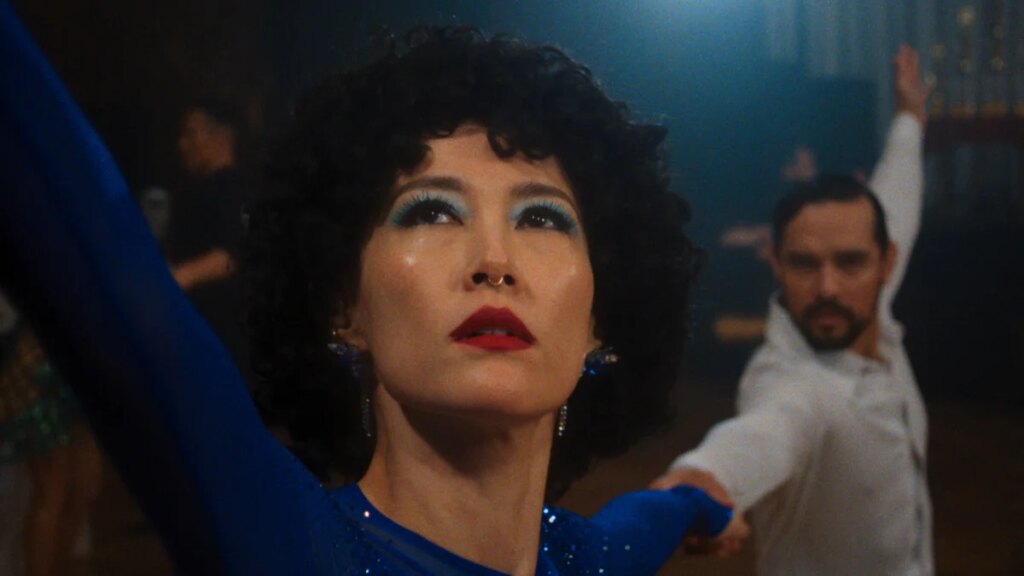
Haru, known to her friends as Ha-chan (Rinko Kinkuchi), stands out. With her tight perm and septum piercing — not to mention the garish smears of makeup she dons for her dance competitions — she’s the nail sticking up that Japanese society loves to hammer down. At least, that’s the proverb that’s repeated in Japanese 101 classes. The reality is more nuanced, as co-writer and director Josef Kubota Wladyka demonstrates in “Ha-Chan, Shake Your Booty!”
Kubota Wladyka’s third feature, which debuted at the Sundance Film Festival, is dedicated to his mother, a Japanese immigrant who raised Josef and his brothers on her own and still participates in competitive ballroom dancing at the age of 81. And although the character is merely inspired by her — the story is wholly fictional — the director’s heartfelt affection for his mom permeates the film. Quirky details abound, from the chirpy voiceover on each of the film’s chapter markers to the huggable raven mascot that embodies Haru’s grief. What keeps them from becoming insufferable (although, as always, viewer mileage may vary) is that Kubota Wladyka grounds them in both profoundly difficult emotions and a lived-in setting that illustrates the multicultural reality of life in 21st-century Tokyo.
Given its title and premise, surprisingly little of the film is actually dedicated to competitive ballroom dancing. An opening sequence introduces us to Haru and her husband, Luis (Alejandro Edda), on the morning of a big competition. He makes breakfast, they watch videos on a tablet, they practice each other’s languages. (Luis is originally from Mexico.) It’s all very cozy and domestic, and the love between them is obvious as they get dressed, pile into a cab and set out for the event. Once they hit the dance floor, Haru is literally walking on air, euphoric with passion for music and for her man. Then it all suddenly and dramatically stops, as Luis falls to the floor clutching his chest.
The period of intense mourning that follows is where “Ha-Chan, Shake Your Booty!” really begins. Despite a pair of blackly comedic funeral scenes that would make Juzo Itami proud, this isn’t really a film about death. It’s a film about moving on, and learning to — if not quite love again — continue living after a devastating loss. Luckily, the “keep on dancing” part of this message, easily the film’s most cloying aspect, is outweighed by something messier and hornier, as “Ha-Chan, Shake Your Booty!” morphs once again into an extremely modern sex comedy.
After she fails to show up to her own birthday party nine months after Luis’ death, Haru’s friends Hiromi (You) and Yuki (Yoh Yoshida) force her to get out of bed and join a Latin dance class.
There, Haru falls in uncontrollable lust with Fedir (Alberto Guerra), a ballroom champion who travels the world tangoing with women on the dance floor and in the bedroom. Scenes where Haru and her friends gossip about Fedir’s open marriage demonstrate the international nature of their world; the concept is not well-known in Japan, but it’s not unheard of in urban bohemian centers, either. Either way, Haru is not as cool with it as she thought she was, leading to an escalating series of wacky antics as she tries to convince herself that her relationship with Fedir is something that it’s not.
The aesthetics of “Ha-Chan, Shake Your Booty!” epitomize the concept of cultural appreciation, as opposed to appropriation. Haru loves Latin dance and Latin music (and, it should be noted, Latin men.) Her cozy, cluttered home is full of objects that appear to have been collected on trips abroad, and the impeccably curated soundtrack features everything from Japanese city pop to ‘90s alt-rock to tango and bluegrass music. At one point, Haru takes Fedir to see a musical based on “Dirty Dancing,” and while a showstopping number where the cast sings “I’ve Had the Time of My Life” in Japanese is somewhat played for laughs, it’s done in an affectionate way rather than a mocking one.
Kinkuchi’s expression watching said play is also one of authentic delight. Whenever the quirk threatens to overwhelm the emotion in “Ha-Chan, Shake Your Booty!,” Kubota Wladyka turns the camera onto his star’s face, and she almost invariably brings it back into balance. This is true even in sequences where characters literally break into song and dance in the style of an old Hollywood musical, as Kinkuchi’s strong, singular presence immerses the viewer in her character’s whimsical imagination and confusing emotions. She makes Haru a character worth rooting for — even, or perhaps especially, when she’s making all the wrong decisions.
In many ways, “Ha-Chan, Shake Your Booty!” is a dramatic pivot away from Kubota Wladyka’s previous feature, “Catch the Fair One,” an ultra-gritty revenge thriller starring professional boxer Kali Reis. But the two films do have a few things in common. Both feature determined heroines on a single-minded quest — the stakes are significantly lower here, but that’s okay — and both display the director’s talent for maintaining a consistent and controlled tone. Without this, the film would step on its own toes. With it, it’s right on beat.
“Ha-Chan, Shake Your Booty!” is seeking distribution.
The post ‘Ha-Chan, Shake Your Booty!’ Review: Rinko Kinkuchi and a Singular Tone Keep Quirky Dramedy on Beat appeared first on TheWrap.