A federal judge in Boston blocked the Trump administration from retaliating against two groups of scholars and students in a case that he said exposed an “unconstitutional conspiracy” to violate the First Amendment.
U.S. District Judge William Young issued the order Thursday in a lawsuit brought by the American Association of University Professors and the Middle East Studies Association that accused the government of arresting and detaining noncitizens because of their pro-Palestinian activism.
Young also unsealed key documents in the case, revealing the intelligence analyst reports and State Department memos that led to five of the detentions last year. They showed that a senior diplomat had repeatedly cautioned that targeting visa holders and permanent residents for deportation over “actions inextricably tied to speech protected under the First Amendment” would be likely to prompt court challenges.
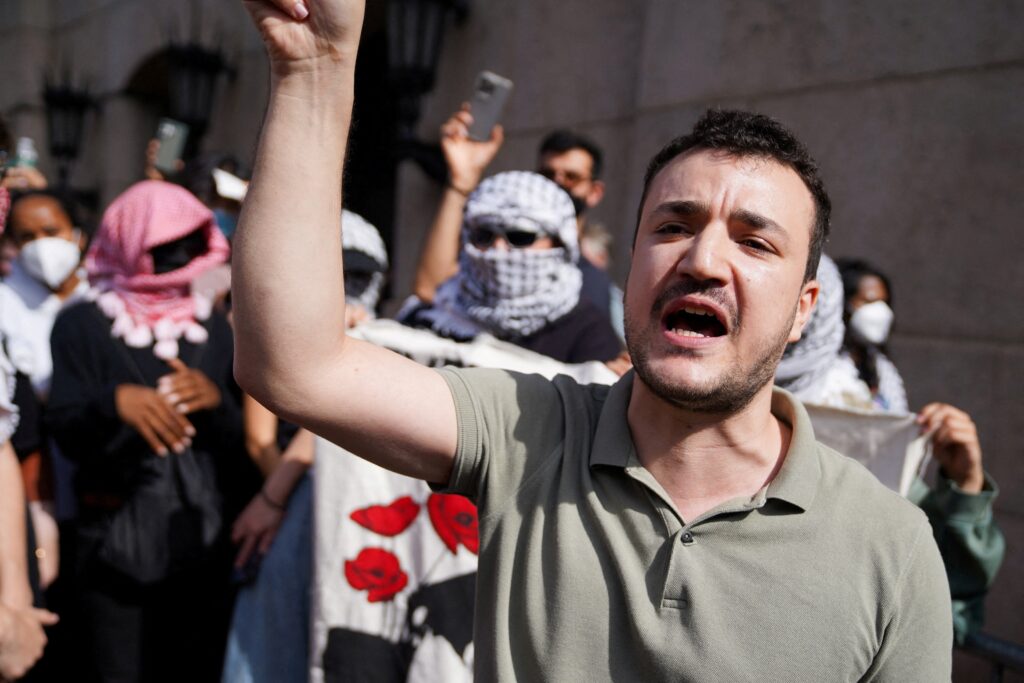
The government actions at the core of the litigation date to March 2025, when the Trump administration launched a campaign to detain and deport noncitizen students at universities who had been active in opposing Israel’s war in Gaza. Though not accused of any crime, those arrested spent weeks confined in Immigration and Customs Enforcement detention facilities, at times hundreds of miles from where they lived, before federal judges ordered their release.
Thursday’s order marks the culmination of a case in which Young previously ruled that the Trump administration’s crackdown was illegal. The government not only violated the free-speech rights of the detained students, Young said, but also sought to chill the same freedoms for thousands of other noncitizens at colleges and universities across the country.
The administration is likely to appeal. Spokespersons for the Department of Homeland Security and the State Department did not immediately respond to requests for comment.
While Young has issued sweeping denunciationsof the administration’s actions — last week he condemned officials’ “breathtaking” violations of freedom of speech — he also has acknowledged the difficulty he faced in reining in its conduct.
In September he wrotethat, in other times, he’d expect the corrective for such unconstitutional behavior approved by the president to “follow as a matter of course from the appropriate authorities,” such as Congress. “Yet nothing will happen.”
His remedy protects anyone who was a member of the two plaintiff groups at the time the case was filed from adverse changes to their immigration status, except in certain defined circumstances. An attempt to deport AAUP and MESA members would be presumed to be “in retribution” for their participation in the lawsuit against the government, the order says.
The only exceptions would be if the government proved that the noncitizen was convicted of a serious offense requiring a jury trial or that there was an “appropriate reason under the governing immigration law” to alter the person’s legal status.
The bench trial — decided by a judge rather than a jury — focused on the targeting of five noncitizen students and scholars: Mahmoud Khalil, Yunseo Chung and Mohsen Mahdawi, who were students at Columbia University; Rumeysa Ozturk, a graduate student at Tufts University; and Badar Khan Suri, a postdoctoral scholar at Georgetown University.
All were arrested except Chung, who obtained a restraining order before ICE could find her. The other four were released on the orders of federal judges, but the Trump administration is still trying to deport each.
While administration officials repeatedly accused the students of being “terrorist sympathizers” and “Hamas supporters,” no evidence of direct links to terrorism was presented at trial. Internal documents showed officials saying they were unable to use existing anti-terrorism provisions to justify the visa revocations.
Homeland Security Investigations, an arm of ICE that goes after transnational crime, took the lead in the crackdown. HSI researched the protesters and referred dozens of cases to the State Department, sometimes citing an obscure and rarely used statute for revoking visas. Then it carried out the arrests.
About 10 HSI analysts were diverted to a so-called “tiger team” devoted to the effort, including from units that normally focus on counterterrorism, counterintelligence and cybersecurity. They compiled more than 100 reports on protesters — a first, according to the testimony of the official who oversaw the process.
The team relied heavily on the website of Canary Mission, an opaque, anonymous pro-Israel group that says it documents individuals who “promote hatred of the USA, Israel and Jews.” It focuses primarily on college campuses.
The website included profiles of people who allegedly participated in a wide range of protest activity against Israel, such as organizing university encampments, signing letters and writing opinion pieces.
HSI arrested Ozturk on the basis of an op-ed she had co-written in the Tufts student newspaper more than a year earlier. The piece criticized the university’s unwillingness to divest from companies with ties to Israel.
While the Trump administration publicly accused Ozturk of engaging in activities “in support of Hamas,” an internal State Department memo noted that there was no evidence she had taken part in any antisemitic activity or indicated any support for terrorism.
Throughout the process, Young said in his ruling, officials consistently referred to campus protests related to Palestine as “per se ‘pro-Hamas’” and treated antisemitism as something that “in essence, one simply knows when one sees it.” During the trial, he reminded those present that the First Amendment protects political speech, including “strong” and “vile criticisms of the State of Israel.”
Noncitizens present in this country have the same right to freedom of speech as citizens, Young wrote in his September ruling.
At the final hearing in the case last week, Young offered a valedictory of sorts. The judge, appointed to the federal bench by President Ronald Reagan, motioned toward the large American flag hanging behind him and noted it would be there long after he was gone and the current case forgotten.
“What concept of freedom does that flag stand for?” Young asked the courtroom. “You all, each one of you, knows the answer.”
The post Judge limits government actions against plaintiffs in free speech case appeared first on Washington Post.