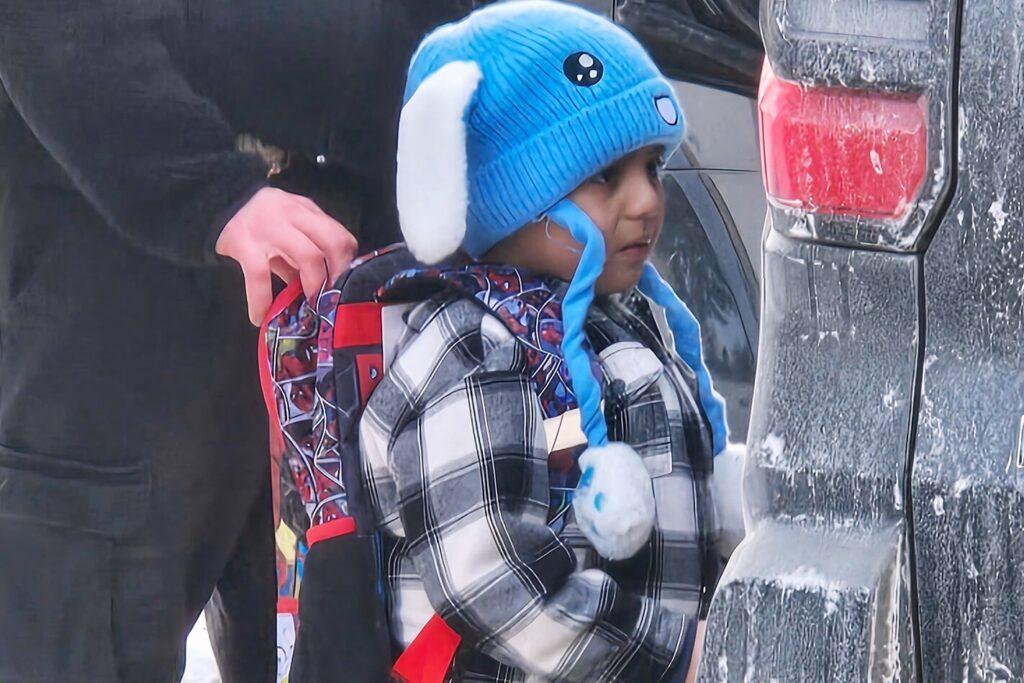
A viral image of 5-year-old Liam Conejo Ramos shows the boy in a blue knit hat with white bunny ears and pompoms, standing with a blank look on his face, staring at the back of a truck. Liam and his father were captured by Immigration and Customs Enforcement officers in Minnesota on Tuesday, and both are now detained in San Antonio, more than 1,200 miles from Liam’s home, his school, his friends and most of his family.
School officials in Minnesota say that the prekindergarten student was used “as bait” by ICE, in an apparent attempt to gain access to the adults inside the private house where he once lived. That act, the use of a boy too young to understand the political game in which he became a pawn, mirrors in a perverse and deeply disturbing way the power of the photograph. The photograph stirs empathy and compassion, the same emotions that ICE agents apparently used to entice adults into making themselves vulnerable to capture.
In the photograph, the hat functions the way toys or pets function in classic portraits of children, such as Dirck Santvoort’s portrait of a small girl with a goldfinch in London’s National Gallery or the tiny lapdog in Mary Cassatt’s “Little Girl in a Blue Arm Chair” in Washington’s National Gallery of Art. It underscores his tender years and innocence, while reminding us that childhood isn’t just about age. It is a condition of existence created, sustained and protected by adults. The hat tells us not only that there is someone close to him who loves and cares for him, but also that all of us, as adults, owe to children the right to live free from the suffering and meanness that so often define the world of adulthood. We must certainly never co-opt them into our guile or cruelty.
Much of what we know about the image must be surmised: that he is bewildered and terrified. What is the evidence for these suppositions? A basic sense of human empathy.
It is not a strongly constructed photograph and was probably never meant to be. It is evidence, forensic data, snatched from the slipstream of human barbarity, probably by a cellphone camera. But its accidental composition accentuates the boy’s helplessness, and by extension, our own compassion for children standing in the bitter cold, torn from the protection of their parents, subject to the brutal treatment of adults. The boy stares at the truck, as we might stare at a wall if brought to the point of complete moral despair, complete loss of faith in too many of our fellow citizens.
This is an image of universal moral urgency, akin to a small number of photographs that once upon a time had the power to change our behavior, away from cruelty or indifference and in the direction of basic decency. The 1972 “Napalm Girl” image, of a child running naked in the street after an attack by U.S.-backed South Vietnamese forces, is one example. Kevin Carter’s 1993 “Vulture and the Little Girl” image, of an emaciated and starving Sudanese child stalked by a hungry vulture, is another. In the last Trump administration, a photograph of Salvadoran migrant Óscar Alberto Martínez Ramírez and his nearly 2-year-old daughter, Valeria, drowned in the Rio Grande, stirred considerable resistance to the president’s immigration policies.
The use of the term “bait” is understandable but inadequate to the moral questions raised by the photograph of Liam. Local school officials say that ICE officers compelled the child to knock on the door of his house, in an attempt to lure other adults out or gain access.
Bait suggests something akin to fishing, with a dynamic of desire and reward. The fish covets the worm but gets hooked in the process. But the use of a 5-year-old child in distress, cold, confused and helpless, to trick and ensnare his own caretakers doesn’t fit this metaphorical use of language.
A universal moral image works because at some level we share a universal moral conscience. There are certain things that, when seen, compel us to action in a way that transcends all other concerns.
It is universal because the suffering of a child cuts across race, nationality and ideological divisions. It is universal because it takes precedence over all other concerns. A child in distress demands action now. The world stops for a moment, and decent people do what is absolutely, immediately necessary.
Among the most deeply distressing things this image represents is the instrumentalization of compassion. ICE didn’t place a box of candy or a $100 bill on the front stoop of the house, hoping to tempt people out. They used a child to appeal to the most innate and essentially human impulse to show care, concern and protect — to capture those who care for him. They weaponized decency, the last incorruptible defense we have against absolute misery and evil.
Debates about photography and images of distress and suffering circle around a recurring concern: that we grow accustomed to drastic and distressing images, and they lose their power. Universal moral images are those few representations that still have the power to cut through the cycles of shock and acceptance, the deadening of our responses, the eventual thinning out of the camera’s power to compel us to action.
This image will be part of a double test. Does it have the power to shock Americans into demanding an end to this cruelty? And if not, do universal moral images still exist in America?
The post The abhorrent power of the photograph of a 5-year-old held by ICE appeared first on Washington Post.