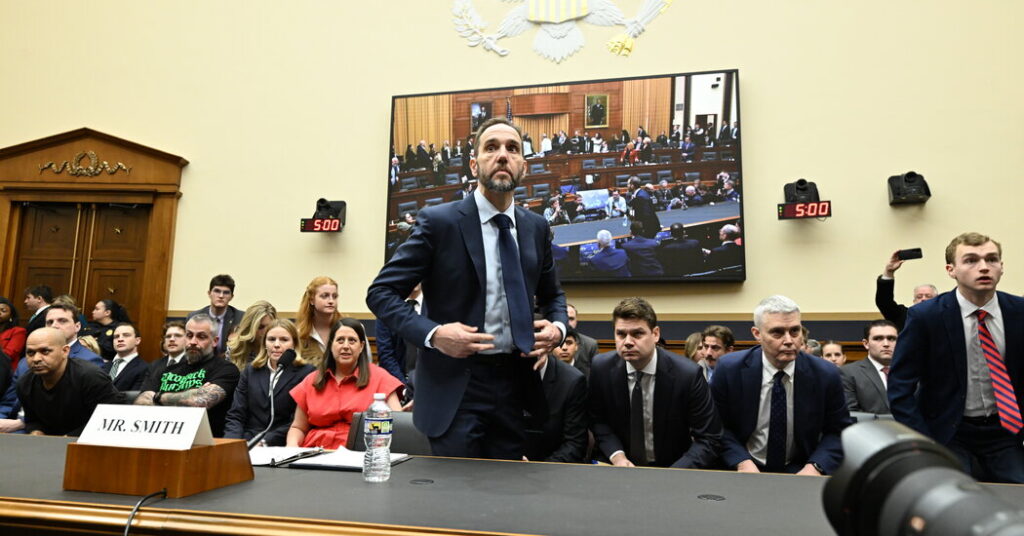
Jack Smith, the special prosecutor who investigated Donald J. Trump, appeared before lawmakers on Thursday to defend his decision to indict Mr. Trump twice after he left office in 2021. It was Mr. Smith’s first and perhaps only chance to make his case in an official forum.
“No one should be above the law in this country, and the law required that he be held to account,” Mr. Smith said in his opening remarks. “So that is what I did.”
The hearing poses significant risks to Mr. Smith, who has said he believes Mr. Trump and his appointees will seize on the smallest misstep to investigate, prosecute and humiliate him. But it also provides him with what is likely to be his best opportunity to challenge Mr. Trump’s justification for deploying the Justice Department to pursue his enemies: that he was persecuted for his politics, not for his misdeeds.
Republicans berated Mr. Smith, repeatedly accusing him of participating in a Democratic conspiracy to destroy Mr. Trump.
But they offered no new evidence to support that claim, and spent much of their time rehashing political arguments and grilling Mr. Smith about his decision to seek a court order for metadata about phone calls Mr. Trump and his allies made to nine lawmakers as they sought to overturn the results of the 2020 election.
Mr. Smith and his team interfered in the “democratic process by seeking to muscle a candidate for a high office,” Jim Jordan, Republican of Ohio and the chairman of the House Judiciary Committee, said in his opening statement.
The witness denied those claims, offering calibrated and mostly emotionless replies that contrasted with the high-volume attacks and defenses emanating from the dais.
Before sitting at the witness table, Mr. Smith smiled and nodded at four law enforcement officers who were attacked by the pro-Trump mob at the Capitol — Michael Fanone, Daniel Hodges, Aquilino Gonell and Harry Dunn.
Mr. Smith’s remarks represent the summation he was never allowed to deliver in a courtroom, and conclude that Mr. Trump “engaged in criminal activity” that undermined democracy and the rule of law.
In his statement, Mr. Smith accused Mr. Trump of “engaging in a criminal scheme to overturn the results” of the 2020 election.
The path that led to Mr. Smith’s testimony mirrored a tortuous legal and political odyssey that began in 2023, when he filed the first-ever federal criminal charges against a former president. It ended the next year when Mr. Trump won the presidency, intent on exacting vengeance on those who had prosecuted him.
For all their public denunciations of Mr. Smith, House Republicans had been privately reluctant to give him a public forum to make his case against Mr. Trump, after courts threw out charges against him in Florida and the District of Columbia.
Thursday’s testimony follows months of back and forth. Lawmakers debated how to proceed, and Mr. Smith demanded that he be given the right to defend his team. Lawmakers and Mr. Smith’s lawyers also wrestled over what the former special prosecutor was allowed to talk about (the election interference indictment in Washington) and what he was not allowed to discuss (many details about the document-retention case sealed by a Trump-appointed judge in Florida).
Mr. Jordan scheduled the public hearing after closed-door testimony by Mr. Smith on Dec. 17, an appearance that struck even his Republican critics as sure-footed and free of the type of misstep that might have led to a criminal prosecution on the grounds that he deceived or stonewalled Congress.
Republicans, led by Mr. Jordan and Senator Charles E. Grassley, Republican of Iowa and the chairman of the Judiciary Committee, have suggested that Mr. Smith was motivated by partisan politics, and have placed him at the center of what they have said was a conspiracy to weaponize the Justice Department against Mr. Trump and his allies.
The F.B.I., now run by a Trump ally, Kash Patel, has scoured its vast holdings to root out negative information about those who once investigated Mr. Trump and his supporters, an undertaking critics have called an opposition research operation.
On the eve of Mr. Smith’s appearance, the bureau continued to selectively release portions of Mr. Smith’s files to impugn him and the work of his team.
This time, the disclosure was made to the conservative journalist John Solomon. On Wednesday morning, he cited F.B.I. documents in reporting that prosecutors working for Mr. Smith had paid thousands of dollars to online sleuths to help them look for video evidence tying Trump supporters who attended the president’s rally near the White House on Jan. 6, 2021, to the subsequent riot at the Capitol.
The work of the sleuths, often known as sedition hunters, was widely used to bring criminal cases against hundreds of the rioters. But Mr. Patel told Mr. Solomon that Mr. Smith’s payments for their help amounted to “a stunning abuse of bureau authorities.” Mr. Patel also vowed to disclose the material to Congress, raising the possibility that Mr. Smith would be questioned about the sedition hunters on Thursday.
The last time Mr. Smith testified — in the closed-door session — he spoke freely about the charges he filed accusing Mr. Trump of seeking to overturn the results of the 2020 election. But he was more constrained in commenting on the other criminal case he brought, which charged Mr. Trump with illegally holding on to reams of classified materials after leaving the White House in 2021.
He will face the same prohibition in his testimony on Thursday given that the expansive report he wrote about the documents case remains under seal because of an order issued by Judge Aileen M. Cannon, the Trump appointee who oversaw the proceeding.
Her order expires on Feb. 24, but Mr. Trump has been trying to prevent the report from seeing the light of day. On Tuesday, his lawyers asked Judge Cannon to permanently keep it under wraps, arguing that its release would “improperly endorse” Mr. Smith’s “unlawful investigation and prosecution” of the case and “irreparably harm President Trump.”
Mr. Smith was appointed in late 2022 to oversee the investigations, but he dropped both cases after Mr. Trump was elected to a second term, citing court rulings that prevented prosecution of a sitting president.
The House Judiciary Committee has already made a criminal referral of one of Mr. Smith’s top deputies, Thomas Windom, to the Justice Department for not fully answering similar questions. Mr. Windom, now Mr. Smith’s law partner, has denied wrongdoing.
Glenn Thrush covers the Department of Justice for The Times and has also written about gun violence, civil rights and conditions in the country’s jails and prisons.
The post Jack Smith Defends Trump Investigations Before Lawmakers appeared first on New York Times.