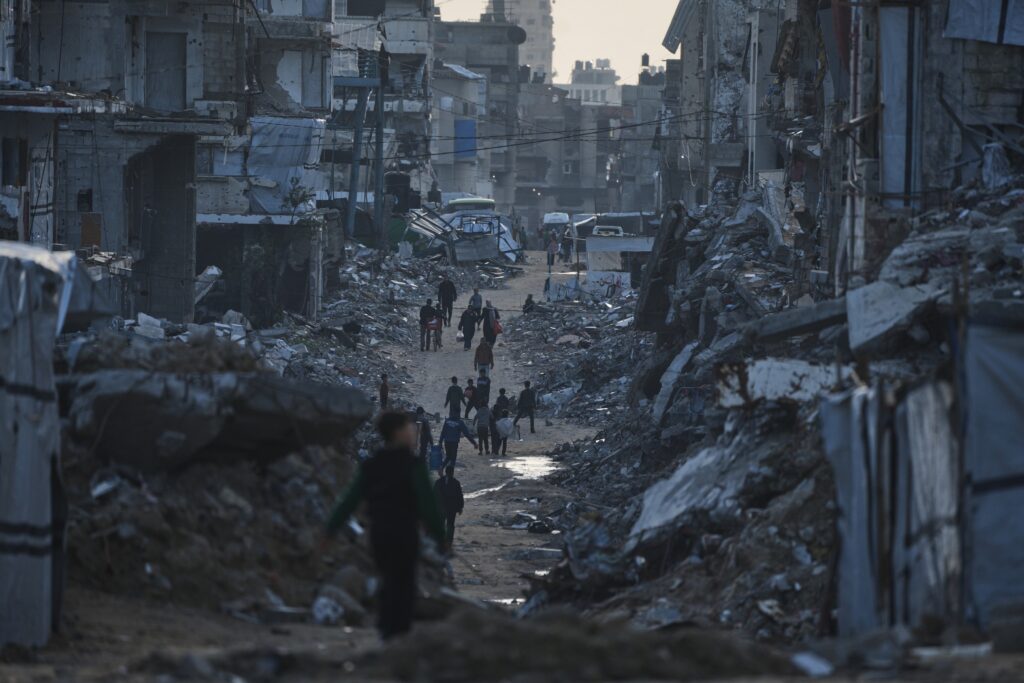
CAIRO — At the World Economic Forum in Davos, Switzerland, on Thursday, the Trump administration outlined what it described as a “master plan” for the Gaza Strip’s future, replete with planned cities, data centers and a beachfront for tourists, but which was far removed from the destruction, desperation and political realities on the ground.
Jared Kushner, President Donald Trump’s son-in-law and key adviser, took to the stage to present a deck of slides with AI-generated images of gleaming high-rises and apartment blocks arranged in concentric rings. From 90,000 tons of rubble generated by the war, he said, a “new Gaza” would be born.
“We’re committed to ensuring Gaza is demilitarized, properly governed and beautifully rebuilt. It’s going to be a great plan,” Trump said. He and other leaders were there to sign the founding charter of the “Board of Peace,” originally conceived as an oversight body for the reconstruction of Gaza but which has since morphed into a U.S.-led council with a more sweeping mandate.
“I think we can spread out to other things as we succeed with Gaza,” Trump said.
According to a map included in Kushner’s slideshow, Gaza’s entire Mediterranean shoreline would be reserved for “coastal tourism,” with 180 high-rise towers lining the beach. Across other parts of the enclave, parks and sports facilities would break up industrial complexes, data centers and advanced manufacturing facilities. Residential areas appear to take up only about half of the map, while some areas marked for agriculture are located in places with poor, sandy soil unsuitable for crops.
The vision contrasts sharply with the present reality in Gaza, where Israeli troops still control more than half of the enclave while some 2 million Palestinians are crowded into the other half, many living in ramshackle tents or bombed-out buildings that provide little shelter from winter storms.
On a visit to the Israeli-controlled side of Gaza on Wednesday, organized and escorted by the military, an area of farmland in central Gaza that once housed American and U.N. aid initiatives looked broken and deserted. As heavy machinery reinforced the sand berm around a small Israeli base, the sound of gunfire crackled in the distance.
Concrete yellow blocks meant to demarcate the “Yellow Line” between the two sides divided the barren, Israeli-controlled zone from the cramped streets and residential blocks of nearby Deir al-Balah, a city whose population swelled with displaced people during the war.
Humanitarian aid has nearly tripled since a U.S.-backed ceasefire took effect in October and a surge of food has provided “full coverage of minimum caloric needs for the first time since October 2023,” the U.N. Office for the Coordination of Humanitarian Affairs said last week. But with food prices still high, malnutrition continues to plague vulnerable groups, nonprofit organizations working in Gaza say.
Over the next 100 days, the priorities will be humanitarian aid and shelter, Kushner said. “Full aid will be immediately sent into the Gaza Strip,” a slide read, though Kushner did not indicate whether Israel had agreed — or whether more border crossing points would open to allow in larger quantities of U.N. and bilateral aid stockpiled outside Gaza.
Kushner has been pushing the idea of beginning to rebuild in parts of Gaza controlled by Israel, alarming Arab countries that fear it would enable a permanent Israeli takeover of half of Gaza.
The intent signaled Thursday to rebuild Gaza in four phases, beginning with Rafah in southern Gaza — most of which currently lies behind Israeli military lines — is likely to fuel those fears. “Workforce housing” will be built there in two to three years, Kushner said, and “we’ve already started removing the rubble and doing some of the demolition.” (He appeared to be referring to the extensive demolition campaigns the Israeli military has carried out in recent months.)
Whether there is the political will and the necessary funds to move forward with rebuilding Gaza remains far from certain.
The announcement last week of a committee of Palestinian technocrats to administer Gaza marked a major milestone, as disparate and usually divided Palestinian factions rallied behind the group. The committee, led by Ali Shaath, a civil engineer from Gaza who held senior roles in the Ramallah-based Palestinian Authority, has begun meeting in Cairo to plan its work. Hamas has said it is ready to hand over governance to the group.
In a video streamed at the Davos gathering, Shaath announced that the Rafah crossing with Egypt — a key lifeline for the movement of people and goods to and from Gaza — would reopen next week “in both directions.” Trump’s 20-point plan for Gaza called for the resumption of traffic through the crossing, which stopped operating in May 2024 when Israel launched an offensive on the Gaza side. Israel has delayed its reopening until Hamas or allied militants return the remains of Ran Gvili, the last Israeli soldier held in Gaza.
Nickolay Mladenov, the newly appointed high representative for Gaza, who will liaise with the Board of Peace, wrote on X on Thursday that “an agreement has been reached regarding the preparation for re-opening of the Rafah crossing.”
But Israeli Prime Minister Benjamin Netanyahu’s office did not say whether Israel had agreed to open the crossing. An Israeli official, speaking on the condition of anonymity because they were not authorized to discuss the issue publicly, said the cabinet would convene next week to deliberate.
“A special effort is being made to recover the body of Ran Gvili, of blessed memory, while making full use of the information we possess,” the official said.
Israeli politicians across the spectrum have also decried the inclusion of ministers from Turkey and Qatar on a Gaza executive committee, under the umbrella of the Board of Peace, that the White House said will focus on supporting “effective governance” in Gaza. Many Israelis worry about the two countries’ long-standing relationships with Hamas, and the announcement fueled calls by the Israeli far right to return to full-scale war in Gaza.
The broad scope of the charter of the Board of Peace, meanwhile, has elicited concerns from some European countries, which have declined so far to sign on. A group of eight powerful Arab and Muslim-majority countries said in a joint statement Wednesday that they would participate — but emphasized that the board should be “transitional” and focused on Gaza.
Trump’s announcement today is “another expression of the shift in the rules of the game that were in place for years in the Gaza Strip — a game that used to be bilateral, between Israel and the Palestinians,” said Ofer Guterman, a former senior analyst with Israel’s military intelligence directorate. “It was conducted between us and them, but currently, we are seeing an internationalization of the conflict in Gaza.”
The powers of the Palestinian administrative committee are still “very vague,” which is cause for concern, Khaled Okasha, an Egyptian consultant who advised Palestinian and Egyptian delegations in ceasefire negotiations, said in an interview Thursday.
Just one of Kushner’s 10 slides that detailed the future of Gaza mentioned Palestinian leadership. It also featured the only Arabic in the slide deck, which was illegibly formatted backward.
With so much uncertainty surrounding how the new governance structures will work, no countries have publicly committed funds to Gaza reconstruction. Kushner did not provide an estimate for how much the implementation of his plan would cost. A reconstruction plan backed by Arab and Muslim-majority countries last year ballparked reconstruction at more than $53 billion, while U.N. experts estimated more recently that it would cost about $70 billion.
Kushner urged private investors not to fear the risk of investing in Gaza and said that a first conference in Washington to fund the plan will be announced within a couple of weeks. The plan also suggested that Hamas leaders would be given “amnesty and reintegration” in return for disarmament of the group, and it promised a full withdrawal of Israeli troops.
Israel has shown no serious signs of a willingness to withdraw and to commit to an end to the war, Okasha said — and Hamas won’t lay down its arms until Israel takes some steps in that direction.
“Netanyahu has no interest in withdrawing from Gaza,” said Israel Ziv, a retired major general and former head of the Israel Defense Forces Operations Division.
Israeli forces have killed more than 460 people since the ceasefire came into place, according to the Gaza Health Ministry. Those include more than 100 children, UNICEF, the U.N. children’s agency, has said. On Wednesday, Israel killed three journalists in an airstrike on their car, far away from the Yellow Line in central Gaza.
Cheeseman reported from Beirut, Loveluck from Deir al-Balah, Soroka from Tel Aviv and Balousha from Toronto.
The post Trump’s ‘master plan’ for Gaza contrasts with reality on the ground appeared first on Washington Post.