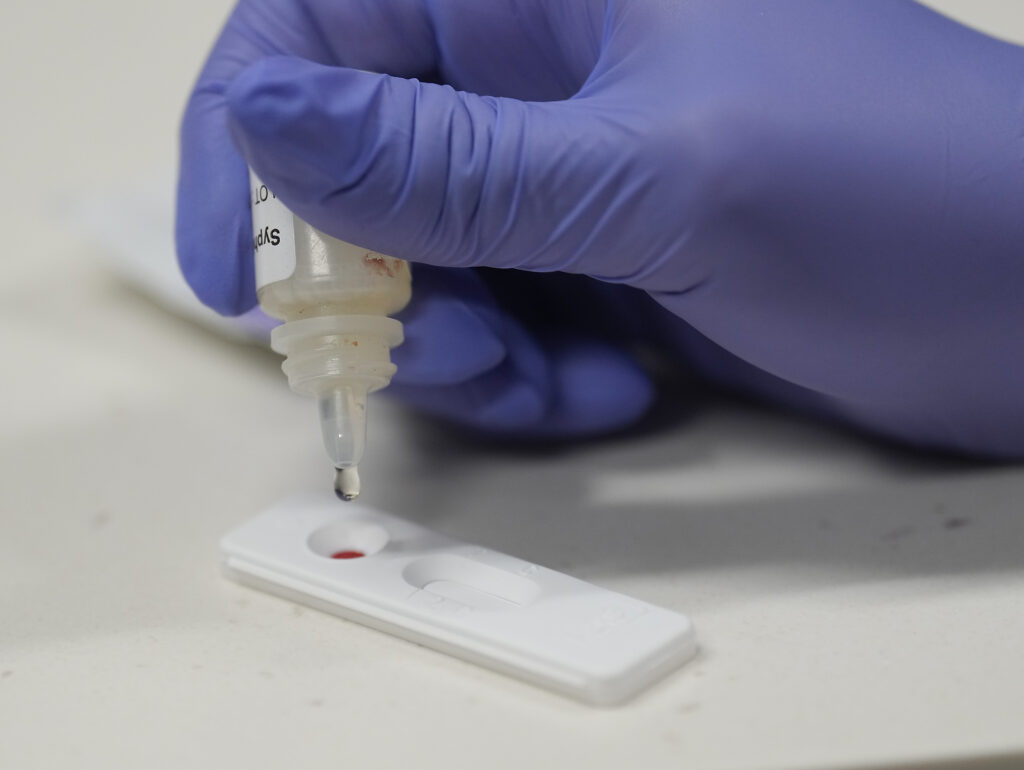
From a 5,500-year-old human shin bone, scientists have discovered a close cousin of the pathogen that causes syphilis, providing the oldest evidence yet that the disease has ancient roots in the Americas, millennia before European contact.
A historical and scientific debate has raged about the origins of syphilis for hundreds of years, a geopolitical blame game intertwined with European colonialism, treatment of Indigenous people and stigma. Was the sexually transmitted disease that began to tear through Europe at the end of the 15th century brought back to the continent by Columbus, or was it already circulating in medieval Europe?
The new study published Thursday in the journal Science adds to a growing body of evidence that the syphilis origin story is not just an Old World versus New World argument, but a much longer story about human coexistence with pathogens. Treponema pallidum, the bacterium whose subspecies cause syphilis and several other modern infections, clearly existed in the Americas before European contact.
The pivotal shin bone belonged to a hunter-gatherer whose remains were found at a rock shelter near Bogotá, Colombia. The discovery pushes back the oldest Treponema genome by 3,000 years.
The find helps fill in the history of a pathogen that shaped the globalizing world, but began its relationship with humans far earlier.
Well before the advent of agricultural practices that increase the likelihood of diseases leaping from animals into humans and spreading through crowded societies, this pathogen began infecting hunter-gatherers, possibly from an animal host.
“It’s easy to fall into narratives of where diseases come from, and that plays into geopolitics. But diseases are way more complex than that,” said Molly Zuckerman, a paleopathologist at Mississippi State University. She praised the study as remarkable, because it reframes some of the biggest questions about the evolution of syphilis, focusing not just where and when it spread, but how its origins were driven by “interactions between humans and the environment, and economic and social processes that are where we know diseases come from.”
Many skeletal remains are marked by lesions that are the telltale sign of treponemal infections such as syphilis, but the discovery of ancient pathogen DNA came as surprise in this case. Miguel Delgado, an archaeologist at the National University of La Plata in Argentina, said that the hunter-gatherer would have been about 40 years old and lived off a local diet, with no signs of infection. During a study of the individual’s ancient DNA, scientists found that mixed in with the human DNA were fragments of bacterial genome.
A rapidly expanding team of experts became involved in the project, piecing together the bits of ancient DNA and finding they matched up to Treponema pallidum, but that it was a new subspecies. The detailed genetic comparison allowed them to predict that the subspecies that cause modern infections, including syphilis and related diseases, yaws and bejel, emerged about 6,000 years ago.
Mathew Beale, a senior staff scientist who studies bacterial evolutionary genetics at the Wellcome Sanger Institute, said in an email that this date was significant, corroborating a previous study that found the pathogen that causes syphilis emerged before European contact. This line of evidence raises questions about other studies that have suggested Treponema was already present in medieval Europe.
Understanding how pathogens that naturally occur in the environment become human diseases is one of the central dilemmas in public health. Syphilis may be an early poster child of this phenomenon. What this study can’t yet determine is how the illness would have been transmitted — when it became the sexually transmitted disease that remains a public health menace today.
“This adds more information to history that’s been, in many cases, lost or obscured because of colonial agendas,” said Elizabeth A. Nelson, a molecular anthropologist at Southern Methodist University and part of the team that conducted the work. “This shows that Indigenous people in the Americas were living with and adapting to complex infectious diseases thousands of years before colonization, so it reinforces the fact that these groups had long, independent stories of health and disease and social interaction that don’t begin with Europe.”
The post 5,500-year-old DNA shows syphilis was rooted in the Americas, before Columbus appeared first on Washington Post.