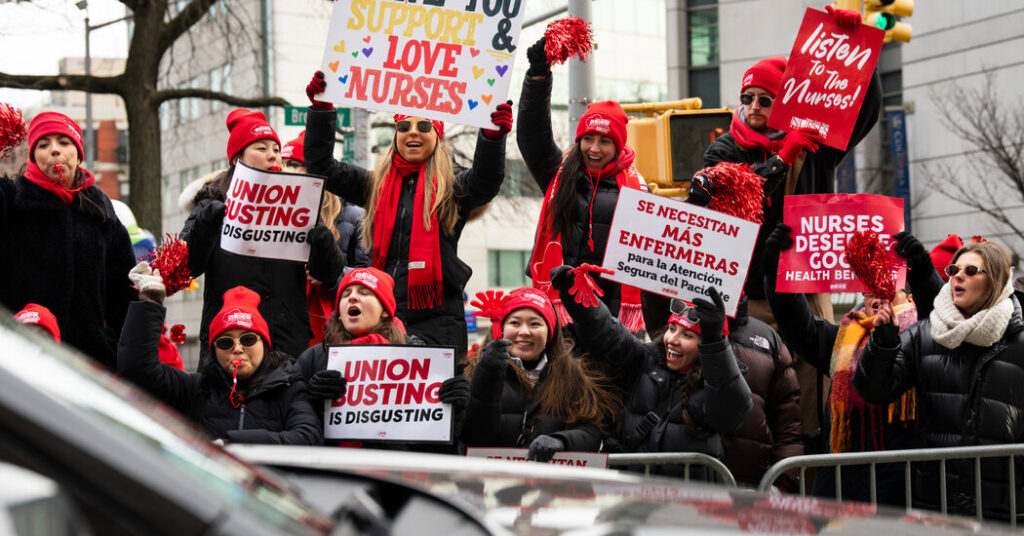
As a strike by nurses at some of New York City’s leading hospitals stretched into its second week, Mayor Zohran Mamdani appeared on a picket line and addressed a crowd of health care workers.
Their strike, he said, had the same goals as his administration: making New York City more affordable. For nurses, he said, the walkout is about making sure “that this is a city you don’t just work in but a city that you can also live in.”
The nurses’ union, the New York State Nurses Association, said it would resume negotiating on Thursday with several of the biggest hospitals in the city, including NewYork-Presbyterian/Columbia, Mount Sinai and Montefiore Medical Center. The two sides have reported little progress toward an agreement and only occasional bargaining sessions since the strike by nearly 15,000 nurses began on Jan. 12.
What are the issues in the strike?
The three hospital systems affected by the strike said their nurses on average make about $160,000 a year and are seeking raises that could propel nurses’ salaries on average past $200,000, according to the hospitals.
One hospital system, Mount Sinai, said that the financial demands originally made by the nurses’ union, known as NYSNA, would increase average pay to $275,000, an assertion that the union disputed.
“From the very start, these negotiations have been primarily about NYSNA’s financial demands, plain and simple,” said Marc Kramer, the lead negotiator for Mount Sinai Hospital and the president of the League of Voluntary Hospitals and Homes of New York.
Since the start of the strike, nurses on the picket line and their union leaders have tended to minimize pay as a major reason for the labor action, instead highlighting other demands.
“If they were to move away from the money for just a second and look at the basic needs of human care, maybe they can see what we are fighting for,” said Johnaira Dilone-Florian, a nurse practitioner at Montefiore who was on the picket line on the third day of the strike.
In speeches and in conversations with reporters, nurses shared their concerns about workplace violence and demanded increased security at hospital entrances after a spate of violent episodes inside hospitals.
They also raised concerns about insufficient staffing, recounting how the hospitals had a history of leaving nurses with too many patients to care for at once.
But they have said less about money, unless it was to discuss the salaries of hospital chief executives. The president of the nurses’ union, Nancy Hagans, has called the hospital bosses “greedy.” The former head of NewYork-Presbyterian, Dr. Steven Corwin, who stepped down this week, received more than $26.3 million in 2024, making him one of the highest-paid hospital executives in the nation that year. His compensation for leading the nonprofit hospital system — which included not just base salary but payouts from incentive plans and other benefits — outpaced even the pay of many executives who lead for-profit hospital chains.
How much do nurses make?
At NewYork-Presbyterian/Columbia Hospital, nurses on average earn $163,000 a year, according to the hospital.
At Montefiore Medical Center in the Bronx, nurses make a bit more. There, the average salary is about $165,000, not including overtime, according to figures provided by the hospital. Of course, not every nurse makes that.
The average pay figures encompass different categories of nurses, including registered nurses and nurse practitioners, who have more education and responsibilities. The salary floor for an entry-level nurse at Montefiore was $117,424 in 2025, while a nurse practitioner earned $158,680 and a nurse midwife made $165,170, according to the union’s contract with Montefiore.
At Mount Sinai Hospital, nurses (including not only RNs but also a smaller number of nurse practitioners and a much smaller number of nurse anesthetists) had an average base salary of about $128,700 last year, according to an analysis prepared for the hospital’s negotiators. But after adding holiday pay and other differential compensation, the total pay of a Mount Sinai nurse averaged about $151,800 in 2025, the analysis showed. With overtime, which came out to $10,200 per nurse, the pay averaged $162,000.
A review of the union contract with Mount Sinai offers further details:
-
An entry level nurse at Mount Sinai last year made $121,931 in base salary. A clinical nurse who was assigned to float between units as needed was paid about 10 percent higher: $134,124.
• After each year of employment, a nurse’s salary increased. After five years, the “experience differential” meant a $9,100 higher salary; 10 years meant a $14,500 higher salary.
• Nurses who work nights are paid an extra $6,100 per year.
• Nurses with a bachelor’s degree earn $1,400 more a year, while those with a master’s degree earn an additional $1,600, and those with a Ph.D. receive $1,900 in extra income.
Some hospital executives have suggested nurses are paid well.
“I can tell you only that the nursing salaries that are paid in New York are well above the wages of other essential workers: police, firefighters, teachers,” said Kenneth E. Raske, the president of the Greater New York Hospital Association, a trade group.
Those are civil service jobs with a government employer. The nurses on strike work for large private, nonprofit institutions.
While entry level nurses make significantly more than new police officers in New York City, officers’ pay rises steeply after a few years. Officers have starting salaries of $60,884, but that climbs to more than $125,000 after five-and-a-half years.
Nurses say that working in a hospital can be grueling, physically tiring and emotionally demanding. In crowded emergency departments, nurses are sometimes given an overwhelming number of patients to treat. In intensive care units, nurses care for patients on the edge of death, sometimes for weeks on end.
Many hospital nurses in New York work 12-hour shifts, three days a week. Their work is high stakes. Mistakes can endanger patients. Polls suggest that they are generally more trusted and regarded as more ethical than members of just about any other profession.
Since the strike began, many nurses have spent long shifts on the picket line outside hospitals, in bitter cold, sometimes bringing their children. Others are working per diem nursing jobs elsewhere, according to interviews with nurses. A few have posted pleas for financial support on gofundme.com.
Mount Sinai nurses lost their health insurance when they went on strike. One of them, Zara Roy, who has worked at Mount Sinai Morningside for about 13 years, said she has had to cancel speech therapy appointments for her 7-year-old daughter now that her family is uninsured.
“It weighs heavily on me,” she said, but sending her daughter for therapy would cost $600 a week.
Still, Ms. Roy, who said she made at least $160,000 last year, supports the strike, characterizing the raises offered by the hospital as “unrealistic.”
In her view, nurses deserve a significant raise.
“I think it’s OK for nurses to make close to $200,000, just to make a livable living in the tristate area, honestly,” said Ms. Roy, who lives in Bergen County, N.J., and pays about $30 in tolls and parking each time she comes to work.
In the New York metropolitan area, a family of four with two working parents needs pretax income of about $145,000 to cover their cost of living, compared with about $112,000 in Miami and about $105,000 in Houston, data compiled by the Living Wage Institute show.
Nurse practitioners in New York earn more than their counterparts in every city in the country with the exception of Bellevue, Wash., according to data compiled by Indeed, the online job site. Indeed shows nursing jobs in New York pay about $142,000 a year, about 9 percent higher than the national average of about $130,000.
Nationally, the median annual pay for registered nurses was $93,600 in 2024, according to the Bureau of Labor Statistics.
New York City nurses in their last contract secured a 7 percent raise in 2023, 6 percent the following year and 5 percent in 2025.
The union would like to see similar raises — or higher — again. The hospitals say the increases this time will be far more modest.
When nurses went on strike in 2023, they had deep public support, after caring for Covid-19 patients during the deadliest days of the pandemic. Their ranks had been diminished because of burnout and retirements, and many hospital units were chronically understaffed. When the nurses went on strike — for the first time in New York City in 25 years — they caught the affected hospitals by surprise.
It’s different this time. Hospitals in New York anticipate billions less in federal dollars in the years ahead, making them reluctant to substantially increase nurses’ pay. And hospital administrators have been preparing for this strike, convinced they can outlast the nurses.
What are the nurses’ financial demands?
Last fall, as negotiations got underway, the nurses’ union asked for annual increases of 10 percent. That alone would push average salaries toward $200,000 by 2028, the third year of the contract. But other proposals would send nurses’ salaries above that.
At Montefiore, where the union posted some proposals online, the nurses are seeking an additional $7 an hour for weekend shifts. The union wanted nurses on the night shift to receive an extra $15,000 annually — not the current $6,000. They sought other increases, too.
Of course, at the start of any contract negotiation, neither side expects to get everything it’s asking for.
At Mount Sinai, the hospital claims that at a bargaining session in mid-December, the union proposed that each emergency department nurse receive hundreds of dollars in surge pay for every shift when there are more than a certain number of patients. The union proposed a similar payout for labor and delivery nurses. One hospital negotiator said that the threshold for additional payments would be reached at least one out of every two days, which could amount to an additional $10,000 or more a year for some nurses.
Amid the conflicting messages from the two sides, one things is clear: They remain very far apart on pay.
What are the hospitals offering?
Hospital negotiators have offered to give each nurse an additional $4,500 a year for the next three years. The nurses can decide how much of that money goes to salaries and how much toward health care, pensions and other benefits, hospital officials said. In interviews, nurses have called that offer unrealistically low or insulting.
That approach differs from traditional offers from management. Typically, hospitals lay out annual percentage increases in pay, as they did in the last negotiation.
This time, hospital officials wanted to illustrate that salaries are just one of many labor costs and to show how raises ripple outward, affecting overtime and holiday pay and driving up the cost of adding staff.
Olivia Bensimon contributed reporting.
Joseph Goldstein covers health care in New York for The Times, following years of criminal justice and police reporting.
The post Nurses in New York City Say They Deserve $200,000 a Year. Here’s Why. appeared first on New York Times.