The great thing about the 72-year-old Winter Show, aside from ticket sales benefiting the East Side House Settlement, which provides a variety of educational and support programs across northern Manhattan and the Bronx, is the sheer range of art and antiquities it brings to the Park Avenue Armory. Silver teapots, Chippendale clocks, English crossbows, paintings of horses, Chinese almanacs, chairs carved from oak trunks, American game boards (Ricco/Maresca Gallery, C16), Tiffany lamps and mosaics (Lillian Nassau, B2, and Macklowe Gallery, C9), a scattering of contemporary art, the “birth certificate” of the Louvre (Thomas Heneage Art Books, B4) and a delightful Fabergé duckling (Wartski, E13) are merely a few of the objects on offer from more than 70 international dealers. Here are nine to start with.
Butcher’s Shop Diorama (Robert Young Antiques, E4)
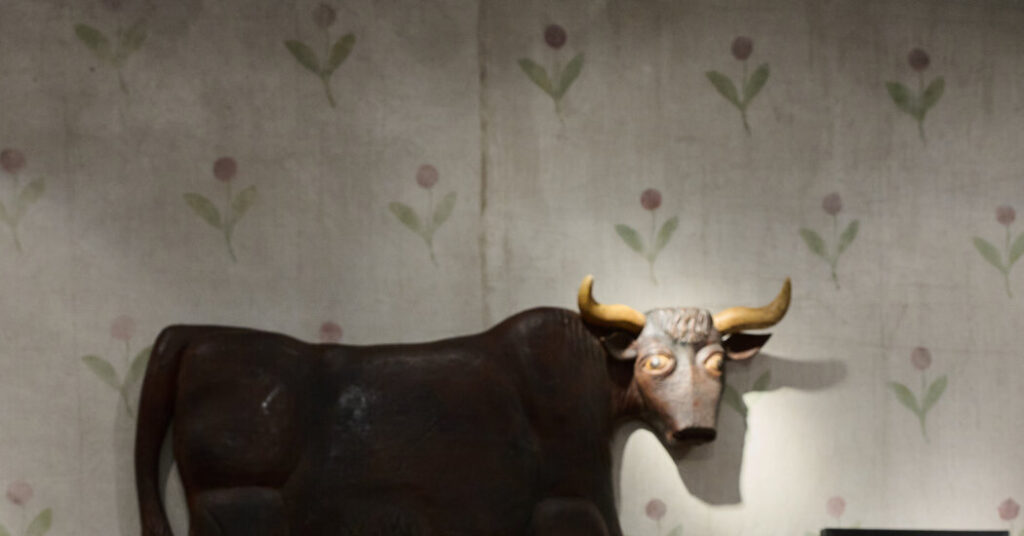
In this extraordinary piece of late-19th-century English folk art, possibly once used as a shop sign, a regal little butcher presides over a two-foot-wide box full of hanging carcasses and chops, all carved from wood and delicately painted the color of blood. Some, like real meat, are even decorated with paper rosettes and sprigs of once-fresh herbs. Standing dead center, the butcher seems to be willing his carnal cornucopia into being with sheer intensity of purpose.
Ancient Roman Cinerarium (Hixenbaugh Ancient Art, E12)
This nearly 2000-year-old marble box once held the ashes of a young boy, whom the gallery says was a distant relative of Pontius Pilate. It no longer has its lid, but in two nearby lids from similar cineraria, you can see the “libation holes” through which grieving relatives would have poured honey, milk or wine; a later discoverer of the box drilled a hole in the bottom, instead, and reused it as a planter. Though the box’s inscription is brief, it’s long enough to be heartbreaking, telling us that the young boy lived exactly 6 years, 6 months, 11 days and 2 hours.
Polychrome Figure of a Seated Bagpipe Player (Aronson of Amsterdam, E14)
What’s most striking about this 18th-century Delftware bagpipe player is the freshness of his colors. With his green jacket, buttery yellow instrument and mottled, cobalt-blue breeches, he could have just stepped out of a misty northern European morning. His expression — that of a friend acknowledging your arrival to a lively party without quite interrupting his conversation — fits perfectly.
Kelmscott Press’s Chaucer (Peter Harrington, C12)
To celebrate their new shop just down the block from the Armory, this London dealer brought a variety of American rarities to the Winter Show, including a Declaration of Independence. But I spent all my time there paging through one of the few hundred existing copies of Kelmscott Press’s complete works of Chaucer, hand-printed in 1896 and bound, in this example, in dyed pigskin by Rivière and Son. With frames, typeface, capitals and intricate, faux-Medieval borders designed by William Morris and 87 absolutely staggering woodblock illustrations by Edward Burne-Jones, it’s often called the most beautiful book ever printed.
Twelve Apostles in Boxwood (Blumka, D7)
The Twelve Apostles are as various, and as expressive, as a company of actors on tour in this set of boxwood plaquettes carved with a delicate hand in early 17th-century Netherlands. The Apostle Andrew leans casually against his X-shaped cross while Simon holds his saw with grim determination, and where Thaddeus is formal and perhaps a little bloated, John raises his chalice with long, sensual fingers and a boyish tilt of the head.
“Women and Rooster” (Bernard Goldberg Fine Arts, C1)
Winold Reiss (1886-1953) made this narrow, five-foot-tall gouache while designing a “Prismatic Room” at Crillon, a new restaurant in New York in 1919. I don’t know how anyone concentrated on their meals in a room full of murals like this. With its rainbow of colorful zigzags and stripes, dominated by reds and yellow, the gouache is probably the most eye-catching thing in the building.
“The Cliff and the Mountain Cloud Brightened with Red Flowers and Yellow Orioles” (Michael Goedhuis, B1)
Born in Datong, China, in 1964, the calligrapher Wei Ligang started out in a classical style but later shifted to a more contemporary take on his ancient tradition. This ravishing diptych, executed in bronzy-yellow acrylic over paper painted black with ink, is an abstract interpretation of its title, a phrase from a Tang Dynasty poem. From the corner of the eye, it all reads as stylized Chinese writing; head-on, though, it’s revealed to be as free as a Brice Marden, with forms that resemble monsters, grimaces and tangled clumps of hair.
Portrait of Abe Lincoln (The Old Print Shop, A12)
Sent to Illinois by the Republican Committee of Massachusetts to draw the presidential candidate Abraham Lincoln, the artist Charles A. Barry studied his subject for 10 days before producing this sensitive, large-scale portrait. Though the resulting lithograph, produced by J.E. Baker of the Boston firm J.H. Bufford’s, didn’t sell particularly well, it was said to be an excellent likeness. Certainly Old Abe, cleanshaven and with tousled hair, looks as much like a silver-screen heartthrob as he ever did.
19th-Century Persian Carpet (Peter Pap Rugs, B13)
Not made for export, this late-19th-century Persian wool rug features a mesmerizing red and blue “boteh” motif. (That’s the curly leaf form later associated with the Scottish city of Paisley.) What look from a distance like abrasions or fading are actually white silk threads woven through to create a snowy shimmer; about a third of the way from the top, the makers turned down the white by reducing its width by one knot.
The Winter Show
Friday, Jan. 23 through Sunday, Feb. 1, Park Avenue Armory, 643 Park Avenue, Manhattan; (718) 292-7392; thewintershow.org. Tickets, which benefit the East Side House Settlement, run from $25 (students) to $45 (general admission). Children under 12 admitted free.
The post The Winter Show in 9 Objects appeared first on New York Times.