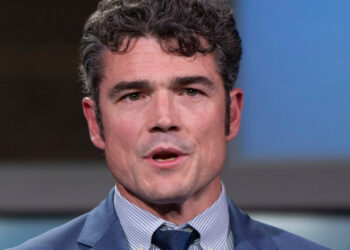
Two months after quitting his job as a corporate C.P.A. to trade full time in prediction markets, Joel Holsinger, 26, was well along the road to making his first $100,000. It was approaching noon on the Tuesday before Thanksgiving last year, and President Trump was about to grant the annual turkey pardon.
Holsinger had more than $700 riding on whether Trump would say two particular words. Both Kalshi and Polymarket, the two big prediction market platforms, were offering yes-or-no-style “mention markets” asking users to bet on whether the president would say more than a dozen words and phrases, among them “hottest,” “big beautiful bill,” “radical left/far left” and “rigged election/stolen election.”
Holsinger had bought 500 “no” shares on “stuffing” at 86 cents, and 500 “no” shares on “cheaper” at 70 cents. He’d chosen the bets largely by studying word frequencies in transcripts of past Trump speeches.
Trump was almost certain to talk about affordability, but he had a history of preferring to use “lower” rather than “cheaper”; since August, he hadn’t said “cheaper” once, Holsinger said. And he’d never, in past turkey-pardon remarks, talked about “stuffing.”
Still, Holsinger was being conservative in how much he was willing to wager. “With a sample size of four,” he said, referring to the Thanksgivings in Trump’s first term, “I’m not going to do anything crazy.”
On Kalshi, Holsinger’s preferred platform, odds that Trump wouldn’t say “stuffing” had fallen to 81 cents. The market’s belief that he would say the word had increased.
“Does anyone have a secret edge on ‘stuffing’?” Holsinger asked into his headset. Wearing sweatpants and a T-shirt and sitting cross-legged on a desk chair in his South Williamsburg, Brooklyn, fourth-floor walk-up, Holsinger was livestreaming; more than 1,000 people tuned in for commentary by the man they know as PredictionMarketTrader. He and his fiancée had recently moved here from Los Angeles, and Home Depot boxes were stacked in the corner.
The big reveal he was waiting for was which of two turkeys would receive the ceremonial pardon: Gobble or Waddle? Holsinger had $2,500 on Gobble.
He hadn’t planned to make the bet. It seemed stupid, and he didn’t see a way to get an edge. He’d been saying things to his audience like “I just haven’t seen a good bull case for Waddle” and “There’s a lot of support for Gobble, but maybe I’m just in an echo chamber.”
But 30 minutes earlier, his friend had discovered a new Associated Press video that seemed to confirm Gobble as the winner: At a White House news briefing, an off-screen voice said that while “both receive the pardon,” Gobble “will be the national Thanksgiving turkey.”
This is the kind of technical distinction that a normal person would be oblivious to but is gold for traders. Bets on the big platforms often have pedantically specific resolution criteria buried in the fine print. Other traders seemed not to have found the video yet, and “yes” shares for Gobble were still available for around 82 cents. Holsinger had snapped up 2,475 shares. If he was right, he’d make about $425.
In the live video from the Rose Garden, a turkey, skin flap swinging ridiculously from its beak, now appeared. “Is that Gobble up there?” Holsinger asked aloud, for the benefit of viewers commenting on his stream. “Can we get a photo comparison?”
Trump rambled, hitting a lot of the mentions traders had money on, including “affordable,” “Walmart” and “egg.”
“And now,” Trump said, “Let’s go and give Gobble — Waddle, by the way, is missing in action, but that’s OK, we’ll pretend Waddle is here. …”
Holsinger’s eyes widened. He’d made a nice profit on Gobble. He’d also made $250 on “cheaper” and “stuffing,” neither of which Trump had said.
But as Holsinger brought his 55-minute stream to a close, he was frustrated that he hadn’t doubled down on his conviction.
“Well, we called it, at least. We were in early. But I guess I got in too early. I should have sized up more. But look, good start to the week, guys. We’re already up $1,300 since Sunday.”
The Archetypal Job of the 2020s?
Before 2020, the only dedicated place you could even try to make a living forecasting current events was a New Zealand-based site called PredictIt, which capped individual bets at $850 and limited the number of traders who could participate in any one market. All that has changed with the rise in the United States of the prediction-market platforms Kalshi and Polymarket.
There are now thousands of questions, live around the clock, on which anyone can take a side: Will Ayatollah Ali Khamenei be out as supreme leader of Iran by the end of July? Will the United States confirm that aliens exist?
Prediction markets are culturally ascendant. CNN has formed a partnership with Kalshi, and Google Finance now integrates data from both Kalshi and Polymarket. The CBS telecast of the Golden Globes this month showed graphics of Polymarket’s real-time betting odds before winners were announced. The company’s founder and chief executive, Shayne Coplan, attended the ceremony.
And they have political tailwinds. In 2024, traders on Polymarket bet more than $3.6 billion on the outcome of the Trump-Harris election — at close of voting on Election Day, prediction markets favored Trump, while polling averages showed Vice President Kamala Harris with a small lead. Trump’s second-term administration has been friendly to the industry. Donald Trump Jr. is an adviser to both Kalshi and Polymarket and an investor in Polymarket. In November, the Commodity Futures Trading Commission signed off on Polymarket’s operating legally in the United States. Other investing and betting apps such as Robinhood and FanDuel have been moving into prediction markets, too.
Making a living betting on prediction markets just might be one of those era-defining occupations — like being a Wall Street trader in the 1980s, a dot-com founder in the 1990s or an influencer in the 2010s. The cultural conditions that have given rise to the existence of the job have all, separately, been the subject of countless chin-stroking examinations. There are the young men increasingly drawn into screens and online communities; the breakdown of traditional career paths, and the rise of make-your-bag YOLO-ing into highly speculative investments; the post-trust, post-expert epistemics of mathematical probability and the wisdom of crowds; the contemporary casino-ization of everything. They may have found their ultimate confluence in the full-time predictions trader.
A TV talking head can bluster without consequences; prediction markets, where money hangs on the outcome, are “punditry with skin in the game,” said one of the most successful prediction traders, who goes by the handle Domer, and asked that his real name not be published. Many traders, like Domer, prefer to operate pseudonymously to avoid attention from the Internal Revenue Service or disgruntled opponents. As Domer says, “If I made $2.5 million last year, someone else lost that.” (Because Polymarket runs on a public blockchain, trading records are transparent.)
“It’s important that we’re coming up with better ways to think about what’s going to happen in the future,” Domer continued.
Prediction markets hold obvious allure for would-be insider traders. In December, a pseudonymous Polymarket user made more than $1 million in 24 hours in part by making the extremely contrarian bet that the singer D4vd would be Google’s most searched person of last year. This month, a mysterious account made more than $400,000 by correctly timing the ouster of Venezuela’s president, Nicolás Maduro. Domer pegs the likelihood that the Maduro whale was an insider at “85-90 percent,” and that the Google whale was an insider at “98-99 percent.” (Polymarket did not respond to a request for comment.)
Most users on the two big platforms lose money, and losing it on sports (which accounts for 90 percent of trading volume on Kalshi) has become the newest way for a cohort of young men, many careerless and laden with student or credit-card debt, to make long-shot bets through frictionless, gamified apps. You can bet via prediction markets at 18; sports books require users in most states to be 21. And because Polymarket and Kalshi have federal approval, gamblers end up with the ability to bet on games in states that still outlaw sports betting.
“We’re setting ourselves up for a generation where financial prudence goes out the window, an influx of personal bankruptcies is inevitable, and the mental health crisis gets even worse than it is today,” as the chief executive of a private-credit marketplace recently observed. An academic study published last month found a correlation between easy access to sports gambling and significant declines in credit scores and increases in bankruptcies, indebtedness and missed loan payments.
The top traders, who call themselves “sharps,” tend to be fast-twitch, male risk-takers with quantitative aptitude and above-average information-processing skills. There is now enough volume and liquidity that a top trader like Domer, who has found in prediction markets the kinds of inefficiencies that can give a trader an edge, can make into the millions of dollars annually. Full-time traders say there are between “50” and “hundreds” of them. According to one analysis, fewer than 0.04 percent of addresses on Polymarket account for 70 percent of profits.
Bets with high trading volume where big money can be made tend to attract the same group of sharps. Recent examples: Would Volodymyr Zelensky wear a suit before July of last year? (The resolution proved fraught, as Zelensky wore something to a NATO summit in June that was kind of, but not unambiguously, suitlike.) Who would win the Romanian presidential election? In that case, many of the sharps lost money by betting on the ultimately unsuccessful right-wing candidate, their consensus proving unreliable.
“That was my biggest loss ever,” said a sharp who goes by Iabvek, an Arizona-based trader who lost $350,000 on the Romania bet. Iabvek asked to not use his real name because he feared, among other things, that he could be extorted. Still, he said, he had made $2.5 million since November 2024. He started trading with a $20 bet in high school, placed under his mom’s name because he wasn’t old enough, on Liz Cheney’s margin of victory in a 2016 Wyoming House race.
Finding a Niche
The sharps all have their own ways of finding an edge. Many would most likely thrive on Wall Street but find prediction markets more interesting. They’ll become deeply familiar with the legislative process, say, or study climate models, or read niche newsletters. So far, according to Iabvek, the number of sophisticated traders remains sufficiently low that you can still make money using simple statistical modeling.
In exclusive Discord groups, many of them trade information, such as tips on “bonds” — their term for low-risk, low-return bets that, while not as ironclad as U.S. Treasuries, are the prediction-market version of a sure thing. A lot of sharps made money when all 12 of the singles from Taylor Swift’s new album charted last year. “Every good person I talk to says this is the bond of the year,” said Jonathan Zubkoff, a 34-year-old Long Island trader.
Zubkoff, who started his career with a $100 bet and said he made $1,034,153 in 2025, used to call congressional offices, identifying himself as a constituent, to find out if a representative was going to be present for this or that floor vote. In the 2021 California recall election, Iabvek went to the state, knocked on “a thousand doors” and concluded that Gov. Gavin Newsom’s popularity was underestimated by polls. When Elon Musk hosted “Saturday Night Live” in 2021, there was a market on whether he’d say “DOGE.” Traders, according to two sharps, stood outside Rockefeller Center and canvassed people who’d attended the rehearsal.
Some sharps rely on superior powers of analysis. Last January, a trader named Caleb Davies started betting that Bad Bunny would beat Swift, the odds-on favorite, as Spotify’s most popular artist of the year. Davies (who still has a day job in I.T.) observed that, in 2023, Bad Bunny had released an album in October, and Swift beat him for the top spot. His new release was last January, giving him much more time to accumulate Spotify streams. Indeed, on Dec. 3, Spotify confirmed Bad Bunny’s victory. Davies made over $20,000.
Some specialize. Zubkoff, in addition to trading on political and weather events, has built a winning record guessing movies’ weekly Rotten Tomatoes scores by setting up what he calls “the Bloomberg terminal for Rotten Tomatoes information” — a custom dashboard of entertainment newsfeeds and other relevant information flows. Even if someone duplicated it, he says, “I would bet on myself being able to process the relevant info quicker than someone else would.”
Last year was a good one for the sharps, and this year is even more promising. The chaos generated by Trump means uncertainty, which means more things to bet on. There are political zealots who, like Swifties, will bet on their hero no matter what. And the explosion of interest in prediction markets — Polymarket had a record 491,000 active monthly traders last month, according to The Block — has meant an influx of naïve money from bettors from other domains (e.g., sports) and civilians with a taste for wagering.
Touching Grass, for Profit
Twenty years ago, Domer, who since January of 2022 has made $2.6 million in profits just on Polymarket, was a recent college graduate who played online poker full time. But he found the reason-defying ups and downs frustrating. “If you’ve played optimally for 40 hours and lost money, you’re questioning your life.” You can’t reverse-engineer a loss when you have no idea whether an opponent was bluffing.
Bored while waiting for a hand to finish, he wondered what else he could bet on. He found an Irish site, Intrade, where he could bet on the Academy Awards. He thought the film critic Roger Ebert was really smart, and Ebert had said that “Crash” should and would win best picture over “Brokeback Mountain” in 2006. Domer put $10 on “Crash” and made $80. “It opened up this world: You can do this.”
When Senator John McCain was set to announce his vice-presidential pick for the 2008 election in Dayton, Ohio, Domer and a friend tracked flights into nearby airports. When they saw one scheduled from Alaska, he made a bundle betting on Sarah Palin getting the nod. Around that time, Domer quit poker to devote himself to prediction markets, which he found less stressful and more subject to reason.
Today, at any moment, he might have over a thousand live bets with more than $2 million at risk. He had nearly $260,000 riding on Pope Leo not being Time magazine’s Person of the Year; it was his most profitable bet of 2025.
As the markets have gotten bigger, and competition sharper, trading has become more time consuming. Domer’s battle station has four monitors and a TV. He orders from Uber Eats a lot. During the Israeli election, his sleep schedule was based around Israel’s.
When Domer met the woman he’s now married to, in 2017, she couldn’t have known what she was signing on for. At the time, the main platforms were Betfair and PredictIt; there were fewer events to bet on, less competition, less money at stake, and Kalshi and Polymarket didn’t exist. “If you think about someone married to me,” Domer said, “there’s constantly stuff on my phone, stuff distracting me. We’re sitting down to dinner, I’m like, ‘I have to run upstairs, Eric Adams just tweeted,’” he added, referring to the former mayor of New York City.
The presidential election year of 2024 was “super chaotic,” he continued. “I said, ‘Just wait until July, we’ll go to Ireland and Basel, it will be awesome,’” he said, referring to the Swiss city. “I kept anchoring to this.”
But in late June, President Joseph R. Biden Jr. had his disastrous debate performance, which prompted what Domer called “the biggest political betting event ever”: Would Biden drop out? “I had so much money on it.” Ironically, because Domer was busy “touching grass” overseas in the weeks before Biden exited the race, he didn’t get sucked into the will-he-or-won’t-he of it and held on to most of his position. He ended up clearing more than $1 million.
Holsinger, the sharp who bet on the Thanksgiving turkeys, looks at someone like Domer and dares to dream. This month, Holsinger’s total profit surpassed $144,000, and he started mulling his next goal, maybe $500,000.
He wants to take bigger trading risks: “My win rate should not be as high as it is. It means I’m not taking spots where I should.”
Fueled by pouches of citrus-flavored Zyn and cans of Celsius, he’s seizing the moment. “Right now, my mentality is just, ‘I need to go.’”
The post Betting on Prediction Markets Is Their Job. They Make Millions. appeared first on New York Times.