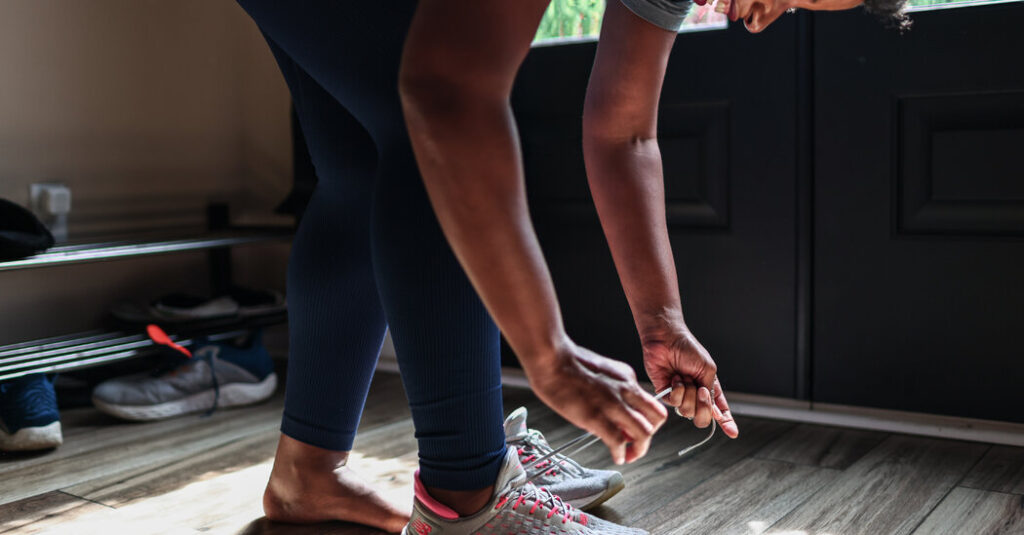
Take a minute to consider the last decade of your life. What type of physical shape do you hope to be in? And what are the activities you want to be able to continue doing?
While there’s no crystal ball to predict your future health, there are a few basic tests you can give yourself to gauge your current strength, power, cardiovascular fitness and balance — all of which will influence your physical abilities going forward. These kinds of tests have been associated with longevity and independent living. They’re also proxies for activities that many people want to be able to do in old age, like getting down on the floor to play with grandchildren or traveling and exploring a new city by foot.
It’s never too early to begin training for your later years, said Stuart Phillips, a professor of kinesiology at McMaster University in Ontario. People naturally lose strength and muscle mass with age, so you want your starting point to be as good as possible. Getting a head start on training is “money in the bank,” Dr. Phillips said.
It’s also never too late to improve your physical abilities, he added: “We’ve got data showing that nonagenarians, so people in their 10th decade of life, or in their 90s, can make gains in strength and function with just a little bit of even light activity.”
Try these four tests to determine where you currently stand. If you don’t perform as well as you might have hoped, don’t worry: A few strength, conditioning and balance exercises, done regularly, can help you improve your score on each one.
1. Sitting-Rising Test
The goal with this assessment is to go from standing to sitting on the floor, and back up again, using the least amount of support as possible. The test is scored on a 10-point scale — five points for sitting down and five points for standing up — and you lose a point for every hand, knee or other body part you use to help yourself. Subtract a half point if you’re unsteady or lose your balance.
Adults in their 30s and 40s should aim for a perfect 10, said Dr. Claudio Gil Araújo, the dean of research and education at the Exercise Medicine Clinic in Brazil, who developed the test. Anyone over 60 who gets an 8 is “in very good shape,” he said.
The test evaluates strength, power, balance and flexibility. Dr. Araújo has also shown it’s a predictor of mortality. A recent study of his looked at more than 4,000 adults age 46 to 75 and found that, over the course of 12 years, the people who scored 4 or below on the sitting-rising test had death rates nearly four times higher than those who scored a 10. He said that was primarily because people with low scores were at a higher risk for falls.
2. Walking Speed Assessment
How fast someone walks at their normal gait is “a very important indicator of functional ability and vitality,” said Jennifer Brach, a professor of health and rehabilitation sciences at the University of Pittsburgh. “It is predictive of future decline, it’s predictive of mortality, nursing home placement, disability, a whole host of different things,” she said.
To assess your walking speed, measure out four meters, or about 13 feet, on a straight, flat surface, and time how long it takes you to cover the distance. (Remember, you’re walking at your normal speed, not as fast as you can.) People of all ages should aim for a gait of at least 1.2 meters per second, a little over three seconds total.
Dr. Brach recommended people retest themselves every few months. “If the value changes, that can be a warning sign,” she said. That’s because while walking feels like a simple task, it requires proper functioning of the cardiovascular, musculoskeletal, vestibular (balance), sensory and nervous systems. A slower gait could indicate that there’s a problem in any one of those systems that may need to be investigated and addressed.
3. Grip Strength Test
Grip strength is also related to mortality. While that connection may seem far-fetched, experts say a grip strength test serves as a helpful indicator for how active a person is in their daily life.
“When you’re using your hands more, it’s probably because you’re doing things more,” said Cathy Ciolek, the president of the American Physical Therapy Association Geriatrics. “You’re carrying groceries, you’re opening the car door, you’re picking up a grandchild.” All of those things work your hands, she said, and the more you do them, the better your grip strength.
Grip strength is also important for maintaining independence with household tasks like cooking. (Think about pulling a heavy dish out of the oven.)
A doctor or physical therapist typically assesses grip strength using a special device called a dynamometer. To test yourself at home, try walking for 60 seconds while holding a heavy weight in each hand (also known as a farmer’s carry), suggested Dr. Nima Afshar, a physician at the concierge medical practice Private Medical. Start with lighter weights and work your way up to heavier ones over time. If you experience hand or body pain, stop.
There aren’t age-related norms for the farmer’s carry like there are with a dynamometer. But Dr. Afshar says a 45-year-old man should aim to carry two 60-pound dumbbells, a 65-year-old two 40-pound dumbbells and an 85-year-old two 25-pounders. For a woman at those ages, goal weights are 40 pounds, 25 pounds and 15 pounds in each hand.
4. Single-Leg Stand
Just as strength naturally declines with age, so does balance. And that raises the risk for falls — a major cause of injury and death in older adults.
Testing one’s balance is as simple as standing on one leg. Adults should aim for a minimum of 10 seconds on at least one side. For an added challenge, Dr. Afshar recommended attempting the test with your eyes closed.
According to a study Dr. Araújo published in 2022, 20 percent of adults age 51 to 75 were unable to make it to 10 seconds. And those individuals had an 84 percent higher chance of dying in the next seven years, possibly because they were unhealthier at the start of the study.
“You can’t predict an individual’s precise mortality” with these types of tests, Dr. Afshar said. But if you’re below average on any of them, it’s likely you won’t fare as well long-term.
That said, he added, all of these metrics — strength, fitness, balance — can be improved, and as you improve, your risk of dying soon goes down.
Dana G. Smith is a Times reporter covering personal health, particularly aging and brain health.
The post Are You Aging Well? Try These Simple Tests to Find Out. appeared first on New York Times.