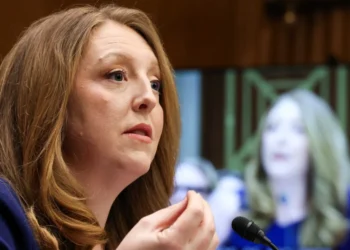
Shajia Ayobi is a 59-year-old grandmother imprisoned for her role in the murder of her abusive husband. Last January, she went before California’s parole board and was found suitable for release. During her 14 years in prison, she has become a leader to her peers: running substance abuse classes, attending chapel and earning educational and good behavior credits. She was even assigned to live in the honor dorm — a unit of the Central California Women’s Facility reserved for model inmates. And yet a year later, Ms. Ayobi, along with nearly 200 other incarcerated people in the state, remains stuck in prison. And she may be there for months to come.
I first learned about Ms. Ayobi when I wrote about how our country’s self-defense laws fail to protect women trapped in abusive relationships. Ms. Ayobi hired an acquaintance to kill her husband after years of extreme abuse. He had destroyed a computer with an ax and threatened the couple’s son. He had stalked her and grown increasingly erratic and dangerous during the years of their marriage.
After Gov. Gavin Newsom’s office reviewed her case, she was assigned a parole officer in San Francisco and found housing through a nonprofit organization. The end of her imprisonment seemed near. She looked forward to spending time with her children, now all grown, and her grandchildren. But just when she was supposed to be freed, she was told that a lawsuit challenging a state program stood in her way.
No one could tell Ms. Ayobi how long she’d have to wait, or the time frame for the lawsuit to be resolved by the California Supreme Court. Another year or two was the likely best-case scenario.
The worst-case scenario, though, was far worse. If a lower court ruling is upheld, people who have been granted parole like Ms. Ayobi would be forced to essentially surrender their good-behavior credits and serve longer sentences. “People will lose years,” said Heidi Rummel, a University of Southern California law professor who directs the Post-Conviction Justice Project.
Ms. Ayobi found herself struggling to process the news. How could a person serve her time, pay her debt to society, have all relevant parties agree to grant her freedom and then be locked up indefinitely? “I was super sad, angry, disappointed and trying to figure out, how do I tell my kids now?” she told me by phone, her voice breaking.
The problem affects nearly 200 people across California prisons — all of whom have been approved for parole. And the number grows each month. The lawsuit stems from a California ballot initiative approved in 2016 called the Public Safety and Rehabilitation Act of 2016, or Proposition 57, which was aimed at reducing the state’s enormous prison population. In 2011, the overcrowding in California’s prisons was so bad that it was determined to be cruel and unusual punishment, and the U.S. Supreme Court ordered California to release or relocate upward of 30,000 incarcerated people.
Proposition 57 was an answer to the Supreme Court’s directive. It outlined three reforms: First, it required judges rather than prosecutors to decide when juveniles could be tried as adults; second, it set up a new parole process for nonviolent offenders; third, it gave the California Department of Corrections and Rehabilitation the authority to create a system in which incarcerated people could earn credits in the form of time off their sentences for their efforts at rehabilitation.
Ms. Rummel told me that one of the main goals of Proposition 57 was to incentivize rehabilitation. The ballot initiative purposely included broad language to give the corrections department discretion to determine standards of eligibility and the kinds of activities, such as vocational training, education classes and domestic violence courses, that would earn a person credits.
The Criminal Justice Legal Foundation, a victim’s rights nonprofit, brought the lawsuit against the corrections department, claiming Proposition 57 was never intended to release violent offenders. Referring to the department, the foundation’s legal director, Kent Scheidegger, said in a press release: “The C.D.C.R. has been releasing violent criminals, including murderers, years earlier than the law allows.”
The specific issue in the lawsuit is whether or not the department has the authority to award credits that could reduce the sentences of people who have “indeterminate” sentences, such as 25 years to life. These sentences are nearly always for violent crimes.
California’s Board of Parole Hearings publishes an annual report that includes recidivism rates for released offenders. The most recent report says that from 2011 to 2020, fewer than 1 percent of those released after serving a life sentence with the possibility of parole were convicted of new felony offenses against other people within three years of their release. When all misdemeanors and felonies were included, the rate was still just 2.5 percent.
In America, incarceration is based on four pillars: deterrence, retribution, incapacitation and rehabilitation. We aim to deter future crimes, punish past ones, take dangerous people off the streets and rehabilitate those who can be reformed. It is this last pillar that is arguably most vexing. What counts as reformed? How can any of us know the intent inside a person’s heart? Some people function well under the strict discipline of prison but fall apart once they’re released and must manage their own lives.
Under the Newsom administration, California has gone further with rehabilitation than most states by adopting what it’s called the California Model. Based in part on Norway’s model of incarceration, it emphasizes rehabilitation, trauma-informed staffing and mutual respect between staff members and inmates. The hope is to increase public safety, reduce recidivism and create a model of incarceration that parallels normal life outside as much as possible.
The California Model has its opponents, to be sure. But what is happening to Ms. Ayobi and others amounts to what Danica Rodarmel, a criminal justice reform lobbyist, calls “psychological torture.”
“It’s one thing to change a policy going forward,” Ms. Rodarmel told me, “but it’s another thing to take things away that were already given.”
For Ms. Ayobi, the stress is palpable. Even a minor infraction can get her parole revoked. News travels fast around prisons, and several people told me how those who are trapped by the lawsuit walk around with a terrifying sense of vulnerability. Stepping out of bounds, for example, can elicit a write-up. “People are denied parole routinely for very normal human contact,” Ms. Rodarmel said. They are now sitting in prison “with the knowledge that if something goes wrong during that time, they could lose their grant.”
Ms. Ayobi told me about a person in her unit whom she suspected was making hooch. If this turned out to be true and was discovered, the entire unit could be written up, which would be enough to revoke her parole. So she requested and has been approved for a single cell.
People who perpetrate violent crime deserve some punishment. But punishment alone cannot drive the conversation because the story of crime does not end at incarceration. At some point, nearly every person we incarcerate will be released. Life in prison without parole is generally reserved for the worst of crimes. So it seems particularly brutal to say to someone like Ms. Ayobi that she’s done everything she was meant to do, stayed out of trouble and proved to the best of her ability that she reformed and could contribute meaningfully to society, but she must nevertheless sit in purgatory for her foreseeable future.
“A lot of them,” Ms. Rummel told me, “are trying to balance the joy and the optimism of knowing they will be released one day, against probably the darkness of thinking they might never be released.”
One might even call it cruel and unusual.
Rachel Louise Snyder (@RLSWrites) is a professor of creative writing and journalism at American University. She is the author of “No Visible Bruises: What We Don’t Know About Domestic Violence Can Kill Us” and “Women We Buried, Women We Burned.”
The Times is committed to publishing a diversity of letters to the editor. We’d like to hear what you think about this or any of our articles. Here are some tips. And here’s our email: [email protected].
Follow the New York Times Opinion section on Facebook, Instagram, TikTok, Bluesky, WhatsApp and Threads.
The post It’s ‘Psychological Torture’: The Woman Who Was Granted Parole but Not Released appeared first on New York Times.