In his first term, President Trump took issue with some actors, arts funding and the media. In his second, he has hit the accelerator. Changing what Americans see and hear at their national museums, their performance spaces and on television is now at the core of his agenda. Mr. Trump views it as an effort to return to a lost vision of national greatness, one that seeks to “remind Americans of our extraordinary heritage.” Critics regard it as a nostalgic, reductive whitewashing. Here are five areas where the Trump administration has tried to reshape American culture.
The Smithsonian Institution
Trump’s complaint
The president has said the institution, which runs 21 museums and the National Zoo, presents a race-centered and overly negative ideology that promotes “narratives that portray American and Western values as inherently harmful and oppressive.”
What the administration did
In an executive order, Mr. Trump directed Vice President JD Vance and a White House adviser to scour the Smithsonian for “improper ideology” and to work to change its governing board by installing members in line with his agenda.
The White House demanded that the Smithsonian turn over internal content like wall text along with planning and financial documents for eight museums, and it threatened the loss of federal funds if the request was not complied with.
The reaction
Historians and others have decried the Trump efforts as an attempt to dictate a distorted version of history. The Smithsonian, which was created as a federal trust by Congress, has asserted that it operates outside the purview of the executive branch.
The Smithsonian did not accept White House jurisdiction when the president said he had fired the director of the National Portrait Gallery for being “a strong supporter of DEI.” (She later resigned on her own.) The institution also drew the ire of administration officials by submitting only some of the requested documents, and on the institution’s own timetable.
But the institution has closed its diversity office and stripped language from a photo of Mr. Trump that spoke of his two impeachments, language that had upset the White House. An artist, Amy Sherald, canceled her show at the Smithsonian after accusing the institution of trying to appease the administration by considering the removal of her image of a transgender Statue of Liberty. The Smithsonian denied that.
Conservative commentators have joined Mr. Trump in criticizing the institution for adopting too negative a view of U.S. history, one that focuses too much on issues like racial inequality.
“We have a great story to tell — this is a fantastic society with historical levels of liberty and prosperity,” said Mike Gonzalez, a senior fellow at the Heritage Foundation. “The Smithsonian has failed by portraying that heritage as being ugly and filled with tyranny and oppression and in need of replacement.”
What’s next
As many as six seats are coming open this year on the Smithsonian’s 17-member governing Board of Regents. Final say over who is appointed is held by the Republican-led Congress and the president. That could spell trouble for the current leader of the Smithsonian, Secretary Lonnie G. Bunch III, and create an opportunity for Mr. Trump to more directly control programming.
If the administration remains dissatisfied with the Smithsonian’s compliance, it could try to restrict access to federal funds, which currently account for some 62 percent of the Smithsonian budget. But the Smithsonian is popular with the public, and efforts to damage it financially, and potentially force some museum closings, could prove politically dangerous.
Federal Architecture
Trump’s complaint
The president says federal architecture lost its way in the 1960s when buildings abandoned classical style for modernist and Brutalist designs that he views as ugly and unpopular. He also had an issue with the traditional East Wing of the White House, but it was one of space, not design.
What the administration did
With his executive order “Making Federal Architecture Beautiful Again,” Mr. Trump revived an initiative from his first term (which had been rescinded by President Biden) that demands more traditional, classical styles of architecture for federal buildings.
In the case of the classical East Wing, Mr. Trump’s concerns were more pragmatic than aesthetic. He agreed with those who have found it too small to host large events without setting up a tent on the White House lawn. So he demolished it.
He is replacing it with a large ballroom, also in a classical style, that some say would be out of scale with the residence itself. Mr. Trump did not consult beforehand with the Commission of Fine Arts, the independent panel established by Congress in 1910 to review architectural changes on sites in Washington, as some say was necessary. He also fired all of its members and appointed some allies to replace them.
But plans for the new ballroom have since been submitted to the commission and a separate review body, the National Capital Planning Commission.
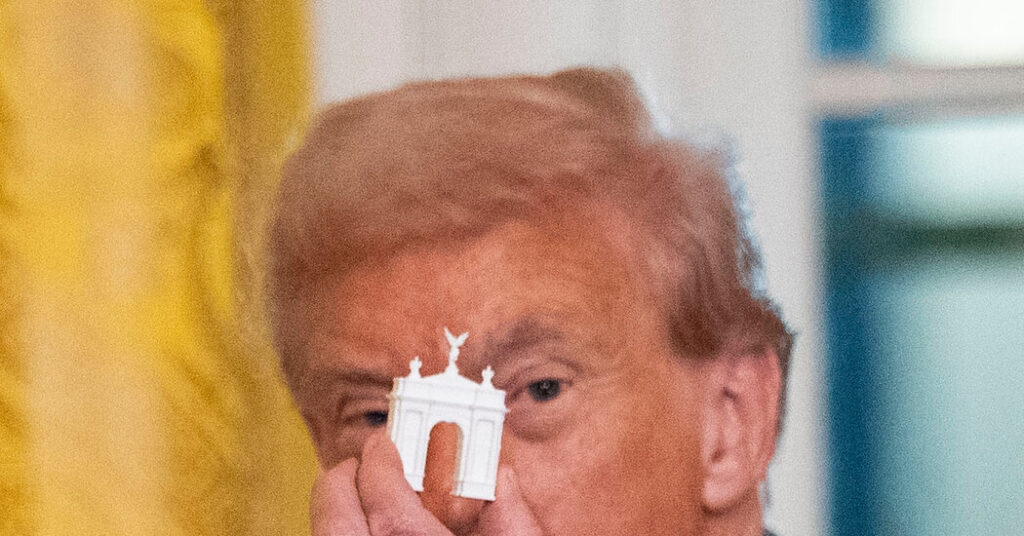
Mr. Trump is also proposing a triumphal arch in Washington for the nation’s 250th anniversary. Models show a structure with two eagles and a golden, winged female figure on top that would rise on a Washington roundabout across the Potomac River from the Lincoln Memorial.
The reaction
Critics say the Trump plans looks backward, not forward, in terms of design, stifling innovation and ignoring local input. The demolition of the East Wing in particular upset preservationists and others who said it lacked proper review and demonstrated contempt for the consensus usually associated with major changes to historic buildings in the nation’s capital.
But the National Civic Art Society, a nonprofit that helped draft the executive order, said the “new edifices will be beautiful, dignified, and admired by the common person.”
What’s next
The National Civic Art Society has said the new guidelines set by the executive order will affect several federal projects, such as designs for new courthouses in several cities.
As for the variety of building plans afoot, what Mr. Trump has proposed and what will be built may be different. Polls indicate that people are unhappy with the East Wing’s demolition. The National Trust for Historic Preservation has sued to stop the ballroom’s construction until the White House goes through a fuller review process. A judge has allowed construction to proceed for now.
Trump Administration: Live Updates
Updated
- Putin says Russia could donate to ‘Board of Peace’ if the U.S. unfroze its assets.
- Europe’s leaders try to find a path forward with Trump.
- Germany’s chancellor urges Europe to cut red tape and spend big on defense.
The Federal Communications Commission
Trump’s complaint
President Trump has long argued that liberal technology companies and the media have been unfairly silencing conservative viewpoints and promoting the left.
What the administration did
The Federal Communications Commission under Mr. Trump has sought to use its powers over the broadcast industry —- it approves company mergers and licenses broadcasters — to penalize coverage and media figures that it considers biased.
It has opened investigations into major broadcasters, including NPR, for content decisions. It forced corporations to retreat from diversity, equity and inclusion programs.
Its chairman, Brendan Carr, threatened to take away the local licenses of ABC stations that continued to air “Jimmy Kimmel Live!” after Mr. Kimmel spoke in his monologue about the man accused of killing a conservative activist. Mr. Kimmel had said the “MAGA gang” was “trying to characterize this kid who murdered Charlie Kirk as anything other than one of them.” This week, the F.C.C. issued new guidance that entertainment-oriented talk shows carried by local television stations should offer candidates competing for office equal airtime, reflecting longstanding conservative concerns that late-night shows in particular are biased.
The reaction
Disney, ABC’s parent company, took Mr. Kimmel temporarily off the air, which set off widespread free speech protests. The company brought him back after a week, to Mr. Trump’s annoyance. Mr. Kimmel said it was never his intention “to make light of the murder of a young man,” but characterized the effort to silence him as “anti-American.”
Skydance, the company looking to buy CBS and its parent, Paramount, struck an agreement with the F.C.C. to present “unbiased” news. It also brought in a former chief executive of the Hudson Institute, a right-leaning think tank, as an ombudsman.
(Paramount has agreed to pay President Trump $16 million to settle his lawsuit over the editing of an interview on “60 Minutes,” and CBS announced the cancellation of Stephen Colbert’s late-night show, a regular target of Mr. Trump. CBS executives said the cancellation was not related “to the show’s performance, content or other matters happening at Paramount.”)
What’s next
Critics continue to say that the F.C.C. is using its regulatory powers to restrict press freedoms and impose government control.
Mr. Carr has defended his actions and has described the investigations as ongoing. He said he is only using government power in the public interest. “As Congress has said,” he said in an interview, “you have a public-interest authority; you have to hold these guys accountable.”
The National Endowment for the Arts/National Endowment for the Humanities
Trump’s complaint
In his first term, Mr. Trump criticized the endowments as wasteful and proposed eliminating them. In his second, he has not issued any direct criticism of either agency. But he installed new leaders who moved to cancel most previously approved grants and redirect their resources to his priorities, including projects celebrating this year’s 250th anniversary of the Declaration of Independence.
What the administration did
Both agencies have been directed to dedicate one-twelfth of their annual budget to support the National Garden of American Heroes, Mr. Trump’s planned patriotic sculpture garden. They have also announced new grant programs relating to celebrations of the country’s 250th anniversary and instituted policies saying that projects promoting “extreme ideologies of race and gender” will not be funded.
The changes have been the most noticeable at the humanities endowment, where virtually all previously approved grants, totaling more than 1,400 awards in all, were canceled in April and more than two-thirds of the staff was laid off. In October, Mr. Trump fired virtually all members of the outside scholarly board that must approve most grants.
Earlier this month, the agency announced many multimillion-dollar grants, including some of the largest in its history, for programs in classical humanities and Western civilization that are favored by conservatives.
The arts endowment released grants for its initiative to celebrate the 250th anniversary of American independence but was cut out of its traditional role overseeing the selection of artists to represent the country at this year’s Venice Biennale.
The reaction
The acting chair of the humanities endowment, Michael McDonald, is clear on what he thinks are the benefits of its new grants. “These N.E.H. grants will produce new resources and media that will help Americans meaningfully engage with the nation’s founding principles as we approach the U.S. Semiquincentennial,” he said in a statement.
However, supporters of the agencies said they were abandoning their mission of supporting projects that have been thoroughly vetted and reflect the breadth of American culture. A news release in November from the office of Representative Chellie Pingree of Maine, the top Democrat on the House subcommittee that oversees the humanities endowment, accused the Trump administration of using that agency as a “slush fund.”
There have been several lawsuits challenging the cuts, most of which are pending. In September, a federal judge in Rhode Island ruled that the arts endowment’s policy of requiring grant applicants to comply with President Trump’s executive order on “gender ideology” violated the Constitution and could not be implemented.
What’s next
Congress, which has a long history of bipartisan support for the agencies, this month voted to maintain funding for both endowments at last year’s levels of $207 million each. (The Corporation for Public Broadcasting, which financed programming the president and other Republicans criticized as “woke,” did not fare as well and dissolved after Congress cut its funding.) Mr. Trump has not signaled whether he would continue to press to eliminate the endowments, but both are still soliciting grant proposals.
The Kennedy Center
Trump’s complaint
The president criticized the John F. Kennedy Center for the Performing Arts for being “woke” and anti-American, complained of financial mismanagement, and said that it was “in tremendous disrepair.”
What the administration did
The president declared he would usher in a “GOLDEN AGE of American Arts and Culture,” and ousted the center’s president and its chairman, David Rubenstein. He installed a political ally, Richard Grenell, as executive director, and purged Democratic appointees from its board, which named Mr. Trump its new chairman.
The National Symphony Orchestra was directed to open all concerts with the national anthem, and the center fired its dance director, replacing her with a choreographer who had complained to Mr. Grenell about “radical leftist ideologies in ballet.”
Mr. Trump had declined to attend the annual Kennedy Center Honors event during his first term after some honorees criticized him. But in 2025, he hosted the evening and screened honors recipients to remove “wokesters.”
Mr. Grenell has said the center’s finances were in disarray when he took over and that the center has raised $130 million, largely from corporate donors. (Prior leaders dispute his claims of financial mismanagement.)
In December, the center’s board voted to rename the center the “Trump-Kennedy Center” in response to $257 million in federal funding the president directed toward renovations of its building.
The reaction
Audiences are down, as was viewership for the Honors broadcast. Several artists and organizations have canceled their engagements and the Washington National Opera set out to find new venues, abandoning the hall where it had played since 1971.
Democrats have challenged the name change as unlawful and said it disrespected the slain 35th president’s legacy.
Mr. Grenell responded to the criticism on Fox News. “They’re complaining,” he said, “about the fireman who’s come in to literally rescue it and put out the fire.”
What’s next
Democratic lawmakers have introduced a bill that would block the renaming attempt and Representative Joyce Beatty, a Democrat from Ohio and an ex officio member of the Kennedy Center’s board, has filed a lawsuit, arguing that only Congress has the authority to change the center’s name.
Robin Pogrebin, Julia Jacobs, Jennifer Schuessler, James Poniewozik and Zachary Small contributed reporting.
Graham Bowley is an investigative reporter covering the world of culture for The Times.
The post Five Fronts in Trump’s Culture War appeared first on New York Times.