For four days, President Trump had once again dangled the prospect of a trans-Atlantic trade war as he threatened to punish European nations if they did not accede to his demands to give Greenland to the United States.
The threats sent stock markets plunging and prompted a frenzy of activity, with European leaders convening emergency meetings, frantically calling the president, and suspending an effort to complete a trade deal with the United States that they had painstakingly negotiated and agreed to just months before.
Then Mr. Trump did what he often does. He backtracked, saying he had reached “the framework of a future deal” for Greenland and the Arctic. Little information about the agreement was immediately available, but Mr. Trump claimed it would be a “great one” for the United States. He said that the tariffs he had planned to impose on eight European countries beginning Feb. 1 no longer needed to go into effect. Stock markets soared.
The president may have walked away from a brewing trade war with Europe as quickly as he began it, but what he left in his wake was another destabilizing moment in global trade. And as those moments pile up, they are having their own effects — including increasing doubts about the value of cooperating with the president and undermining some of the trading system he and his advisers have been working to create. His approach has also pushed countries away from the United States, toward one another and, more important, toward China.
In the second year of his second term, Mr. Trump has had ample opportunity to remake the global trading order in his own vision. But that doesn’t seem to have quieted his urge to rip it all up. The president has continued to goad the country’s closest trading partners with new tariff ultimatums, and threatened to upend even his own trade arrangements, sometimes before they have been completed.
Global businesses and foreign leaders had hoped that this year would be the end of tariff uncertainty. Although tariffs would be significantly higher, at least the world would settle into more predictability as the American president’s trade vision was cemented in a series of trade agreements between the United States and its trading partners. But Mr. Trump appears to be more eager than ever to inject fresh chaos into the global trading order.
Concessions by trading partners haven’t calmed that urge. Over the past year, many governments took the approach of trying to placate Mr. Trump. Country after country dropped their own tariffs and came to terms with higher American taxes on their exports, in return for trade deals that included less punishing tariffs than the president had threatened.
The only notable exception to the trend was China. Instead of conceding to Mr. Trump’s demands, Beijing went tit-for-tat in a trade clash that ended up hurting American farmers, carmakers and defense manufacturers as well as the Chinese economy. That approach, which was made possible by America’s deep reliance on China for critical minerals as well as agriculture exports, forced Mr. Trump to back down.
Despite threats of retaliation, Europe also adopted a conciliatory approach. European leaders grudgingly acknowledged the president’s point that their unbalanced trade was a problem, and promised to lower tariffs on American products even as the United States drastically raised its own tariffs on European exports.
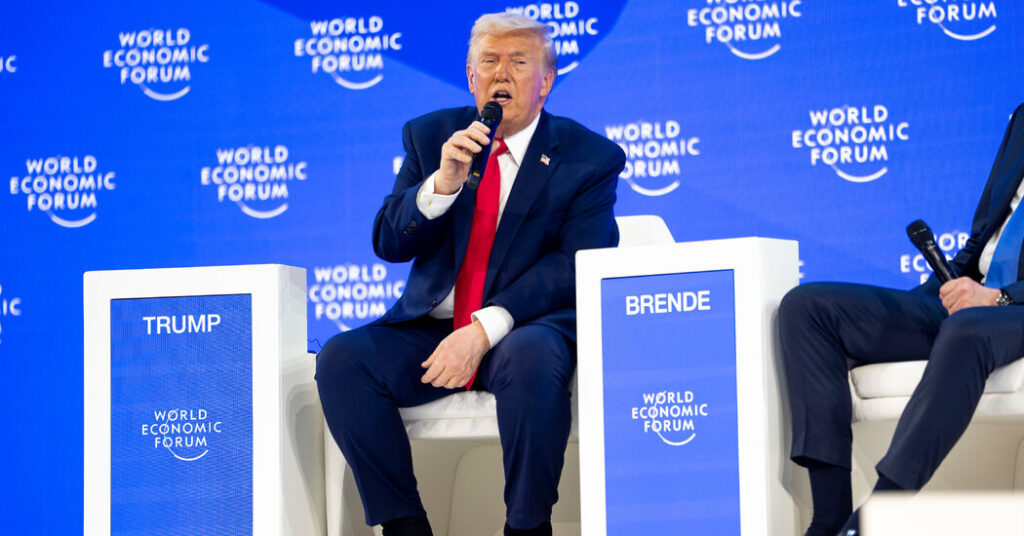
The European Union secured a trade deal that imposed a 15 percent tariff on their imports and the promise of peace — but it didn’t last for long. As Europe was struggling to get its parliament to approve the deal’s required changes, Mr. Trump issued threats against Greenland that were too drastic for European leaders to accept. After a menacing speech at the World Economic Forum in Davos, Switzerland, on Wednesday, in which Mr. Trump called for Denmark to sell Greenland to the United States and issued veiled threats to both Europe and Canada, the European Union formally suspended its work on its trade arrangement with the United States.
A senior European official suggested on Sunday that if the Greenland situation was successfully resolved, the trade deal could still ultimately be completed.
The E.U. deal is not the only trade arrangement the president has called into question of late. This month, Mr. Trump dismissed the U.S.-Mexico-Canada Agreement that he had negotiated and signed in his first term as “irrelevant,” raising doubts about whether the pact will survive negotiations this year. For many North American companies, significant tariff exemptions under U.S.M.C.A. have been the reason they haven’t suffered more in Mr. Trump’s trade war.
Adding more uncertainty to the picture is the fact that the Supreme Court is reviewing Mr. Trump’s use of an emergency law to issue many of his tariffs. If the Supreme Court rules against Mr. Trump, that could usher in another period of volatility as many of the president’s tariffs are struck down but then replaced with other levies.
“I don’t think this is the year tariff uncertainty passes,” said Edward Alden, a senior fellow at the Council on Foreign Relations.
Pushing allies away
The past year suggests that what Mr. Trump respects the most is a forceful response from a country able to wield economic damage to the United States, like China, not an effort toward cooperation. The president also appears to see little downside to the “madman theory” of foreign policy, keeping foreign leaders convinced he is erratic and unpredictable.
But critics say the approach has other downsides. As the United States becomes viewed as a less reliable partner, other governments have sought out business and trade agreements elsewhere, or made preparations to stand more on their own.
Often, that has involved countries drawing closer to China — strengthening the geopolitical influence of America’s main rival. This month, Canada struck a new partnership with China that would allow Beijing to export more electric vehicles to North America, among other changes.
To respond to the Greenland threats, the European Union had discussed deploying an anti-coercion instrument on the United States that it had developed for dealing with rivals like China.
In his remarks at Davos, He Lifeng, China’s vice premier, emphasized China’s partnership with other countries and said it had “remained steadfast in supporting multilateralism and free trade.”
Mr. Alden said he believed Mr. Trump’s tactics would “force the Europeans into a change of direction” from their former strategy of appeasing the United States.
There had been a lot of grumbling in Europe that the government had given away too much to Mr. Trump, Mr. Alden said. This incident is likely to “strengthen all the skeptics who will say, ‘Look, you know, it doesn’t matter what we give Trump, he’s going to want more,’” he added.
“Trump has succeeded in making China the lesser of the two threats to the global trade and economic system, and that’s quite an accomplishment, because China poses all sorts of threats to the global trade and economic system,” Mr. Alden said.
In his remarks on Wednesday, Mr. Trump argued that the United States had provided for Europe’s defense and got “nothing” for it.
But Mark Carney, the prime minister of Canada, suggested in his speech that what the United States had received for providing the world with public goods — like collective security, open sea lanes and a stable financial system — was the rest of the world going along with its agenda.
Mr. Carney said pointedly that powerful countries were now using economic integration as vehicle for coercion, and he called for Canada to follow its own path.
“The middle powers must act together, because if we’re not at the table, we’re on the menu,” he said.
Ursula von der Leyen, the president of the European Commission, also called for building “a new form of European independence” during her speech at Davos on Monday.
“Nostalgia will not bring back the old order,” she said, adding, “If this change is permanent, then Europe must change permanently too.”
Mr. Trump’s advisers had downplayed the president’s threats. Howard Lutnick, the commerce secretary, referred to the tensions with Europe as a “kerfuffle” and predicted “it’s going to end in a reasonable manner.”
But on Tuesday night, as Mr. Lutnick addressed a dinner, he was reportedly heckled by former Vice President Al Gore, and Christine Lagarde, president of the European Central Bank, walked out. On Monday, the Chinese Embassy in the United States had posted an A.I.-generated video on X of Uncle Sam burning a paper marked “rules,” and laughing amid piles of burning rubble.
Jake Colvin, the president of the National Foreign Trade Council, a Washington-based business association, said the Greenland threats felt “different.” They were more than just the latest example of the president using tariffs as a foreign policy tool, he said.
“We are rapidly alienating one of our most important geopolitical allies when our focus should be on building on the progress that the president has made in the commercial relationship and uniting to address the growing geostrategic threat from China,” he added.
Matthew Ryan, head of market strategy at the global financial services firm Ebury, had predicted that Mr. Trump would back down. He pointed out that prediction markets had pointed toward the tariffs not going into effect, and said his base case was for a “TACO” — an acronym meaning “Trump Always Chickens Out” that traders coined last year after Mr. Trump frequently backed down from tariff threats.
“As we know from recent history, Trump uses these tariffs as a blunt instrument and a negotiating lever to pull to get his way on the world stage.” But, Mr. Ryan added, “this cavalier stance is becoming an extremely risky tactic.”
Jeanna Smialek contributed reporting from Brussels.
Ana Swanson covers trade and international economics for The Times and is based in Washington. She has been a journalist for more than a decade.
The post Trump Returns to a Familiar Role: Sowing Trade Chaos appeared first on New York Times.