The Natural History Museums of Los Angeles County on Thursday announced its largest-ever donation — a gift from the Mr. and Mrs. Samuel Oschin Family Foundation, which will be used to establish the Samuel Oschin Global Center for Ice Age Research. The center will serve as the “intellectual backbone” of the La Brea Tar Pits’ long-planned makeover, said NHM President and Director Lori Bettison-Varga.
The development is part of the organization’s Reimagine project — a yearslong site renovation aimed at making the Tar Pits more accessible, and emphasizing their function as the only active paleontological research hub located in a major urban area. By leveraging international research partnerships and education programs, the new research center is meant to make the site’s work more collaborative and boost its global and local presence.
“This center formalizes and elevates the Tar Pits’ role as the world’s leading hub for Ice Age research,” Bettison-Varga said. “It’s a gift for science at a time when we feel the importance of helping the public understand the scientific process is paramount.”
Bettison-Varga declined to say how much the donation was worth, but a rep for the NHM said the board has now raised $131 million toward its $240 million goal for the campaign.
The Los Angeles County Board of Supervisors last week approved the first phase of the project, which is expected to begin in the fall of 2026 and conclude by mid-2028, ahead of the L.A. Olympics. This includes a renovation of the George C. Page Museum as well asaccessibility and signage upgrades.
“The eyes of the world are on L.A. at that time,” Bettison-Varga said. “This is a global location. People around the world come to see the tar pits.”
The Reimagine project, she said, represents an opportunity to join an “overall uplifting of culture and science in the Miracle Mile.”
By making the site’s research more visible to the public — through construction updates and outreach initiatives — the research center is also intended to draw younger generations toward careers in science.
Donor Lynda Oschin, chairman of the board and secretary of the Mr. and Mrs. Samuel Oschin Family Foundation, said in a news release that she and her late husband started their foundation, “to inspire future generations by supporting organizations that deepen our understanding of the world around us.”
“There is no place on Earth like La Brea Tar Pits. It is fitting to honor my husband Samuel Oschin’s legacy by supporting science and research in the heart of Los Angeles, a city he helped to develop and shape,” Oschin said.
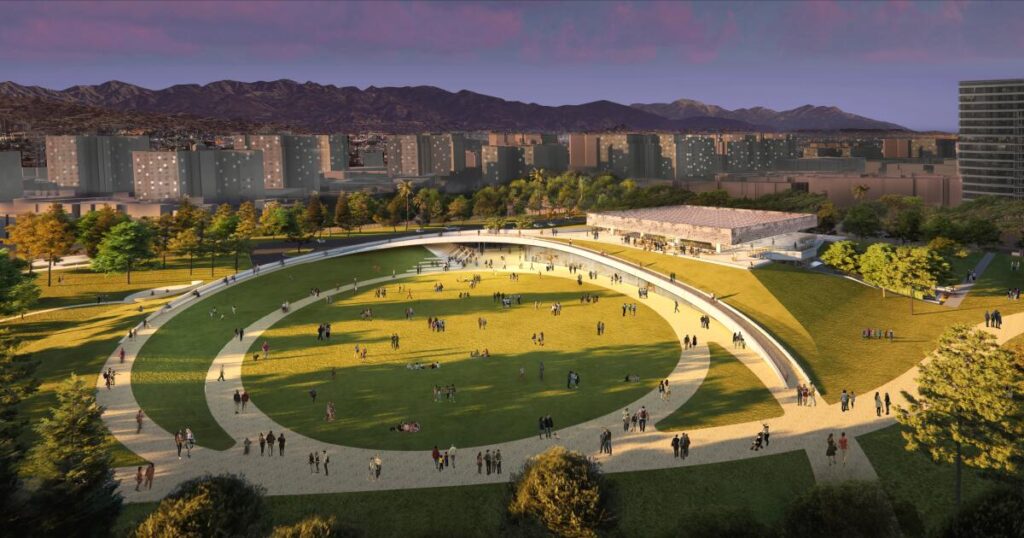
The board on Thursday also released new renderings of the campuses planned transformation, which includes a pedestrian loop connecting excavation sites, research laboratories and museum spaces as well as updated Pleistocene gardens — which will include the tar pits’ iconic mammoths.
These will be seen from the lofted windows of adjacent Los Angeles County Museum of Art’s soon-to-open David Geffen Galleries, and once the upgrades are completed the two campuses are meant to complement each other. Both will also be accessible via the Metro’s new Wilshire/Fairfax Station, which is slated to open later this year.
To date, La Brea Tar Pits researchers have unearthed millions of samples from the pits dating back 50,000 years and still conduct daily open-air excavations. More than 2 million samples are housed in the Page Museum.
In 2022, the International Union of Geological Sciences named the La Brea Tar Pits one of the world’s First 100 IUGS Geological Heritage Sites.
Looking toward the future, Bettison-Varga said the research site hopes to better position itself to offer insights into climate change in order to help people “understand the story of extinction and resilience.”
“As we all endure the effects of a changing planet, there has seldom been a more important time to expand opportunities to discover our natural world,” Los Angeles County Supervisor Holly J. Mitchell said in a news release.
The post La Brea Tar Pits receives largest-ever donation toward new Ice Age research center as part of campus makeover appeared first on Los Angeles Times.