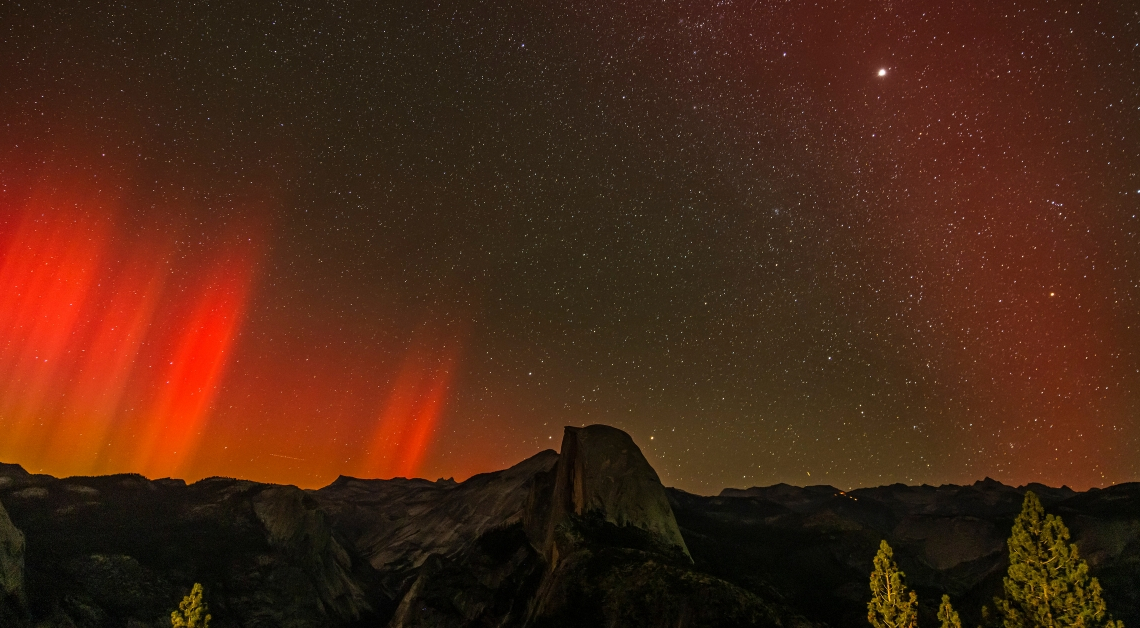
If you live in Southern California and noticed the sky doing something a little weird this week, you’re not going insane. The Northern Lights showed up far outside their usual range, appearing in places that don’t normally factor aurora-watching into the evening.
The reason was actually straightforward. Earth was hit by the strongest solar radiation storm recorded in 23 years, according to the National Oceanic and Atmospheric Administration’s Space Weather Prediction Center.
The event followed a powerful X-class solar flare that sent a fast-moving cloud of charged particles toward Earth. When that material reached the planet, it disrupted Earth’s magnetic field enough to allow solar particles into the upper atmosphere, producing auroras at unusually low latitudes.
The storm reached G4, classified as “severe” on the geomagnetic scale. That level prompts close monitoring because it can interfere with radio communications, affect satellites in orbit, and place strain on some ground-based systems. NOAA hasn’t confirmed widespread damage tied to this storm, though events at this level are taken seriously by engineers and space weather forecasters.
The 2025 Solar Storm Explained
Some headlines described this as the biggest solar storm in decades. That description needs a little more dissecting, though. The Mother’s Day storm of May 2024 reached G5, the highest geomagnetic category, and remains the most powerful recent event. What set this week’s storm apart was the strength of its radiation component.
Solar radiation storms measure high-energy particles traveling through space before they interact with Earth. This event reached S4 on that scale, a level last recorded during the Halloween solar storms of 2003. NOAA confirmed the benchmark in public updates, calling it the most intense solar radiation storm in more than two decades.
Aurora sightings followed. Reports came in from across the United Kingdom, Germany, France, and Scandinavia. In the United States, timing limited visibility during the first peak, which arrived before sunset. Later surges produced sightings farther south, including Georgia, New Mexico, and parts of California, according to reports collected by Spaceweather.com.
Forecasters say additional auroras could be possible as lingering solar material continues interacting with Earth’s magnetic field. But that activity is expected to taper off.
The broader context is important to take in here. The Sun is moving toward the most active phase of its 11-year cycle, a period associated with more frequent and more intense solar events. This storm expanded where auroras appeared and pushed space weather into public view again, without causing the kind of disruption seen during the most extreme events.
Most people never think about solar radiation storms. This one forced us to.
The post Biggest Solar Radiation Storm in 23 Years Sparks Northern Lights Worldwide appeared first on VICE.