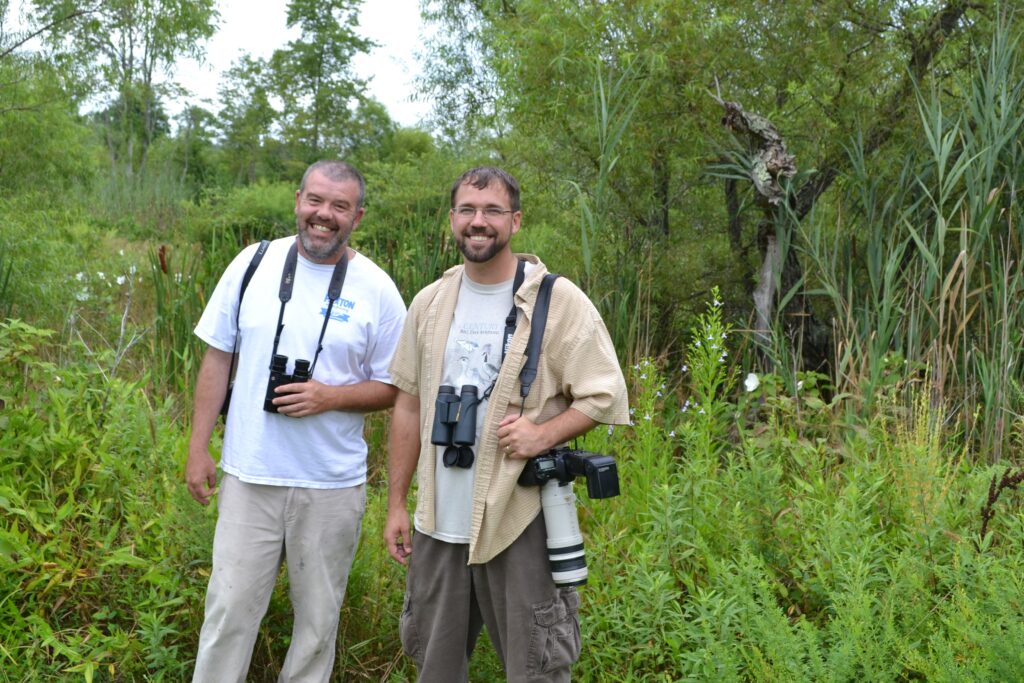
Birding buddies Jim Brighton and Bill Hubick were taking a walk in the woods north of Annapolis in the summer of 2012 when they stumbled upon a knee-high plant studded with yellow, star-shaped flowers. Neither could identify the delicate plant, so they took a photo and planned to look it up later.
That turned out to be a challenge. Brighton consulted his plant guides only to find that quite a few yellow, star-shaped flowers grow in the region. He turned to the U.S. Agriculture Department’s online plant atlas — iNaturalist was barely a blip on the internet back then — but the site lacked a single entry for Maryland.
“I got pretty frustrated,” he says. But he also got an idea. Together with Hubick, “we decided we were going to develop a website that would give people a list — as complete as possible — of all the living things in the state.”
Almost 15 years later, the Maryland Biodiversity Project (MBP) has catalogued more than 22,000 species across the Old Line State, from fruit flies to fir trees and beyond. More than 32,000 volunteer naturalists have contributed to the now-massive database, but none more than Brighton, who last year celebrated his 5,000th documented species, a cypress weevil in Calvert County. (Hubick isn’t far behind, with some 3,400.)
The project has grown from a simple checklist of creatures into a community of devoted citizen scientists who take part in spider safaris, warbler walks and other data-collecting field trips. Meanwhile, the observations they gather have become a vital resource for the agencies charged with protecting the state’s most vulnerable creatures.
‘The collector’s gene’
Both Hubick and Brighton were drawn to nature as kids.
“My nickname was Billy the Bug because I was always flipping over rocks to see what was underneath,” Hubick says.
The 48-year-old software developer recalls a childhood bedroom full of 10-gallon tanks “with anything I could get my hands on” and a backyard swimming pool turned turtle pond. Later, when a stint in the military took him to Hawaii, an encounter with an albatross sparked an obsessive birding habit.
Brighton, an Eastern Shore native, was “an outdoors kid,” whose biology teacher grandfather taught him to notice the flora and fauna near their Dorchester County home, a practice he says gave way to list-keeping. “I would keep lists of everything I saw,” he says, “when I saw it, how many I saw, and who was with me.”
Hubick and Brighton met in 2005, not in Maryland but in Canada, where each had arrived separately looking for Arctic owls that had wandered further south than usual. “We ended up in the same bar,” says Brighton, who is 54 and does finishing work at Hinckley Bachelor Point, a boatyard in Oxford.
They recognized “the collector’s gene” in each other, Brighton says, and began spending much of their free time in the wild and wooded corners of Maryland, logging as many species as they could count, including birds and bugs as well as butterflies and dragonflies. “We always joked our car could break down on the side of the road anywhere, and we could keep ourselves busy all day.”
Through these rambles, Brighton and Hubick befriended Maryland’s most knowledgeable naturalists, who often helped them identify what they found. But there were plenty of minnows, mites and mosses that no one could name. For years, the men discussed the need for a crowdsourced database. But they didn’t act on the idea until they spied that dainty yellow flower — a whorled loosestrife, they know now.
A wild challenge
Brighton and Hubick didn’t have to wait long to find out if their fellow naturalists would take part in their project, which in the early years relied on submissions through the photo-sharing website Flickr.
“It was actually too successful too quickly,” Brighton says. At one point, there were 23,000 submissions that needed to be carefully vetted for accuracy. “We weren’t sure how we would get through it all. It weighed on us a lot.”
Maintaining the integrity of the data was paramount, Hubick says, “but no one is an expert on all the species in Maryland. So how do you, especially before the tools that exist today, verify the ID of these challenging plants or wasps or whatever? That was hard. The scale and scope were crushing.”
At first, they relied on their growing network of expert naturalists, slowly digging their way through the slush pile of species while both working full-time jobs. But in 2020, Hubick and Brighton decided to collaborate with another increasingly popular crowdsourced biodiversity project, iNaturalist. Today, Maryland entries approved on that site are automatically sent into a queue for the MBP database, where a community curator reviews them for inclusion.
This insistence on pristine data is one reason the database is so valuable to conservation efforts, according to Jason McNees, an information manager for the Maryland Natural Heritage Program, an agency tasked with tracking the state’s rare, threatened and endangered species.
“They curate a lot of trusted data, and trusted is the important word there,” he says.
While there might be fewer completely new discoveries to document these days, high-quality observations of even common species remain a powerful tool for scientists to track trends over time.
McNees says the agency’s biologists turn to the MBP database to get a baseline of the population and distribution of a certain species, and also to help figure out where and when to conduct their own surveys.
“We have a limited number of staff spread across the state,” McNees says. “So this data is a huge resource that increases our capacity in some really good ways.”
Exploring new habitat
For some amateur naturalists, including James Tyler Bell, taking part in the MBP has helped dislodge them from their ecological comfort zones.
Bell, a retired science technician with the Smithsonian Environmental Research Center, used to snap photos for the MBP while he was doing field work for his day job.
“My focus was strictly on birds,” he says. Now he enjoys getting to know other species around his St. Mary’s County home. Bell began noticing moths. Then beetles. Then slime molds. He’s now documented more than 2,000 species for the MBP.
“It opened up my vision of the ecosystem as a whole,” Bell says.
As for Hubick and Brighton, the logistical grunt work of running the massive database hasn’t tempered their outdoor escapades. Quite the opposite. “It’s been like lighter fluid on a fire,” Hubick says.
“I went from being a birder to someone who hasn’t used their binoculars in a long time,” Brighton says. “There’s just so much, and I want to see it all.”
He’s well on his way. Brighton has entered more than 61,000 records in the MBP database. All of this work has given him a newfound sense of gratitude for the place he calls home.
“Maryland is awesome. You can go from 3,000-foot mountains to tidal marsh in 3½ hours,” Brighton says. “I’ve gained an incredible appreciation for what we have.”
Ashley Stimpson is a freelance writer in Columbia, Maryland.
The post Two friends are on a quest to catalogue every living thing in Maryland appeared first on Washington Post.