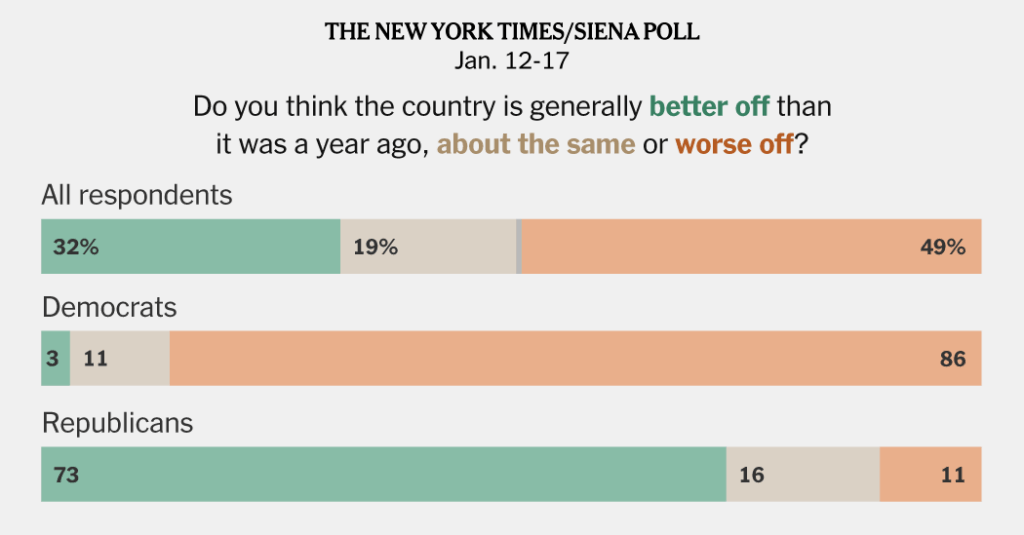
Less than a third of voters think the country is better off than it was when President Trump returned to the White House a year ago, with a wide majority saying he has focused on the wrong issues, according to a new poll from The New York Times and Siena University.
A majority of voters disapprove of how Mr. Trump has handled top issues including the economy, immigration, the war between Russia and Ukraine and his actions in Venezuela. And significantly, a majority of Americans, 51 percent, said that Mr. Trump’s policies had made life less affordable for them.
All told, 49 percent of voters said the country was worse off than a year ago, compared with 32 percent who said it was better.
[See all of the latest polls measuring President Trump’s approval rating.]
The survey also revealed the extent to which Mr. Trump has polarized the nation into its furthest partisan corners, with more voters seeing him as on track to be historically bad or good than merely below or above average. Some 42 percent of voters said he was on track to be one of the worst presidents in American history — and 19 percent said he was headed to be one of the best.
Mr. Trump’s own job approval rating stands at 40 percent, down three points since September. His disapproval rating has crept up to 56 percent.
Only 42 percent of voters rated Mr. Trump’s first year as a success.
One glimmer of good news for Mr. Trump is that the share of voters who say the country is on the right track, while low, has remained largely unchanged since at least April. It also remains higher than it was under his predecessor, Joseph R. Biden Jr., who on this question alienated not just Republicans and independents but also half of Democrats. Under Mr. Trump, most Republicans still feel the country is headed in the right direction.
Still, there were some signs of softening support for Mr. Trump among Republicans when it came to his approach to foreign affairs and addressing the cost of living. His lowest approval rating within his party came on his handling of the release of files related to the convicted sex offender Jeffrey Epstein: Only 53 percent of Republicans approved of his handling of that matter.
Overall, only 34 percent of independent voters, who tend to determine who wins elections, approve of the job that Mr. Trump is doing. And twice as many independent voters think the country is worse off now compared with a year ago than better, 52 percent to 24 percent.
In a hypothetical question about the 2026 midterm elections, voters favored a Democratic candidate over a Republican by 5 percentage points, 48 percent to 43 percent. The Democratic edge among independent voters was 15 percentage points, although a sizable share of independent voters declined to pick a preferred party.
Mr. Trump will turn 80 this year and will be the oldest president ever to serve by the end of his term. Voters do not see his age as a hindrance the same way they did for Mr. Biden, with 40 percent saying he is too old to be effective, but 58 percent saying that he is not. That figure is largely unchanged since October 2024.
“I think he must be doing something right when there are so many people opposed to him,” said Paul Minihane, 77, a real estate broker who lives in Dedham, Mass. “I mean, Donald Trump could look at me in the face and tell me to go screw myself. And I’d say, ‘Thank you.’ I think that’s good. I don’t think he’s looking to kiss everybody’s ass. I think he’s going to do what he thinks is the right thing. And I think that’s a positive thing.”
His enduring popularity with the base presents a bind for Republican congressional candidates, who must win over his supporters without repelling swing voters.
In an open-ended question about what emotions Mr. Trump evokes, Democrats expressed outrage, sadness, disgust or fear. Republicans reported pride, satisfaction, hopefulness or relief. A small share of voters who supported Mr. Trump in 2024, around 12 percent, expressed emotions related to outrage, disgust or disappointment.
The economy and related topics — inflation and the cost of living — remain the top issue for American voters by far.
Mr. Trump’s 40 percent approval rating on the economy mirrored his overall standing. But other indicators showed more vulnerability, including that only 24 percent of voters thought he had made life more affordable and only 34 percent believed he had handled the issue of the cost of living well.
“Maybe I have bad public relations people, but we’re not getting it across,” Mr. Trump said at the White House on Tuesday at an event celebrating his one-year mark.
Only 32 percent of voters said the economy was better today than a year ago. At the same time, when asked about the current economy, voters gave a slightly rosier assessment than April 2025, with 29 percent calling the economy good or excellent now, up from 22 percent then.
Overall, 57 percent of voters thought Mr. Trump was focused on the wrong issues — including a whopping 69 percent of voters under 30, more than any other age group.
Voters whose top issue was an economic concern were more likely to say Trump was focused on the wrong issues. Voters whose top issue was immigration thought Trump was focused on the right issues.
On immigration, voters are broadly more favorable toward Mr. Trump’s policies than their implementation, continuing a trend seen in previous Times/Siena polls.
Half of voters said that they supported the Trump administration’s deportations of people living in the United States without legal status, and half approved of his handling of the border between Mexico and the United States.
At the same time, a sizable 61 percent majority, including 71 percent of independents, said the administration’s Immigration and Customs Enforcement agency had “gone too far” with its tactics, which have driven protests in multiple American cities. Similarly, 63 percent of voters said they disapproved of how ICE is handling its job. The poll was conducted in the aftermath of the shooting of Renee Good by an ICE officer in Minneapolis that spurred national attention and local protests.
“Criminals in the United States that happen to be illegal immigrants, those people need to be deported,” said Jeffrey McGinn, a 55-year-old Republican who works at a health care tech company and lives in Columbia, Tenn. “He’s rounding up soccer moms and trying to ship them out with no due process at all. That is not what America wanted. That’s not what Republicans wanted. The people that voted for Trump did not want that.”
“I do want border security but I want moderation in it,” said Mr. McGinn, who said that he had voted for Mr. Trump in 2016 and 2020, but not in 2024. “I want his focus on jobs. I want to consider paying off the debt. I want to look at taxes and how to make things more efficient and more market oriented. Trump isn’t doing any of that.”
About 17 percent of Republicans said that Mr. Trump has not had a successful year so far as president, with Republicans under 45 more likely to say he was unsuccessful and focused on the wrong issues.
Jeremy Brew, 42, who lives in Superior, Wis., and voted for Mr. Trump in 2024, said that he had been drawn to Mr. Trump’s “America First” agenda but been disappointed by his focus on foreign affairs during the first year of his second term.
“There’s no reason we need to be sending troops in to be taking — whether they’re a dictator or not, you know — taking them out and kidnapping foreign leaders,” he said of the actions in Venezuela.
“It’s not in America’s best interest to be getting involved in all of these foreign affairs,” he added, recalling the mess in Iraq. “It’s always come back to bite us.”
Most voters agree, though, that Mr. Trump had a productive year. A majority said that Mr. Trump has done about what they expected (39 percent) or more (40 percent). Even a majority of Democrats felt the president got done about what they expected or more.
As to the quality of what he accomplished, the partisan divide ran deep: 62 percent of Democrats said Mr. Trump’s second term has been worse than expected, most Republicans said it was about what they expected (48 percent) or better (39 percent).
One of Mr. Trump’s central economic policies has been widespread tariffs, and 54 percent of voters opposed them, including 45 percent who strongly opposed them.
Delila Mustedanagic, a 22-year-old stay at home mother in Portland, Ore., who did not vote in 2024, said that the tariffs had been impacting her life. She said that they had hurt sales at the drywall company where her fiancé works. Her mother’s boyfriend works in a furniture store where sales are lagging because of high shipping prices.
“Those tariffs,” she said, “have been affecting a lot of people’s jobs.”
Caroline Soler and Christine Zhang contributed.
Shane Goldmacher is a Times national political correspondent.
The post Few Voters Say Trump’s Second Term Has Made the Country Better, Poll Finds appeared first on New York Times.