Of all the strange things grief does to the brain, the strangest might be the time warp. Some of us catapult into the future, unable to stop obsessing over what might happen. Others become mired in the past, imagining that we might pinpoint where it all went wrong. Still others become paralyzed in the present, powerless to conceive of any moment beyond the now.
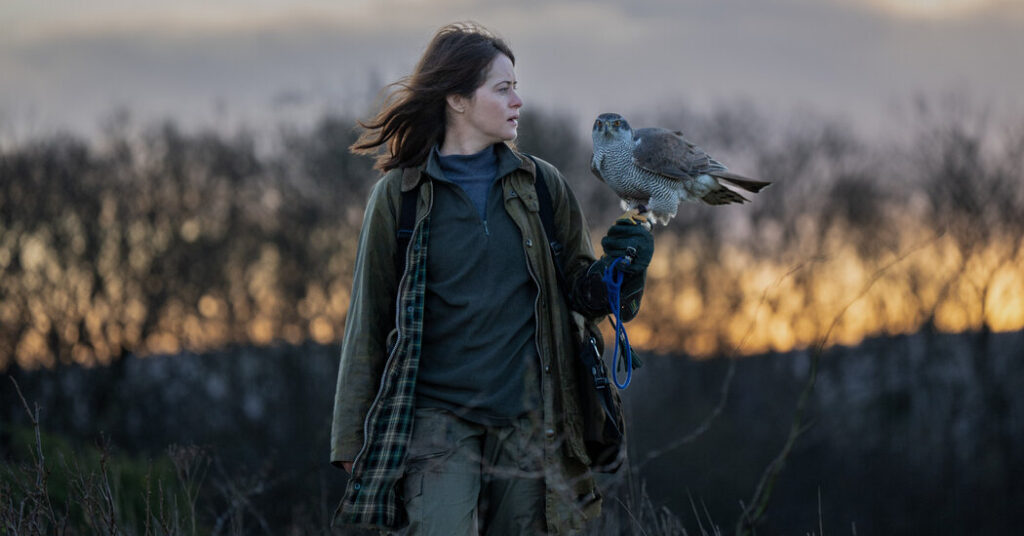
When her beloved father (Brendan Gleeson), an award-winning photographer, suddenly passes away, Helen MacDonald (Claire Foy) skids into that last category. She’s in the final months of a fellowship at Cambridge, on the cusp of the rest of her life. She needs to make plans for work and a new place to live. But though she maintains a stoic exterior in public, when she’s at home, she can barely budge.
Helen scarcely understands her own emotional state, but what she does know is that she needs a companion. Humans, even her best friend, Christina (Denise Gough), are increasingly unbearable. So she turns to the natural world, which her father taught her to love. She calls up an old friend from her falconing days, Stuart (Sam Spruell), and asks him to help her acquire and train a wild goshawk — a bird, he warns her, that is not for the faint of heart. “I need one,” she tells him. She can’t explain why, but she knows it.
“H Is for Hawk,” directed by Philippa Lowthorpe, was adapted by Lowthorpe and Emma Donoghue from MacDonald’s award-winning 2014 memoir. (MacDonald has come out as nonbinary since the book’s publication; the film uses she/her pronouns for the character of Helen.) A narrative about an animal helping a grieving person to heal is hardly unusual. But there’s something appealingly nonlinear and wild in Helen’s story that strips out some of the saccharine pablum that can sneak into these stories. As Helen trains the hawk, whom she dubs Mabel, you might expect Helen’s own heart to be healing in tandem. But in fact, the growing bond between human and hawk also seems to pry Helen away from the human world, and her mental state deteriorates. This is not a simple story.
The best part of “H Is for Hawk” is Mabel, who gets plenty of screen time and whom Foy clearly learned to handle for the film. Mabel is comically out of place in Helen’s living room in the university’s fellow housing, alight on her perch and wearing the leather hood that keeps her from freaking out over anything that might happen in the room. Working with the cinematographer Charlotte Bruus Christensen, Lowthorpe spends long moments letting the camera drift over Mabel’s oblong body and gray-brown feathers. We get up close to her inquisitive eyes and her talons. We watch her eat; we watch her watch Helen and respond to her. When she flies and hunts, the camera follows her swift movements. And when she bates (that is, tries to fly away while leashed to Helen’s arm), we can see her strength. Helen (and by extension, Foy) is clearly struggling to keep her there.
That makes the growing relationship between hawk and handler all the more satisfying, and thus when Mabel and Helen later encounter other people — while out on a walk through Cambridge, or at a gathering of fellows — we can feel the uneasiness of the hawk. We understand the relationship better because we’ve spent time with them both.
What doesn’t work as well in “H Is for Hawk” is the structure, which doesn’t quite hold together. Some of this is almost inevitable when a memoir is adapted for the screen. The narrator of a memoir is usually the protagonist, and thus the genre is interior by nature, with the author able to let us in on the many shades of their emotion. We see through their eyes and feel through their senses.
Film, by contrast, is exterior — we are watching the character — and even the most sensitive filmmaker or actor will struggle to overcome that limitation. Because Helen is not just reserved but repressed, the challenge is even trickier. And certain interesting threads don’t get drawn through quite as tightly as they might, such as an ongoing inquiry in Helen’s work into how social and cultural constraints shape the way science is conducted. It’s there, but you might find yourself wanting a little more.
What does work about “H Is for Hawk” (aside from Mabel, whose presence is enough to recommend the film) is its refusal to make grief facile or tidy, or to proclaim that healing must look the same for everyone. Julian of Norwich, the 14th-century mystic, comes up several times in Christina and Helen’s conversations. Julian lived in permanent seclusion in a bricked-up cell, devoting herself to a solitary life of prayer. What we know of her is scant, but when Christina quotes Julian’s most famous words, it seems, to Helen, to hold some key to her own healing, that in grief she can still be like a hawk, circling high above her life to take in the whole landscape, including the past and future. “All shall be well,” Julian wrote, “and all shall be well, and all manner of things shall be well.”
H Is for Hawk Rated PG-13 for somber themes, language and death, as well as several scenes in which a hawk hunts, kills and eats small game. Running time: 1 hour 54 minutes. In theaters.
Alissa Wilkinson is a Times movie critic. She’s been writing about movies since 2005.
The post ‘H Is for Hawk’ Review: All Shall Be Well appeared first on New York Times.