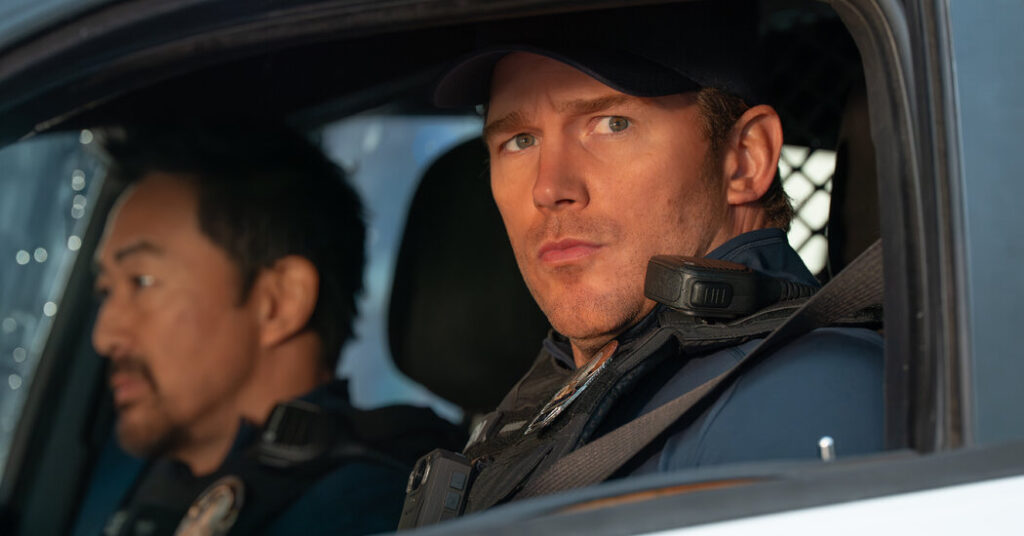
It takes a certain level of irrational exuberance to cast Chris Pratt as a convincing foil for the artificial intelligence of the future, which is basically “Mercy” in a nutshell. An unlikely movie star, Pratt has built a career on playing recognizable, somewhat elevated Everydudes swept up in extraordinary circumstances, guys with crinkly smiles, flexed muscles and narrative contrivances who can navigate their way to “the end.” He was ideally cast as a charmingly roguish scavenger in his blockbuster breakthrough, “Guardians of the Galaxy” (2014), though in the years since he’s rarely had a role that fit his skill set as persuasively.
That hasn’t changed with “Mercy,” a witless, thrill-free hodgepodge of shinily packaged action-thriller clichés. Presumably, the pitch seemed solid enough to get greenlit; certainly, the results check a number of proverbial boxes. In addition to Pratt, the movie features a well-regarded second lead to class up the joint (Rebecca Ferguson), has a director with a commercial track record (Timur Bekmambetov) and marshals a heat-seeking subject (A.I.) to deliver its warmed-over crime story (a man accused of murdering his wife). Alas, the only thing that gives the whole shebang an iota of friction, as well as an unhappy shiver of the real, are its images of heavily armed law enforcement throngs swarming across Los Angeles.
Written by Marco van Belle, the story takes place in 2029 in yet another bleakly futuristic Los Angeles. There, violent criminals live segregated from the rest of the population in a zone that — at least from the story’s safe remove — resembles a hyperbolic version of the sprawling homeless encampments that exist throughout that city, especially in and around its downtown. This grim framing has serious political and narrative potential, but here all the misery is just atmospheric backdrop for another story about a heroic individual up against the system. That would be a detective, Chris Raven (Pratt), who wakes one day to see an onscreen A.I. avatar, Judge Maddox (Ferguson) — effectively an old-school hanging judge.
Apparently, in the remarkably productive three years between today and this dystopian near-future, all the many problems with A.I. — its biases as well as its hallucinations and misleading outputs — have been rectified, creating a criminal-justice system that is as ostensibly perfect as it is efficient. In this new world order, the presumption of innocence has been tossed. Now, defendants have 90 minutes (the movie’s run time is 99 minutes, credits included) to clear themselves. If the court finds them guilty, the defendants are executed at once, which is evidently cheaper than the pesky cost of housing and feeding prisoners for life.
Raven was all in on the program until he was strapped to a chair and facing what may be an exceedingly short future, which suggests that he lacks basic empathy. But whatever! As the digital clock runs down, he rages against the machine (Maddox smiles in turn), curses, sweats, furiously furrows his brows and starts working his own case. Because the supposedly all-knowing Maddox can access anyone and anything, Raven is able to pore through the evidence, accessing a kajillion bytes of data and call on suspects, witnesses and colleagues (enter Kali Reis as Jaq, another detective). He also watches cellphone videos of his life(Annabelle Wallis plays his dead wife, Nicole, while Kylie Rogers plays their kid, Britt).
Given that Raven is largely immobilized in a chair throughout the entire movie, Bekmambetov has to work overtime to liven things up with an array of visual approaches. As the investigation continues, Bekmambetov toggles between the courtroom and the world outside, floods the screen with multiple smaller screens and mimics immersive simulations (which just look like, well, a regular movie). As the complications accrue, the pace accelerates, the screens accumulate and the story’s larger, more intriguing implications about power, justice and the surveillance state fade. In the end, all that remains is a guy who, much like the hapless audience member, is unhappily stuck in a chair watching a lot of onscreen nonsense.
Mercy Rated PG-13 for guns and murder-scene blood. Running time: 1 hour 39 minutes. In theaters.
Manohla Dargis is the chief film critic for The Times.
The post ‘Mercy’ Review: Watching the Detective Watching appeared first on New York Times.