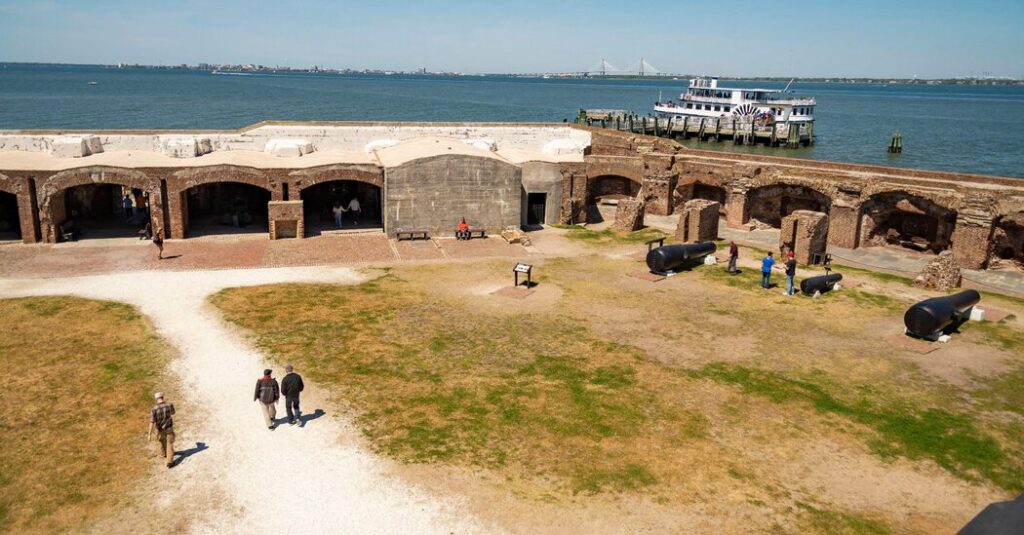
Fort Sumter, an imposing island fortress in South Carolina, was bombarded by Confederate forces at the start of the Civil War. Now, it faces a more modern threat: Rising seas, fueled by climate change, could leave much of the site underwater by the end of the century.
But the average visitor to Fort Sumter might not learn about this existential threat. That’s because the National Park Service has removed a sign that detailed the risks the site faces from climate change to comply with a directive from President Trump, according to three federal employees briefed on the mater.
The Park Service, which manages the site, took down the sign this month from the pier where visitors arrive by ferry at Fort Sumter, which is on an artificial island in Charleston Harbor, said the three federal employees, who spoke on the condition of anonymity because they feared retaliation.
In an executive order in March, Mr. Trump directed the Park Service to review plaques, films and other materials presented to visitors at 433 sites around the country. It said that these materials should not “inappropriately disparage Americans” and that they should emphasize the “progress of the American people” as well as the “beauty, abundance and grandeur of the American landscape.”
Elizabeth Peace, a spokeswoman for the Interior Department, the parent agency of the Park Service, did not comment on the removal of the sign at Fort Sumter. But she said that, in general, the Park Service is “taking action to remove or revise interpretive materials” to ensure “accuracy, honesty and alignment with shared national values.”
The sign at Fort Sumter said that “as the earth’s climate changes, rising seas could inundate most of the fort’s walls” and flood the parade ground, the open area on the fort’s lower level where soldiers used to assemble.
The parade ground would be “constantly submerged,” the sign said, if the mean sea level of Charleston Harbor were to rise by 4 feet. Researchers have estimated that the mean sea level of the harbor could rise by at least 3.3 feet, or one meter, by 2100.
Fort Sumter is part of the Fort Sumter and Fort Moultrie National Historical Park. In 2016, the Park Service worked with researchers at Western Carolina University to study the park’s exposure to the effects of climate change, including sea level rise, coastal erosion, flooding and storm surge.
The findings were grim: The researchers classified more than a dozen structures in the park as highly vulnerable to the ravages of global warming. They found that it would cost more than $1.1 billion to replace all of these structures, including buildings, docks, roads and parking lots.
Trump Administration: Live Updates
Updated
- Germany’s chancellor urges Europe to cut red tape and spend big on defense.
- Most voters say Trump is focusing on the wrong issues in his second term, a poll finds.
- Newsom blames Trump for canceling his Davos appearance.
The U.S. Army Corps of Engineers has already joined with the Park Service to repair the sea walls surrounding Fort Sumter, which were built in the 1800s. Saltwater erosion and surging tides have gnawed at the sea walls over the past several decades, causing some rocks to crumble.
Robert S. Young, who directs the Program for the Study of Developed Shorelines at Western Carolina University, said he wished the Park Service had not removed the sign because it informed visitors of a pressing threat to the entire region.
“We need to prepare for a meter or more of sea level rise, and that’s going to be life-changing for people who want to live and conduct business on the Charleston Peninsula,” Dr. Young said.
Kristen Brengel, the senior vice president for government affairs at the National Parks Conservation Association, an advocacy group, accused the Trump administration of “censoring climate science” at the park.
“There was no justifiable reason to remove a sign that educates visitors about the changes they are seeing to Fort Sumter with their very eyes,” Ms. Brengel said in an email. “For years, National Park Service staff have been raising the alarm about the threat sea level rise poses to Fort Sumter. They have worked tirelessly to protect this priceless place.”
The Trump administration has directed other Park Service sites across the country to scrub references to slavery in connection with the March executive order.
Last fall, Trump administration officials asked staff at Fort Pulaski National Monument in Georgia to remove a copy of an 1863 photograph called “The Scourged Back.” The photo, which depicts a formerly enslaved man with severe scars on his back from whippings, became one of the most powerful images of the Civil War era.
In response to such removals, a coalition of librarians, historians and others affiliated with the University of Minnesota began a campaign called Save Our Signs last year. The group asked the public to take photos of content at national parks and has used those images to build an online archive. So far, the archive includes around 10,000 photos from more than 300 parks.
“We’ve been really cheered by the response we’ve gotten,” said Lena Bohman, one of the leaders of Save Our Signs. “And we’re still accepting more submissions.”
Maxine Joselow covers climate change and the environment for The Times from Washington.
The post Park Service Erases Climate Facts at Fort Sumter, Where the Civil War Began appeared first on New York Times.