There will be more twists and turns, highs and lows, but I’m afraid it’s time to recognize a sad reality — it’s over.
This week, two things happened that, taken together, send a clear signal to the United States and the world — the American-led alliance of democracies is in the midst of a rupture. We have broken faith with our allies, and our allies are choosing resistance over submission to Trump’s aggression and greed.
Before we get to the dramatic developments in Davos, Switzerland, let’s set the stage. On Sunday night, we learned that President Trump sent the Norwegian prime minister, Jonas Gahr Store, a message that can only be described as deranged and delusional. You may have read it before, but please read it again.
“Dear Jonas,” it began, “Considering your Country decided not to give me the Nobel Peace Prize for having stopped 8 Wars PLUS, I no longer feel an obligation to think purely of Peace, although it will always be predominant, but can now think about what is good and proper for the United States of America.”
Trump, incredibly enough, was tying his desire to acquire Greenland to the Nobel committee’s awarding someone else the Nobel Peace Prize, a decision that he wrongly attributed to the government of Norway.
Making everything worse, even as Trump is behaving in a demonstrably irrational way, America’s vaunted checks and balances are failing. Impeachment and conviction are off the table. There is no chance that Trump’s cabinet of sycophants would invoke the 25th Amendment. Congress is led by invertebrates — with many of them apparently convinced that he’ll subjugate the world in much the same way that he subjugated them, through threats, bluster, and the unyielding support of millions in the MAGA mob.
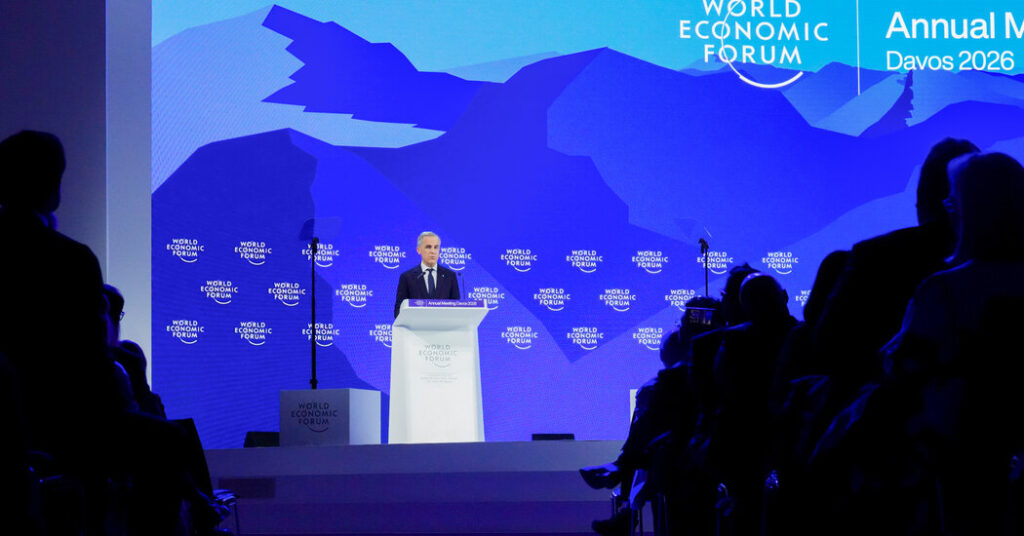
On Tuesday, however, the prime minister of Canada, Mark Carney, said no. He delivered what might be the most important address of Trump’s second term so far. To enthusiastic applause in Davos, he articulated a vision of how the “middle powers” — nations like Canada — should respond to the great powers. It is decidedly not according to Trump’s plan.
First, Carney spoke the plain truth. “For decades,” Carney said, “countries like Canada prospered under what we called the rules-based international order. We joined its institutions, we praised its principles, we benefited from its predictability. And because of that, we could pursue values-based foreign policies under its protection.”
But, Carney said, this order was always “partially false.” We knew “that the strongest would exempt themselves when convenient. That trade rules were enforced asymmetrically. And we knew that international law applied with varying rigor depending on the identity of the accused or the victim.”
Even an imperfect system had profound benefits — so long as America remained both strong and virtuous. “American hegemony, in particular,” he said, “helped provide public goods: open sea lanes, a stable financial system, collective security and support for frameworks for resolving disputes.”
That all appears to be over. We’re not in a state of transition, but rather one of “rupture.” That’s Carney’s word for it, and he’s right.
This declaration might seem bracing and perhaps even premature. The system is under strain, yes. But ruptured? Really? We could be mere months away from a decisive repudiation of Trump and Trumpism in the midterms. Shouldn’t that reassure our allies? Besides, doesn’t Trump backtrack all the time? Didn’t he just turn down the temperature over Greenland?
But consider the reality from an allied perspective. They now know that there is considerable appetite in the American population for at least some form of Trumpism. They know that one of the two American parties is firmly in the hands of people — including Vice President JD Vance — who may even be more hostile to NATO than Trump himself. They’ve watched as former Trump opponents, men like Marco Rubio, have been assimilated into the MAGA machine.
So long as that is true, that means the Western alliance will always be precarious. You cannot build an enduring economic order or a stable defense strategy when chaos and confusion are always one election away. It turns out that the much-maligned “postwar consensus” provided many benefits to America and the world.
The Trump theory — to the extent there is a coherent theory — is that America’s economic and military might means that we’ll benefit from this rupture. We’ll no longer be exploited by freeloading allies, and their own weakness means that we can impose our will. Through tariffs and threats we can even extort territorial changes — acquiring Greenland from Denmark and (who knows?) perhaps even turning Canada into the 51st state.
Our strength used to be their strength. And now? Our strength is their weakness — a weakness we can exploit.
Carney sees this reality clearly. “Great powers have begun using economic integration as weapons,” he said. “Tariffs as leverage. Financial infrastructure as coercion. Supply chains as vulnerabilities to be exploited.” Integration, he said, has become the source of their “subordination.”
.op-aside { display: none; border-top: 1px solid var(–color-stroke-tertiary,#C7C7C7); border-bottom: 1px solid var(–color-stroke-tertiary,#C7C7C7); font-family: nyt-franklin, helvetica, sans-serif; flex-direction: row; justify-content: space-between; padding-top: 1.25rem; padding-bottom: 1.25rem; position: relative; max-width: 600px; margin: 2rem 20px; }
.op-aside p { margin: 0; font-family: nyt-franklin, helvetica, sans-serif; font-size: 1rem; line-height: 1.3rem; margin-top: 0.4rem; margin-right: 2rem; font-weight: 600; flex-grow: 1; }
.SHA_opinionPrompt_0325_1_Prompt .op-aside { display: flex; }
@media (min-width: 640px) { .op-aside { margin: 2rem auto; } }
.op-buttonWrap { visibility: hidden; display: flex; right: 42px; position: absolute; background: var(–color-background-inverseSecondary, hsla(0,0%,21.18%,1)); border-radius: 3px; height: 25px; padding: 0 10px; align-items: center; justify-content: center; top: calc((100% – 25px) / 2); }
.op-copiedText { font-size: 0.75rem; line-height: 0.75rem; color: var(–color-content-inversePrimary, #fff); white-space: pre; margin-top: 1px; }
.op-button { display: flex; border: 1px solid var(–color-stroke-tertiary, #C7C7C7); height: 2rem; width: 2rem; background: transparent; border-radius: 50%; cursor: pointer; margin: auto; padding-inline: 6px; flex-direction: column; justify-content: center; flex-shrink: 0; }
.op-button:hover { background-color: var(–color-background-tertiary, #EBEBEB); }
.op-button path { fill: var(–color-content-primary,#121212); }
Know someone who would want to read this? Share the column.
And so the choice is clear — submit or resist.
Carney did not receive a rousing standing ovation because he called for submission. Instead, he marked out a path of allied integration and cooperation that could create, in essence, a new great power rival to the United States.
Submission, in fact, was never an option. Proud nations do not agree to become vassals. And so the choice isn’t between resistance and submission, but between forms of resistance — whether the “middle powers” will create national fortresses or enter into new alliances and agreements that don’t include the United States.
Carney, in essence, says yes to both. Canada, he said, is doubling its military spending and rebuilding its defense industrial base, but it’s also entering into an array of new agreements, including — most troubling to the United States — agreements with China and Qatar.
And what does that mean for Trump’s ambitions for Greenland? Carney could not have been more clear: “On Arctic sovereignty, we stand firmly with Greenland and Denmark and fully support their unique right to determine Greenland’s future. Our commitment to Article 5 is unwavering.”
In other words, if Denmark calls for aid in the event of American aggression, Canada will answer. And the standing ovation indicated that other nations would as well.
Carney’s conclusion was clear: “The powerful have their power. But we have something too — the capacity to stop pretending, to name reality, to build our strength at home and to act together.”
I’m afraid that years of mockery of allied nations and allied strength have led millions of Americans into a profound error, where we believe that Europe and other liberal democracies are easily cowed and bullied. Incredibly, there are powerful people in the administration who seem to believe that we’ll be stronger and more prosperous when we’re finally freed of the anchor of European weakness and wokeness.
This critique was grounded in a measure of truth. Many of the great nations of Europe — Germany most notably — allowed their defenses to decay after the Cold War. Europe did seem intimidated by Vladimir Putin. The European response to Russian aggression in Ukraine in 2014 was wholly inadequate. It was necessary for American presidents to coax our allies into spending more on our shared defense.
But what began as an appropriate, bipartisan movement to persuade key allies to increase their military spending has now morphed into contempt for our allies and for our alliances.
This is profoundly foolish. If the middle powers answer Carney’s call, they could form an economic and defense alliance that rivals American power. Combine the economies of the European Union along with countries like the United Kingdom and Canada and the militaries of the key European nations, and you have a nuclear-armed defense and industrial alliance that cannot simply be cowed into submission.
There is an analogy to Putin’s miscalculation regarding Ukraine. He, too, saw the West as woke and weak. He apparently thought his soldiers would just march into Kyiv. Yet his brutal invasion awakened Ukraine’s martial courage, and it shocked Europe out of its complacency.
Now Trump is doing much the same thing. His demands for Greenland and attempts to intimidate Canada into doing his bidding are eerily reminiscent of Putin’s demands for Crimea (accomplished) and his ongoing attempt to turn Ukraine into a vassal state.
How is any of this in America’s interest? How does replacing friends and partners with allies and rivals make America more secure? How does engineering enmity with some of the most prosperous nations in the world guarantee American prosperity?
On Tuesday, Mark Carney called Donald Trump’s bluff. Trump wants subjects, but he’s getting rivals, and the American people will pay the price.
Some other things I did
My Sunday column was about the killing of Renee Good and how Congress and the Supreme Court have created a zone of immunity for federal officials that allows them to commit acts of violence and oppression with impunity:
In Federalist No. 51, James Madison wrote some of the most famous words of the American founding. “If men were angels, no government would be necessary,” Madison wrote. “If angels were to govern men, neither external nor internal controls on government would be necessary. In framing a government which is to be administered by men over men, the great difficulty lies in this: You must first enable the government to control the governed; and in the next place oblige it to control itself.”
This is a version of the ancient question: Who will watch the watchers?
Madison’s next words were crucial. “A dependence on the people is, no doubt, the primary control on the government; but experience has taught mankind the necessity of auxiliary precautions.”
In the Trump era, those auxiliary precautions have utterly failed. They’ve been undermined to the point where the reverse is now true. Rather than providing additional precautions against the rise of authoritarian rule, American law and precedent seem to presume that angels govern men, and those angels would be free to do even more good if only they possessed a free hand.
My Saturday round table with Jamelle Bouie and Michelle Cottle focused on the midterms. Will there be a blue wave in November? It depends almost entirely on what voters think of the president:
Part of the issue and one of the problems you’re going to have in analyzing this election is — as we said at the very top of this — these midterms are mainly verdicts on the president. And so running for things like affordability or building more housing, those are the kitchen-table issues that voters want to hear about. Also, at the same time, when you don’t have the presidency, it’s very hard to implement an agenda. It’s very hard to run on: “This is the agenda we are going to implement if you vote for us.” It’s much easier to run on: “Here’s all the crap we’re going to stop.”
So, in some ways I think what you’re going to have is — to go back to this analogy — a break glass in the case of emergency sort of election, where you’re saying we are in an emergency situation right now, there is a lot of chaos, there’s a lot of confusion, there’s a lot of rage, there’s a lot of anger, and we’re going to be able to at least provide some accountability and some restraint that doesn’t exist right now. I think that that’s going to be a very compelling top-line message.
Thanks for reading. You will soon start to get my columns emailed to you too.
If you’re enjoying what you’re reading, please consider recommending it to others. They can sign up here.
Have feedback? Send me a note at [email protected].
You can also follow me on Threads (@davidfrenchjag).
The post How Do You Preserve the Free World When America Goes Rogue? appeared first on New York Times.