NEW DELHI — With Bangladesh’s largest Islamist party poised to have its best-ever performance at the ballot box next month, U.S. diplomats are looking to step up their engagement with the group, according to audio recordings obtained by The Washington Post.
The Jamaat-e-Islami organization has been banned multiple times in the country’s history, most recently under Sheikh Hasina, the ironfisted prime minister toppled by student protesters in 2024. The party has traditionally advocated for governing by sharia law and reducing work hours for women to help them “fulfill their duties toward their children,” but it has recently sought to soften its public image and expand its support base — saying it is now mainly focused on rooting out corruption.
As the political landscape changes in Bangladesh, American diplomats there have signaled they are open to working with the resurgent Islamist movement. In a Dec. 1 closed-door meeting with female Bangladeshi journalists, a U.S. diplomat based in Dhaka said the country has “shifted Islamic” and predicted Jamaat-e-Islami would “do better than it’s ever done before” in the Feb. 12 election, according to the audio recordings.
“We want them to be our friends,” the diplomat said, asking if the reporters in the room would be willing to bring members of the party’s influential student wing on their programs: “Can you talk to them?” he asked. “Will they go on your show?”
The diplomat, whom The Post is not naming for security reasons, downplayed worries that Jamaat-e-Islami would try to force its interpretation of Islamic law on Bangladesh, saying Washington had leverage it was prepared to use. “I simply do not believe that Jamaat can impose sharia,” the diplomat said, noting that if party leaders made concerning moves the United States “would have 100 percent tariffs put on them the next day.”
In a statement to The Post, Monica Shie, the spokesperson for the U.S. Embassy in Dhaka, the Bangladeshi capital, said “the conversation that took place in December was a routine gathering, off-the-record discussion between U.S. Embassy officials and local journalists.” She added that “numerous political parties were discussed” during the meeting and that “the United States does not favor one political party over another and plans to work with whichever government is elected by the Bangladeshi people.”
Mohammad Rahman, the U.S. spokesperson for Jamaat-e-Islami, said in a statement that “we choose not to comment on the context of remarks reportedly made during a private diplomatic meeting.”
The previously unreported comments provide a clearer picture of how U.S. diplomats in Bangladesh view the country’s political future during a pivotal moment of transition. The uprising against Hasina paved the way for the formation of an interim government led by the Nobel Peace Prize-winning economist Muhammad Yunus and for the upcoming elections — meant to mark a decisive democratic turn for Bangladesh after decades of instability.
The American outreach to Jamaat-e-Islami could “potentially drive another wedge between the U.S. and India,” said Michael Kugelman, a senior fellow for South Asia at the Atlantic Council. Relations between the countries are already at a low point, owing to disagreements over India’s recent conflict with Pakistan, its purchases of Russian oil, an unfinished trade deal and punishing U.S. tariffs on many Indian products.
“India’s biggest fear in Bangladesh for many years has been Jamaat,” Kugelman said. India views the party as being allied with Pakistan, he said, and a threat to its regional security strategy.
In her statement, Shie wrote that the Bangladesh elections will not have “any substantial impact on U.S.-India relations.” Washington’s relationship with Dhaka and New Delhi, she said, “stand on their own merits.”
Jamaat enters the ‘mainstream’
Bangladesh was born out of turmoil, gaining independence from Pakistan in 1971 after a bloody war. In the decades since, Dhaka has endured military coups, dictatorships and turbulent civilian rule by entrenched political parties, namely Hasina’s Awami League and the Bangladesh Nationalist Party (BNP).
The country has also struggled to balance its ties with larger regional powers, including China and India, with whom it shares a roughly 2,500-mile land border.
India-Bangladesh relations are already near rock-bottom. Hasina was an ally of the Indian government and went into exile in New Delhi after her ouster. In November, she was sentenced to death by a Bangladeshi tribunal, which found her guilty of overseeing the killing of at least 1,400 protesters. India has not extradited her to Dhaka to face her sentence despite a request from Bangladesh’s interim government.
“The conviction of Hasina [was] politically genius,” the U.S. diplomat said in the December meeting. The tribunal was not “free and fair,” the official added, but “she’s guilty, and they proved it … within their mandate, which was impressive.”
A recent rash of violent crimes against Hindus in Bangladesh has further exacerbated tensions. Indian authorities suspended visa operations in the Bangladeshi city of Chattogram last month after mobs threw stones at security forces near the mission; Bangladesh paused visa operations at its embassy in New Delhi after right-wing Hindu protesters burned photos of Yunus and clashed with police.
The interim government has sought to restore order and prepare the country for a political transition. “Bangladesh is a family. We need to unite it,” Yunus said after assuming power in 2024. Last week, in a post on X, he emphasized that the looming elections will be fair and will happen on time. “No matter who says what, elections will be held on February 12 — not a day before, not a day after.”
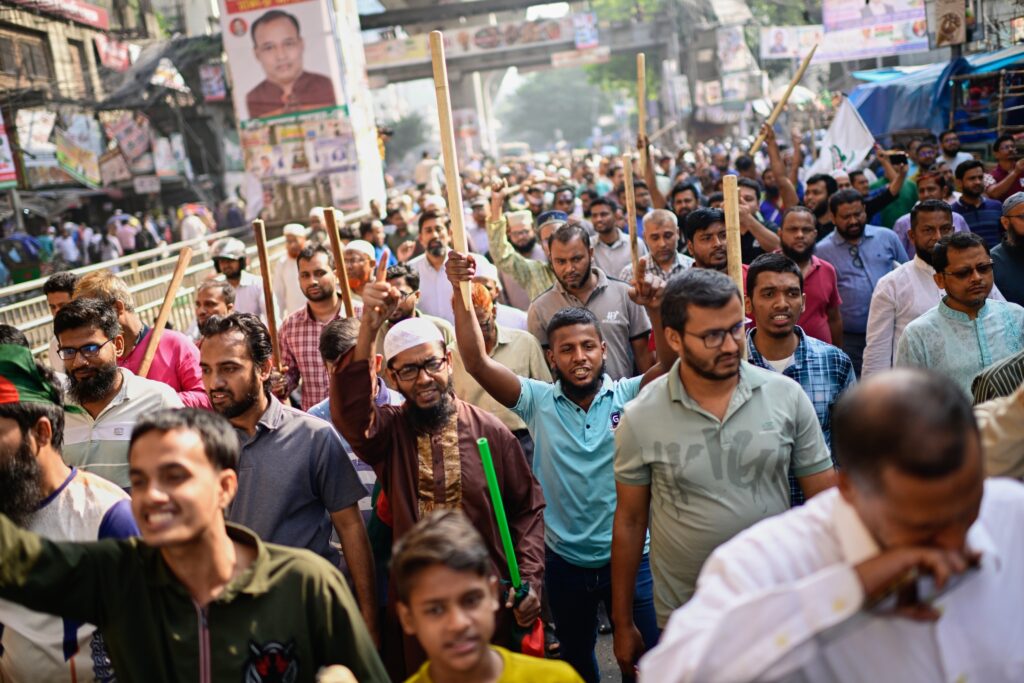
Political analysts expect Jamaat-e-Islami will have a strong showing. After being banned from politics under Hasina, the party has gained steam during the campaign and “is now mainstream,” according to Mubashar Hasan, an adjunct researcher and expert in Bangladeshi politics at Western Sydney University in Australia.
Mohammad Rahman, the Jamaat-e-Islami spokesperson, said the party was running on a platform of “anti-corruption, transparency, accountability, and good governance.” The proposal to reduce work hours for women remains in a “preliminary stage,” he added, and the party has no plans to implement sharia law.
Jamaat-e-Islami’s main rival in this election is the BNP. Tarique Rahman, the party chairman who returned to Dhaka on Dec. 25 after years of exile in London, would be likely to be prime minister if the party prevails. He privately believes Jamaat-e-Islami will over-perform at the ballot box but would not bring them into a potential coalition government, according to a person familiar, speaking on the condition of anonymity to discuss BNP strategy.
The leader, or ameer, of Jamaat-e-Islami, has said he is open to working with the BNP. “If the parties come together, we’ll run the government together,” Shafiqur Rahman told Reuters in January. Jamaat-e-Islami was a junior member of a BNP-led government between 2001 and 2006.
Since Hasina’s ouster in 2024, Jamaat-e-Islami has held four meetings in Washington with U.S. officials and “several” meetings in Dhaka, Mohammad Rahman said in his statement to The Post. The party leader also met virtually with U.S. Trade Representative (USTR) Jamieson Greer on Friday.
The State Department declined to comment on the Washington meetings and described the meetings with Jamaat-e-Islami in Dhaka as part of “routine diplomatic work.” The USTR did not respond to a request for comment.
In August, a senior Indian diplomat met the ameer at his house in Dhaka as he was recovering from open-heart surgery, Mohammad Rahman told The Post. India’s ministry of external affairs did not respond to a request for comment.
At the embassy gathering in Dhaka, the U.S. official indicated that in addition to reaching out to Jamaat-e-Islami, mission staff may also engage with other conservative Islamist political parties, including Hefazat-e-Islam Bangladesh and Islami Andolan Bangladesh.
“We want them to be our friends, because we want to be able to pick up the phone and say: “That thing you just said, ‘So here’s how that’s going to play out,’” the diplomat added.
The diplomat stressed that if Jamaat-e-Islami was to rise to power and implement policies that are anathema to Washington, the U.S. would retaliate against the country’s massive garment industry.
“Bangladesh’s entire economy, 20 percent of your exports to the United States, depend on a series of socially liberal clothing chains and clothing brands,” the official said. “If Bangladesh tells women they can only work five hours, or kicks them out … and imposes sharia law, there will be no more orders. And if there are no more orders, there will be no Bangladeshi economy.”
But “Jamaat is not going to do that,” the official continued. “There are too many university-educated, smart people to do that. We will make exceedingly clear to them what will happen.”
That is unlikely to quell anxieties in New Delhi, analysts said. India labeled Jamaat-e-Islami’s chapter in Indian-administered Kashmir an “unlawful group” in 2019 and renewed the designation in 2024.
If the U.S.-India relationship were “in better shape,” Kugelman said, the Americans may have been more willing to heed Indian concerns about Jamaat-e-Islami ahead of the election. But “with the partnership a real mess, … I don’t think that U.S. officials would feel the need to be that attentive to, or sensitive to, Indian concerns.”
Supriya Kumar contributed to this report.
The post U.S. seeks to be ‘friends’ with Bangladesh’s once-banned Islamist party appeared first on Washington Post.